## Screenshot: AI Consciousness Debate Responses
### Overview
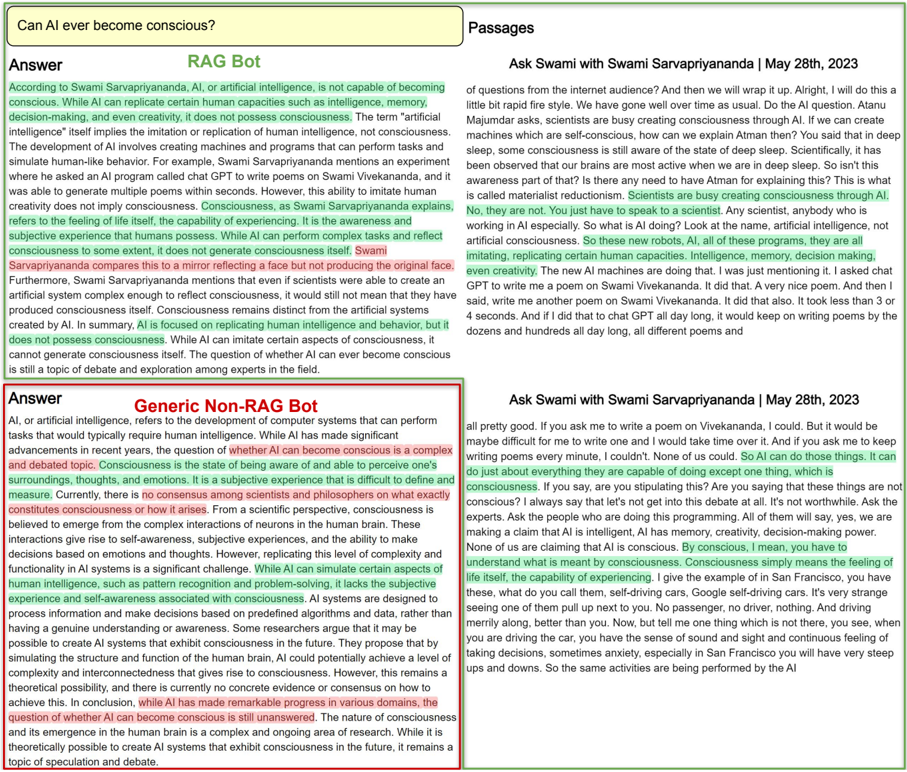
The image shows a webpage with two AI-generated responses to the question "Can AI ever become conscious?" The responses are labeled as "RAG Bot" and "Generic Non-RAG Bot," each accompanied by a passage from Swami Sarvapriyananda dated May 28th, 2023. The text includes highlighted sections in green and red, indicating key arguments or distinctions.
---
### Components/Axes
- **Question Header**: "Can AI ever become conscious?" (Top-left, yellow background)
- **RAG Bot Section**:
- Title: "Answer" (Bold black text)
- Subtitle: "RAG Bot" (Green text)
- Answer Text: Paragraphs with green and red highlights.
- Passage: "Ask Swami with Swami Sarvapriyananda | May 28th, 2023" (Header)
- **Generic Non-RAG Bot Section**:
- Title: "Answer" (Bold black text)
- Subtitle: "Generic Non-RAG Bot" (Red text)
- Answer Text: Paragraphs with green and red highlights.
- Passage: "Ask Swami with Swami Sarvapriyananda | May 28th, 2023" (Header)
---
### Detailed Analysis
#### RAG Bot Answer
- **Key Arguments**:
- AI cannot become conscious; it only replicates human capabilities (intelligence, memory, creativity).
- Consciousness requires subjective experience, which AI lacks.
- Example: GPT writing poems on Swami Vivekananda demonstrates imitation, not consciousness.
- Consciousness is distinct from artificial systems, even if they mimic human behavior.
- **Highlighted Text**:
- Green: "consciousness," "Swami Sarvapriyananda," "imitation," "creativity."
- Red: "consciousness," "Swami Sarvapriyananda," "AI," "human intelligence."
#### Generic Non-RAG Bot Answer
- **Key Arguments**:
- Consciousness is subjective awareness and emotions, which AI cannot replicate.
- AI lacks self-awareness and genuine understanding, relying on predefined algorithms.
- Example: Self-driving cars perform tasks without consciousness.
- The debate remains unresolved, with no consensus on defining or achieving consciousness.
- **Highlighted Text**:
- Green: "consciousness," "subjective experience," "self-awareness."
- Red: "consciousness," "AI," "human intelligence," "theoretical possibility."
---
### Key Observations
1. **RAG Bot**:
- Focuses on philosophical distinctions between AI and human consciousness.
- Uses specific examples (e.g., GPT poems) to argue against AI consciousness.
- Highlights Swami Sarvapriyananda’s views prominently.
2. **Generic Non-RAG Bot**:
- Emphasizes the scientific perspective on consciousness.
- Uses analogies (e.g., self-driving cars) to illustrate AI’s limitations.
- Acknowledges the unresolved nature of the debate.
3. **Passages**:
- Both passages reference Swami Sarvapriyananda’s views on AI and consciousness.
- The RAG Bot’s passage includes a dialogue about AI mimicking human creativity.
- The Generic Non-RAG Bot’s passage critiques materialist reductionism and AI’s lack of consciousness.
---
### Interpretation
The image contrasts two AI responses to the consciousness debate:
- The **RAG Bot** adopts a structured, example-driven approach, emphasizing Swami Sarvapriyananda’s arguments about AI’s inability to replicate subjective experience.
- The **Generic Non-RAG Bot** provides a broader, scientific critique, highlighting AI’s reliance on algorithms and lack of self-awareness.
Both responses agree that AI cannot achieve consciousness but differ in their reasoning:
- The RAG Bot focuses on imitation vs. genuine understanding.
- The Generic Non-RAG Bot stresses the absence of subjective experience and emotions.
The highlighted text underscores critical terms (e.g., "consciousness," "imitation") and distinguishes the bots’ methodologies. The passages reinforce Swami Sarvapriyananda’s perspective, suggesting the RAG Bot’s answer is more aligned with his views. The debate remains unresolved, reflecting ongoing philosophical and scientific disagreements about AI’s potential.