\n
## Diagram: Abstract Computational Model
### Overview
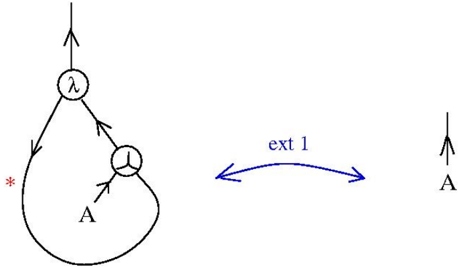
The image depicts an abstract diagram representing a computational model, likely related to lambda calculus or a similar formal system. It consists of a circular structure with labeled nodes and arrows indicating flow or transformation. There's also a bidirectional arrow labeled "ext 1" connecting the circular structure to a vertical arrow labeled "A".
### Components/Axes
The diagram contains the following components:
* **Nodes:**
* A node labeled "λ" (lambda) at the top.
* A node containing a symbol resembling a "Y" inside a circle.
* A node labeled "A" within the circular structure.
* A small asterisk (*) positioned to the left of the circular structure.
* **Arrows:**
* Arrows originating from the "λ" node pointing downwards towards the circular structure.
* Arrows within the circular structure connecting the "λ" node to the "Y" node and the "Y" node to the "A" node, and the "A" node back to the "λ" node, forming a loop.
* A bidirectional arrow labeled "ext 1" connecting the circular structure to a vertical arrow.
* A vertical arrow labeled "A" on the right side of the diagram.
### Detailed Analysis / Content Details
The diagram shows a closed loop starting at "λ", going to the "Y" node, then to "A", and back to "λ". The asterisk (*) is positioned outside the loop, near the starting point of the loop. The "ext 1" arrow suggests an external operation or transformation applied to the circular structure, resulting in the "A" output.
The "Y" node is a complex symbol, resembling a stylized "Y" within a circle. It's unclear what this symbol represents without further context.
### Key Observations
* The circular structure represents a recursive or iterative process.
* The "ext 1" operation appears to extract or transform the result of the loop into a single value "A".
* The asterisk (*) might indicate an initial state or input to the system.
* The diagram is highly abstract and lacks numerical data or specific values.
### Interpretation
This diagram likely represents a computational process, possibly a fixed-point computation or a recursive function definition. The "λ" node could represent a lambda abstraction, defining a function. The "Y" node might represent a combinator, a higher-order function used to achieve recursion. The loop represents the repeated application of the function until a fixed point is reached. The "ext 1" operation then extracts the final result, which is labeled "A".
The asterisk (*) could represent the initial input or seed value for the computation. The diagram suggests a process where a function is applied repeatedly to itself, ultimately converging to a stable output "A". The "ext 1" operation is crucial for obtaining the final result from the iterative process.
Without additional context, it's difficult to determine the precise meaning of the diagram. However, it clearly illustrates a computational model involving recursion, abstraction, and transformation. The diagram is a visual representation of a mathematical or logical concept, rather than a presentation of empirical data.