## Diagram: System Component Flow with External Interaction
### Overview
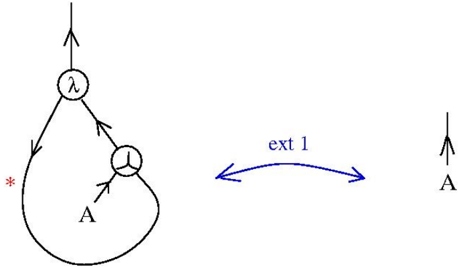
The diagram illustrates a system with three primary components: a central node labeled "λ", a looped subsystem labeled "A", and an external interaction labeled "ext 1". Arrows indicate directional relationships, with a red asterisk marking a critical point in the subsystem.
### Components/Axes
1. **Central Node**:
- Labeled "λ" (Greek letter lambda)
- Positioned at the top-left with an upward-pointing arrow
2. **Looped Subsystem**:
- Labeled "A"
- Contains a circular path with a red asterisk (*) marking a critical node
- Contains an internal node with three outgoing arrows (trifurcation)
3. **External Interaction**:
- Labeled "ext 1"
- Represented by bidirectional curved arrows
- Connected to subsystem "A" via a vertical arrow labeled "A"
4. **Critical Marker**:
- Red asterisk (*) placed on the looped path of subsystem "A"
### Detailed Analysis
- **λ Node**: Acts as the primary input/output source, with a single upward arrow suggesting unidirectional flow.
- **Subsystem A**:
- Contains a closed loop with a critical point marked by the red asterisk
- Internal trifurcation node suggests branching logic or parallel processes
- **External Interaction (ext 1)**:
- Bidirectional arrows indicate two-way communication
- Vertical arrow labeled "A" suggests direct coupling between external system and subsystem A
### Key Observations
1. The red asterisk in subsystem A likely denotes a failure point, bottleneck, or special condition requiring attention
2. The trifurcation node within A suggests three possible processing paths or decision points
3. The vertical coupling between ext 1 and A implies direct influence on the subsystem's operation
4. The unidirectional flow from λ contrasts with the bidirectional ext 1 interaction
### Interpretation
This diagram appears to represent a control system or process flow with:
- A primary driver (λ) initiating operations
- A feedback loop (subsystem A) with inherent complexity (trifurcation) and a critical vulnerability (asterisk)
- External system interaction (ext 1) that can both influence and be influenced by the subsystem
The red asterisk's placement on the loop suggests this critical point may be essential for maintaining system stability or represents a point of potential failure. The bidirectional ext 1 interaction indicates the subsystem doesn't operate in isolation but engages in mutual exchange with external factors, potentially creating feedback loops that could amplify or mitigate the system's behavior.