## Chart Type: Comparative Line Graphs
### Overview
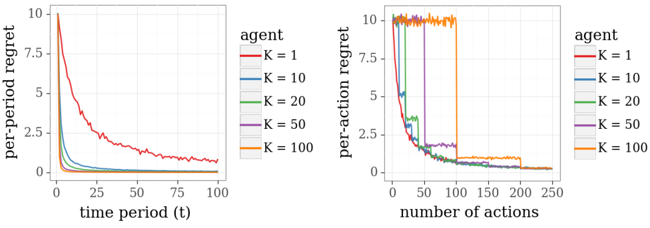
The image presents two line graphs comparing the performance of different agents (K=1, K=10, K=20, K=50, K=100) based on regret. The left graph shows "per-period regret" over "time period (t)", while the right graph shows "per-action regret" over "number of actions". The graphs illustrate how regret changes with time and actions for each agent.
### Components/Axes
**Left Graph:**
* **Title:** per-period regret
* **X-axis:** time period (t)
* Scale: 0 to 100, with tick marks at 0, 25, 50, 75, and 100.
* **Y-axis:** per-period regret
* Scale: 0 to 10, with tick marks at 0, 2.5, 5, 7.5, and 10.
* **Legend:** Located at the top-right of the left graph.
* K = 1 (Red)
* K = 10 (Blue)
* K = 20 (Green)
* K = 50 (Purple)
* K = 100 (Orange)
**Right Graph:**
* **Title:** per-action regret
* **X-axis:** number of actions
* Scale: 0 to 250, with tick marks at 0, 50, 100, 150, 200, and 250.
* **Y-axis:** per-action regret
* Scale: 0 to 10, with tick marks at 0, 2.5, 5, 7.5, and 10.
* **Legend:** Located at the top-right of the right graph.
* K = 1 (Red)
* K = 10 (Blue)
* K = 20 (Green)
* K = 50 (Purple)
* K = 100 (Orange)
### Detailed Analysis
**Left Graph (per-period regret vs. time period):**
* **K = 1 (Red):** Starts at approximately 10 and decreases rapidly initially, then decreases more slowly, stabilizing around a value of approximately 1 after t=50.
* **K = 10 (Blue):** Starts at approximately 10 and decreases rapidly to near 0 by t=25.
* **K = 20 (Green):** Starts at approximately 10 and decreases rapidly to near 0 by t=25.
* **K = 50 (Purple):** Starts at approximately 10 and decreases rapidly to near 0 by t=25.
* **K = 100 (Orange):** Starts at approximately 10 and decreases rapidly to near 0 by t=25.
**Right Graph (per-action regret vs. number of actions):**
* **K = 1 (Red):** Starts at approximately 10, decreases to approximately 5 around action 25, then increases again to approximately 10, and remains there.
* **K = 10 (Blue):** Starts at approximately 10, decreases to approximately 3.5 around action 40, then drops to approximately 1.5 around action 60, and remains there.
* **K = 20 (Green):** Starts at approximately 10, decreases to approximately 3.5 around action 40, then drops to approximately 1.5 around action 60, and remains there.
* **K = 50 (Purple):** Starts at approximately 10, decreases to approximately 3.5 around action 40, then drops to approximately 1.5 around action 60, and remains there.
* **K = 100 (Orange):** Starts at approximately 10, remains there until action 100, then drops to approximately 1.5 around action 120, and remains there.
### Key Observations
* In the left graph, agents K=10, K=20, K=50, and K=100 converge to a low per-period regret much faster than agent K=1.
* In the right graph, agent K=1 exhibits a different behavior, with the regret increasing after an initial decrease.
* Agents K=10, K=20, K=50, and K=100 show a stepwise decrease in per-action regret.
### Interpretation
The graphs suggest that agents with K > 1 (K=10, K=20, K=50, K=100) learn more efficiently than agent K=1, achieving lower per-period regret over time. The right graph indicates that the per-action regret for K=1 initially decreases but then increases, suggesting that this agent may be exploring suboptimal actions. The stepwise decrease in per-action regret for the other agents suggests that they are adapting their strategies in discrete stages. The agent K=100 maintains a high regret for a longer number of actions before dropping to a low regret.