\n
## Diagram: Human Pose Estimation - Attention Mechanism
### Overview
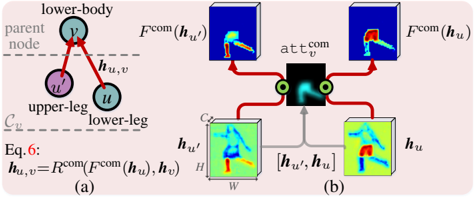
The image depicts a diagram illustrating an attention mechanism within a human pose estimation system. It shows a hierarchical structure of body parts (lower-body, upper-leg, lower-leg) and how attention is applied between these parts to refine pose estimations. The diagram is split into two main sections: (a) a hierarchical representation of body parts, and (b) the attention mechanism itself.
### Components/Axes
* **Body Part Hierarchy (a):**
* Nodes: `v` (lower-body, parent node), `u'` (upper-leg), `u` (lower-leg).
* Edges: Represent relationships between body parts.
* Labels: `lower-body`, `upper-leg`, `lower-leg`, `parent node`, `C₂`.
* **Attention Mechanism (b):**
* Input Features: `Fcom(hu')`, `Fcom(hu)`.
* Attention Weight: `attv`.
* Output Features: `hu'`, `hu`.
* Transformation Matrices: `H`, `W`.
* Concatenated Features: `[hu', hu]`.
* **Equation:** `hu,v = Rcom(Fcom(hu')) , hu,v`
* **Color Coding:** The diagram uses color to highlight areas of activation within the pose estimations (blue, red, yellow).
### Detailed Analysis or Content Details
**(a) Body Part Hierarchy:**
The diagram shows a tree-like structure. The `lower-body` (represented by a teal circle) is the parent node (`v`). It has two child nodes: `upper-leg` (represented by a purple circle, `u'`) and `lower-leg` (represented by a red circle, `u`). A dashed line labeled `C₂` separates the parent node from the child nodes. The equation `hu,v = Rcom(Fcom(hu')) , hu,v` is provided, likely representing a transformation or relationship between the features of the parent and child nodes.
**(b) Attention Mechanism:**
* Two feature maps, `Fcom(hu')` (top-left, blue background) and `Fcom(hu)` (top-right, blue background), are input into an attention module (center, black background with a teal and yellow activation pattern).
* The attention module produces an attention weight `attv`.
* The attention weight is used to refine the feature maps, resulting in output feature maps `hu'` (bottom-left, green background) and `hu` (bottom-right, green background).
* The output feature maps are then concatenated `[hu', hu]` and transformed by matrices `H` and `W`.
* Red arrows indicate the flow of information from the input features to the attention module and then to the output features. A white arrow indicates the flow of concatenated features.
### Key Observations
* The attention mechanism appears to be focused on refining the feature representations of the upper and lower legs based on the context of the lower body.
* The color coding in the feature maps suggests that the attention mechanism is highlighting specific regions of the body.
* The hierarchical structure suggests a recursive application of the attention mechanism across different levels of the body.
### Interpretation
This diagram illustrates a method for improving human pose estimation by incorporating an attention mechanism. The attention mechanism allows the system to focus on relevant parts of the body when estimating the pose of a specific joint. The hierarchical structure suggests that the attention mechanism can be applied recursively to refine the pose estimation at different levels of detail. The equation provided indicates a transformation process between the features of parent and child nodes, likely using the attention weights to modulate the information flow. The use of color-coded feature maps provides a visual representation of the attention mechanism's focus and the areas of activation within the pose estimations. The diagram suggests a sophisticated approach to pose estimation that leverages contextual information and attention to achieve more accurate and robust results. The diagram does not provide any numerical data, but rather a conceptual overview of the process.