## Diagram: Hierarchical Feature Processing and Attention Mechanism
### Overview
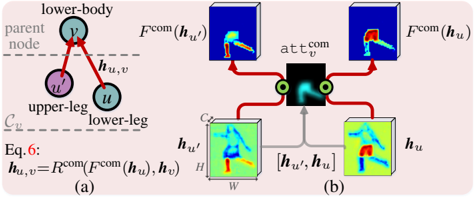
The image depicts a two-part technical diagram illustrating a hierarchical feature processing system with attention mechanisms. Part (a) shows a node hierarchy for lower-body feature aggregation, while part (b) demonstrates a computational pipeline with feature combination and attention operations.
### Components/Axes
**Part (a): Node Hierarchy**
- **Nodes**:
- Parent node (labeled "lower-body")
- Upper-leg node (labeled "u")
- Lower-leg node (labeled "v")
- **Connections**:
- Red arrows between parent node and child nodes
- Equation: `h_u,v = R^com(F^com(h_u), h_v)` (Eq.6)
- **Labels**:
- "lower-body" (parent node)
- "upper-leg" (child node)
- "lower-leg" (child node)
- "C_v" (possibly a constraint or context variable)
**Part (b): Computational Pipeline**
- **Blocks**:
1. `F^com(h_u')` (blue block with human figure)
2. `att^com_v` (black block with attention visualization)
3. `F^com(h_u)` (blue block with human figure)
- **Arrows**:
- Red arrows indicating data flow between blocks
- Gray arrow connecting `att^com_v` to output
- **Dimensions**:
- `H` (height) and `W` (width) labels on output block
- **Legend**:
- Blue: Feature combination (`F^com`)
- Red: Attention mechanism (`att^com`)
- Green: Output feature (`h_u`)
### Detailed Analysis
**Part (a) Analysis**
- The node hierarchy suggests a bottom-up feature aggregation process:
- Parent node (`h_u,v`) combines features from upper (`h_u`) and lower (`h_v`) legs
- Equation 6 defines the combination operation using:
- `F^com`: Feature combination function
- `R^com`: Recursive combination operator
- The dashed lines (`C_v`) may represent contextual constraints or confidence thresholds.
**Part (b) Analysis**
- The pipeline processes features through three stages:
1. Initial feature combination (`F^com(h_u')`)
2. Attention mechanism (`att^com_v`) that selectively focuses on relevant features
3. Final feature combination (`F^com(h_u)`) producing output `h_u`
- The attention block (`att^com_v`) uses a heatmap visualization (green/blue gradient) to indicate feature importance
- Output dimensions (`H x W`) suggest spatial feature maps, likely from a convolutional network
### Key Observations
1. **Color Consistency**:
- Blue blocks (`F^com`) match blue legend entries
- Red arrows correspond to attention operations
- Green output matches green legend marker
2. **Spatial Relationships**:
- Attention block (`att^com_v`) is centrally positioned, acting as a bottleneck
- Output block (`h_u`) receives processed features from both attention and initial combination paths
3. **Equation Context**:
- Eq.6 defines the mathematical foundation for feature combination in the hierarchy
### Interpretation
This diagram represents a multi-stage feature processing system for human pose estimation or similar tasks. The hierarchy in (a) suggests a modular approach to body part feature extraction, while (b) shows how these features are refined through attention mechanisms. The attention block's central position indicates its critical role in feature selection, potentially improving model performance by focusing on discriminative features. The use of recursive combination (`R^com`) in Eq.6 implies a sophisticated feature integration strategy that could handle complex pose variations. The spatial dimensions (H x W) in the output block suggest the system operates on 2D feature maps, likely from image-based input processing.