## Diagram: Concentric Ring System with Directional Flow
### Overview
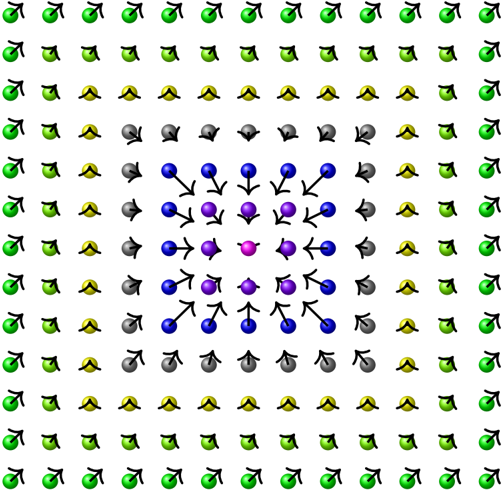
The image is a diagram depicting a system of concentric rings composed of colored circles, each with directional arrows. The diagram illustrates a pattern of directional flow or influence, with arrows pointing either inward toward the center or outward away from the center. There is no textual information, labels, axes, or legends present in the image.
### Components/Axes
* **Structure:** The diagram consists of a grid of circles arranged in concentric rings around a central point.
* **Elements:** Each element is a colored circle with one or two small black arrows attached, indicating a direction.
* **Color Coding:** The circles are color-coded by ring, from the outermost to the innermost:
* **Outermost Ring:** Green circles.
* **Second Ring:** Yellow circles.
* **Third Ring:** Gray circles.
* **Fourth Ring:** Blue circles.
* **Fifth Ring:** Purple circles.
* **Center:** A single magenta circle.
* **Directional Indicators (Arrows):**
* **Green Ring (Outermost):** All arrows point **outward**, away from the center of the diagram.
* **Yellow Ring:** All arrows point **inward**, toward the center.
* **Gray Ring:** All arrows point **inward**, toward the center.
* **Blue Ring:** All arrows point **inward**, toward the center.
* **Purple Ring:** All arrows point **inward**, toward the center.
* **Magenta Circle (Center):** Has no arrows attached.
### Detailed Analysis
* **Spatial Layout:** The rings are perfectly centered. The magenta circle is at the geometric center. The rings are evenly spaced, creating a symmetrical pattern.
* **Flow Pattern:** The diagram establishes a clear directional flow:
1. The outermost (green) layer exhibits an **outward dispersal** pattern.
2. All subsequent inner layers (yellow, gray, blue, purple) exhibit an **inward convergence** pattern, with arrows pointing toward the central magenta circle.
* **Element Count (Approximate):** The grid appears to be 13x13, but the concentric ring structure is the primary organizational principle, not the grid. The number of circles per ring increases with distance from the center.
### Key Observations
1. **Directional Dichotomy:** There is a fundamental opposition in direction between the outermost ring (outward) and all inner rings (inward).
2. **Central Focal Point:** The magenta circle is the terminus for all inward-pointing arrows but does not itself emit any directional indicators, suggesting it is a sink, destination, or core state.
3. **Color Gradient:** The color progression from green (outer) to magenta (center) may represent a gradient of state, intensity, or category, though the specific meaning is not defined.
4. **Symmetry and Order:** The diagram is highly ordered and symmetrical, suggesting a designed system, model, or abstract representation of a process.
### Interpretation
This diagram visually models a system with a core-periphery structure and opposing directional flows. The outward-pointing arrows on the periphery (green) could represent emission, dispersion, exploration, or boundary defense. The inward-pointing arrows on all inner layers (yellow to purple) suggest convergence, attraction, collection, or a funneling process toward the central core (magenta).
The magenta center, lacking arrows, is interpreted as the system's focal point—perhaps a processor, a stable state, a resource pool, or a goal. The color gradient may indicate a transformation or intensification of elements as they move inward.
**Potential Analogies:**
* **A Biological System:** The outer layer could be a protective membrane expelling waste, while inner layers transport nutrients to a nucleus.
* **A Data or Energy System:** The periphery gathers or generates signals/data (inward flow) from a wide area, processes them through layers, and consolidates them at a central hub. The outermost green layer's outward arrows might represent system broadcasts or error emissions.
* **A Social or Organizational Model:** It could depict a structure where the core (magenta) is leadership or a central idea, with concentric rings of management or influence (inward focus), and an outer layer of public engagement or external relations (outward focus).
The primary information conveyed is the **relationship between position, color, and directional flow** within a centralized, layered system. The absence of text makes it an abstract model, applicable to various fields where core-periphery dynamics and directional processes are relevant.