## Chart: Accuracy vs. Logical Coherence Trade-off (10-Axiom)
### Overview
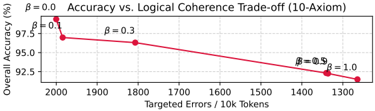
The image is a line chart illustrating the trade-off between overall accuracy and targeted errors per 10k tokens, influenced by a parameter β. The chart shows how accuracy decreases as the number of targeted errors increases, with different β values marked along the line.
### Components/Axes
* **Title:** Accuracy vs. Logical Coherence Trade-off (10-Axiom)
* **X-axis:** Targeted Errors / 10k Tokens. The scale ranges from approximately 1300 to 2000, with tick marks at intervals of 100.
* **Y-axis:** Overall Accuracy (%). The scale ranges from 92.5% to 100%, with tick marks at intervals of 2.5%.
* **Data Series:** A single red line represents the trade-off.
* **Beta Values:** Beta values are annotated along the line: β = 0.0, β = 0.1, β = 0.3, β = 0.9, β = 1.0.
### Detailed Analysis
The red line shows a downward trend, indicating that as the number of targeted errors increases, the overall accuracy decreases.
* **β = 0.0:** Located at approximately (2000, 99%).
* **β = 0.1:** Located at approximately (2000, 97.5%).
* **β = 0.3:** Located at approximately (1800, 96%).
* **β = 0.9:** Located at approximately (1400, 93%).
* **β = 1.0:** Located at approximately (1300, 92%).
### Key Observations
* The chart demonstrates an inverse relationship between accuracy and targeted errors.
* The parameter β seems to influence the position along this trade-off curve. Lower β values correspond to higher accuracy and fewer targeted errors.
* The most significant drop in accuracy occurs between β = 0.3 and β = 0.9.
### Interpretation
The chart illustrates the trade-off between accuracy and logical coherence, as controlled by the parameter β. As β increases, the model targets more errors (potentially to improve coherence), but this comes at the cost of overall accuracy. The data suggests that there is a point of diminishing returns, where increasing β leads to a substantial decrease in accuracy without a proportional decrease in targeted errors. The "10-Axiom" likely refers to the specific set of logical rules or constraints used in this analysis.