## Real-World Spatial Reasoning and Paper Folding
### Overview
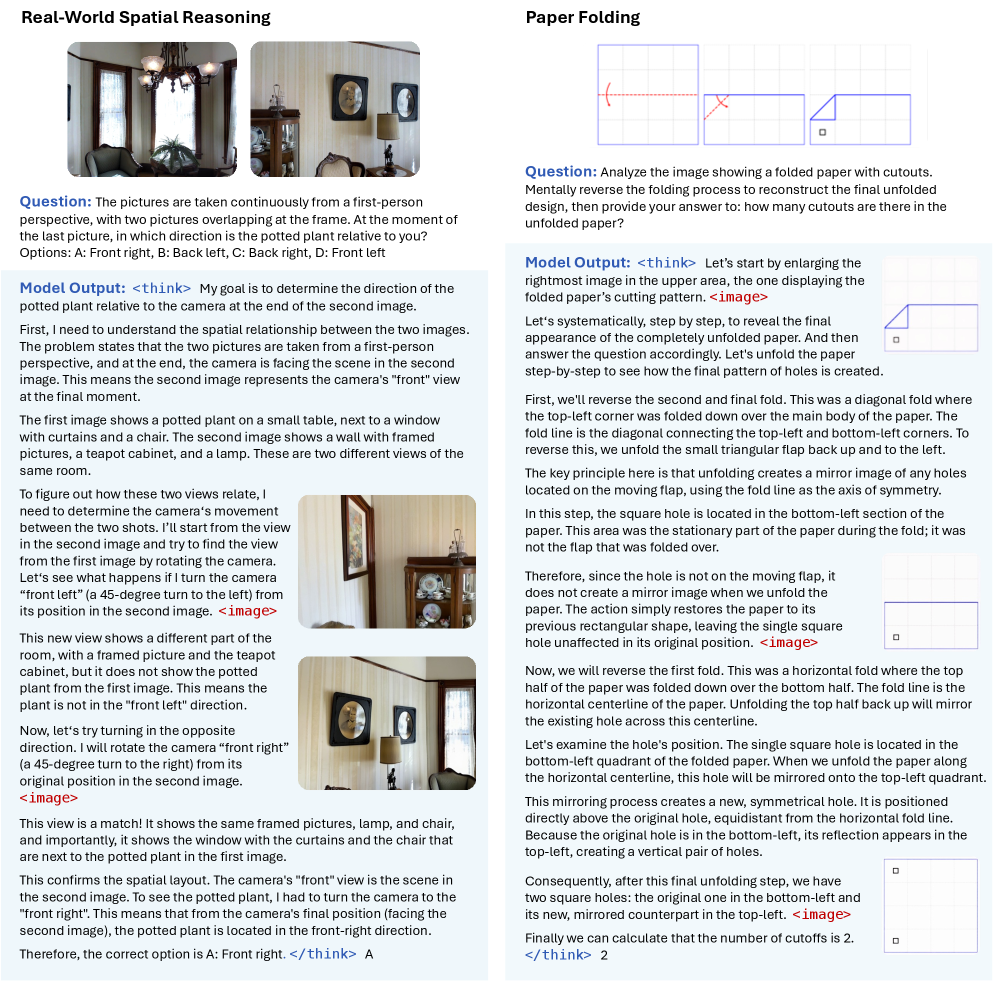
The image presents two distinct problem-solving scenarios: one involving spatial reasoning with overlapping images, and the other involving mentally unfolding a paper with cutouts. The left side focuses on determining the relative position of an object (potted plant) based on two images taken from a first-person perspective. The right side focuses on visualizing the unfolded state of a paper after a series of folds and cutouts.
### Components/Axes
**Real-World Spatial Reasoning (Left Side)**
* **Question:** Poses the spatial reasoning problem.
* **Options:** Multiple-choice answers (A, B, C, D) indicating possible directions.
* **Model Output:** A step-by-step explanation of the reasoning process.
* **Images:** Two photographs showing different views of a room.
**Paper Folding (Right Side)**
* **Question:** Poses the paper folding problem.
* **Model Output:** A step-by-step explanation of the unfolding process.
* **Diagrams:** A series of diagrams illustrating the folding and unfolding steps, including the cutouts.
### Detailed Analysis
**Real-World Spatial Reasoning (Left Side)**
* **Question:** The pictures are taken continuously from a first-person perspective, with two pictures overlapping at the frame. At the moment of the last picture, in which direction is the potted plant relative to you?
* Options: A: Front right, B: Back left, C: Back right, D: Front left
* **Model Output:**
* Goal: Determine the direction of the potted plant relative to the camera at the end of the second image.
* The first image shows a potted plant on a small table, next to a window with curtains and a chair. The second image shows a wall with framed pictures, a teapot cabinet, and a lamp.
* The model output describes a process of mentally rotating the camera's view to match the different images.
* Conclusion: The correct option is A: Front right.
**Paper Folding (Right Side)**
* **Question:** Analyze the image showing a folded paper with cutouts. Mentally reverse the folding process to reconstruct the final unfolded design, then provide your answer to: how many cutouts are there in the unfolded paper?
* **Model Output:**
* The model output describes a step-by-step process of mentally unfolding the paper.
* The process involves reversing diagonal and horizontal folds.
* The key principle is that unfolding creates a mirror image of any holes located on the moving flap, using the fold line as the axis of symmetry.
* Conclusion: Finally we can calculate that the number of cutoffs is 2.
### Key Observations
* The spatial reasoning problem relies on understanding perspective and relative positions.
* The paper folding problem relies on visualizing transformations and symmetry.
* Both problems are presented with a step-by-step explanation of the solution.
### Interpretation
The image presents two distinct cognitive tasks that require different types of reasoning. The spatial reasoning task involves understanding how changes in perspective affect the relative positions of objects. The paper folding task involves mentally manipulating a 2D object through a series of transformations. Both tasks highlight the importance of visualization and step-by-step problem-solving. The model outputs provide a clear and logical explanation of the reasoning process, making the solutions accessible.