\n
## Document Analysis: Paper Folding & Spatial Reasoning
### Overview
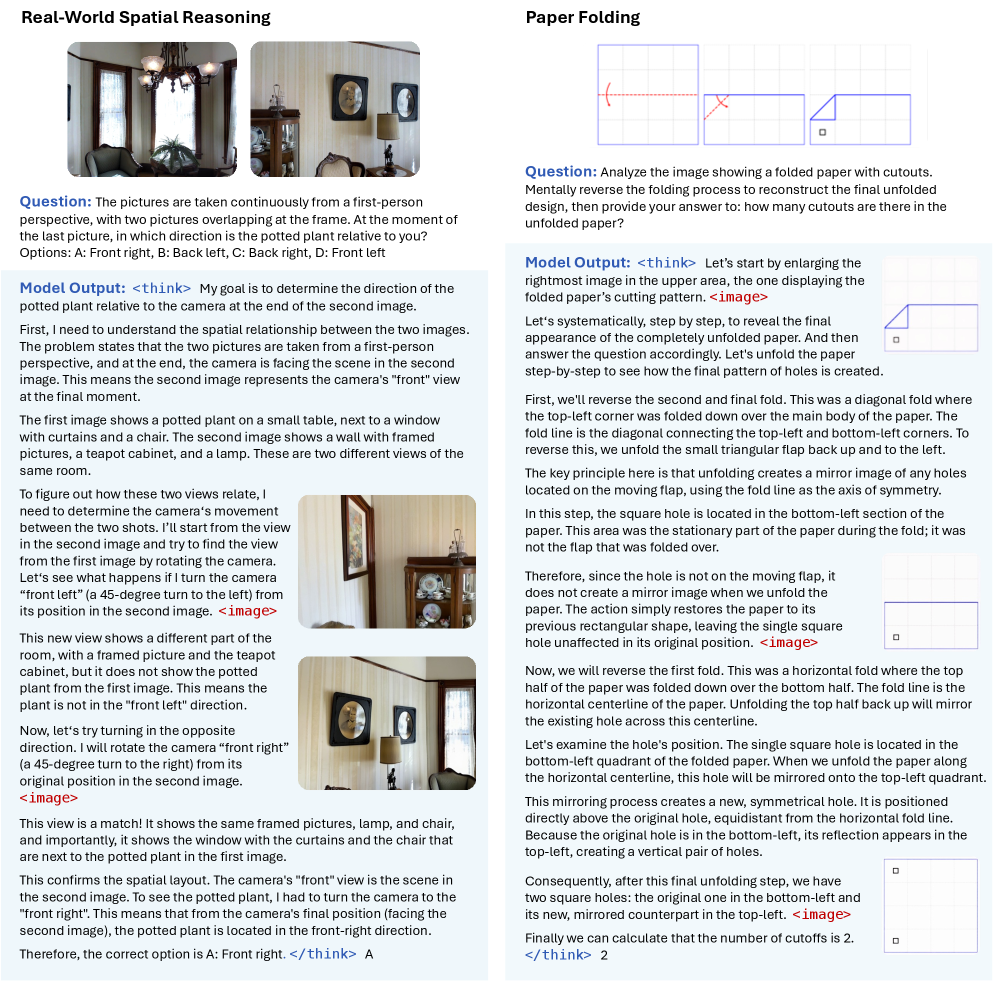
The image presents a two-part document. The left side contains a question related to real-world spatial reasoning, accompanied by a model output explaining the reasoning process. The right side presents a paper folding problem, also with a model output detailing the solution. Both sections include images to illustrate the problems and solutions.
### Components/Axes
**Left Side (Spatial Reasoning):**
* **Title:** "Real-World Spatial Reasoning"
* **Question:** "The pictures are taken continuously from a first-person perspective, with two pictures overlapping at the frame. At the moment of the last picture, in which direction is the potted plant relative to you? Options: A: Front right, B: Back left, C: Back right, D: Front left"
* **Model Output Label:** "Model Output: <think>"
* **Images:** Two images depicting a room from a first-person perspective, showing a potted plant in different positions.
* **Image Captions:** "<image>"
**Right Side (Paper Folding):**
* **Title:** "Paper Folding"
* **Question:** "Analyze the image showing a folded paper with cutouts. Mentally reverse the folding process to reconstruct the final unfolded design, then provide your answer to: how many cutouts are there in the unfolded paper?"
* **Model Output Label:** "Model Output: <think>"
* **Images:** An image of a folded paper with cutouts, and another image showing the unfolded paper with marked cutouts.
* **Image Captions:** "<image>"
* **Text Blocks:** Several paragraphs explaining the step-by-step unfolding process.
### Detailed Analysis or Content Details
**Left Side (Spatial Reasoning):**
The text describes a scenario where two images are taken from a first-person perspective, with overlap between frames. The task is to determine the relative direction of a potted plant in the final image. The model output explains the reasoning: determining the camera's angle based on the change in the potted plant's position. The final answer is not explicitly stated, but the reasoning suggests the plant is to the "front right".
**Right Side (Paper Folding):**
The problem involves mentally unfolding a folded paper with cutouts to determine the total number of cutouts in the unfolded state. The model output details the unfolding process:
1. The initial fold is a diagonal fold where the top-left corner was folded down over the main body of the paper.
2. The key principle is that unfolding creates a mirror image of any holes located on the moving flap, using the fold line as the axis of symmetry.
3. The square hole is located in the bottom-left section of the paper.
4. Since the hole is not on the moving flap, it does not create a mirror image when unfolded.
5. The circle hole is on the moving flap, creating a mirror image.
6. The triangle hole is also on the moving flap, creating a mirror image.
7. The final unfolded paper has one square hole, two circle holes, and two triangle holes, totaling five holes.
The answer is explicitly stated as "5".
### Key Observations
* Both sections demonstrate a problem-solving approach using a "think" label to denote the model's reasoning process.
* The spatial reasoning problem relies on visual interpretation and understanding of perspective.
* The paper folding problem requires logical deduction and visualization of the unfolding process.
* The paper folding solution is presented with a clear step-by-step explanation.
### Interpretation
The document showcases the application of AI models to solve spatial reasoning and geometric problems. The "think" outputs provide insight into the model's thought process, demonstrating an ability to break down complex problems into smaller, manageable steps. The spatial reasoning problem highlights the model's capacity to interpret visual information and infer relationships between objects. The paper folding problem demonstrates the model's ability to apply geometric principles and visualize transformations. The inclusion of images is crucial for both problems, as they provide the necessary visual context for the model to operate effectively. The document suggests a trend towards using AI for tasks that traditionally require human spatial intelligence and problem-solving skills. The clarity of the paper folding explanation suggests a strong ability to articulate logical reasoning.