TECHNICAL ASSET FINGERPRINT
2157c460226280494de38fb4
Click to view fullscreen
Press ESC or click to close
FOUND IN PAPERS
EXPERT: healer-alpha-free VERSION 1
RUNTIME: free/openrouter/healer-alpha
INTEL_VERIFIED
\n
## Technical Document Extraction: Spatial Reasoning and Paper Folding Problems
### Overview
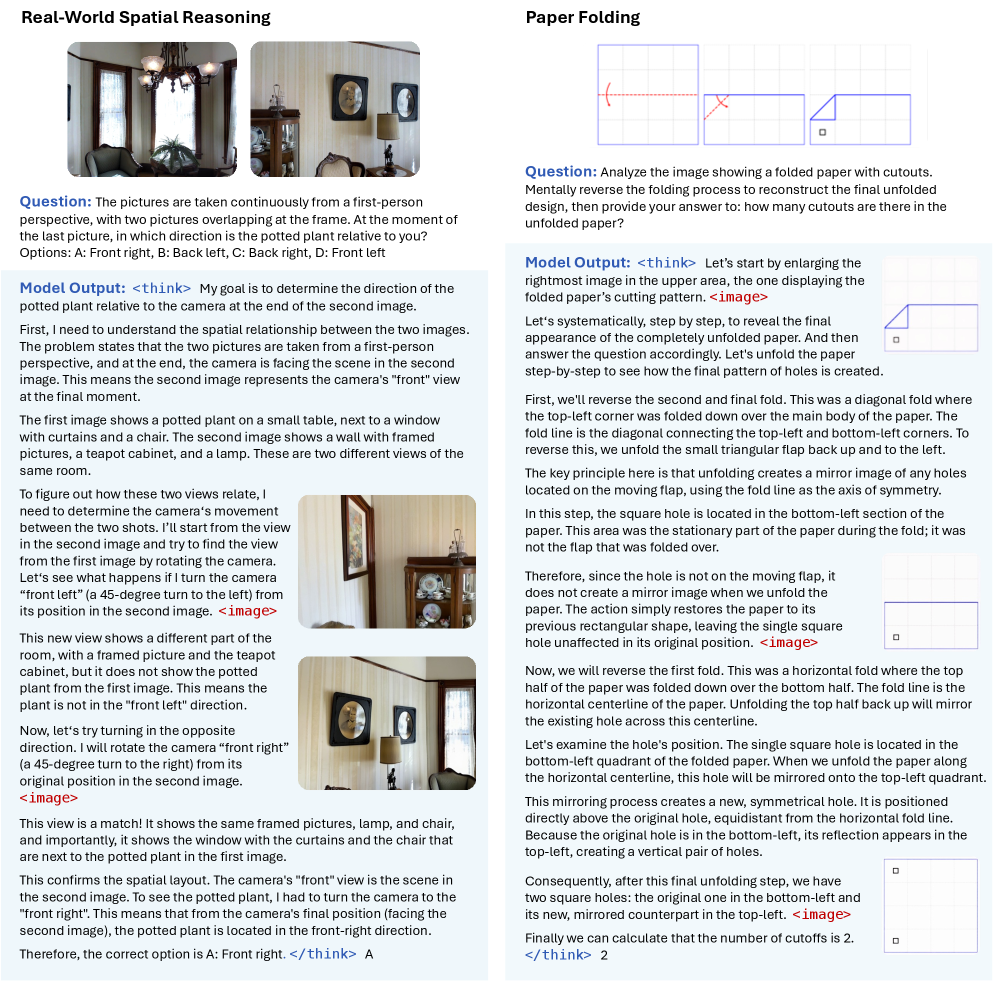
The image is a composite technical document presenting two distinct spatial reasoning problems, each accompanied by a model's step-by-step solution. The left section, titled "Real-World Spatial Reasoning," uses photographic sequences to solve a directional question. The right section, titled "Paper Folding," uses geometric diagrams to solve a mental unfolding problem. Both sections follow a consistent format: a question, a series of visual aids, and a detailed "Model Output" that explains the reasoning process.
### Components/Axes
The document is divided into two primary vertical columns.
**Left Column: Real-World Spatial Reasoning**
* **Title:** "Real-World Spatial Reasoning"
* **Visual Components:** Three photographs of a room interior, taken from different perspectives.
* **Top Image:** Shows a potted plant on a small table next to a window with curtains and a chair.
* **Middle Image:** Shows a wall with framed pictures, a teapot cabinet, and a lamp.
* **Bottom Image:** A composite view showing the framed pictures, lamp, and chair, with the window and curtains visible to the left.
* **Text Components:**
* **Question:** "The pictures are taken continuously from a first-person perspective, with two pictures overlapping at the frame. At the moment of the last picture, in which direction is the potted plant relative to you?"
* **Options:** "A: Front right, B: Back left, C: Back right, D: Front left"
* **Model Output:** A detailed `<think>` block explaining the spatial analysis.
* **Final Answer:** "A"
**Right Column: Paper Folding**
* **Title:** "Paper Folding"
* **Visual Components:** A sequence of four diagrams illustrating a paper folding and cutting process.
* **Diagram 1 (Top Left):** A square with a horizontal dashed line (fold line) and a red arrow indicating a fold from top to bottom.
* **Diagram 2 (Top Right):** The resulting rectangle after the first fold, with a diagonal dashed line (fold line) and a red arrow indicating a fold from the top-left corner down to the bottom-left corner.
* **Diagram 3 (Bottom Left):** The resulting shape after the second fold (a right triangle), with a small square cutout shown in the bottom-left corner.
* **Diagram 4 (Bottom Right):** The final folded shape with the cutout.
* **Text Components:**
* **Question:** "Analyze the image showing a folded paper with cutouts. Mentally reverse the folding process to reconstruct the final unfolded design, then provide your answer to: how many cutouts are there in the unfolded paper?"
* **Model Output:** A detailed `<think>` block explaining the unfolding process.
* **Final Answer:** "2"
### Detailed Analysis
**Real-World Spatial Reasoning Analysis:**
The model output performs a systematic spatial analysis.
1. **Goal Identification:** Determine the direction of the potted plant relative to the camera at the moment of the second (last) picture.
2. **Scene Reconstruction:** It identifies the content of the first image (plant, table, window) and the second image (wall, pictures, cabinet, lamp) as two views of the same room.
3. **Camera Movement Hypothesis:** To relate the views, it hypothesizes rotating the camera from its position in the second image.
4. **Testing Hypotheses:**
* **Test 1 (Front Left):** Rotating the camera 45 degrees left from the second image's view reveals a different part of the room (framed picture, teapot cabinet) but does not show the potted plant. This rules out "Front left."
* **Test 2 (Front Right):** Rotating the camera 45 degrees right from the second image's view reveals a scene that matches the first image: it shows the framed pictures, lamp, chair, and critically, the window with curtains and the chair next to the potted plant.
5. **Conclusion:** The match confirms that to see the potted plant from the camera's final position (facing the second image), one must turn to the "front right." Therefore, the plant is located in the front-right direction.
**Paper Folding Analysis:**
The model output performs a step-by-step reversal of the folding process.
1. **Goal Identification:** Determine the number of cutouts in the fully unfolded paper.
2. **Process Reversal:**
* **Step 1 (Reverse Final Fold):** The last fold was a diagonal fold (top-left corner down). The key principle is that unfolding creates a mirror image of holes across the fold line. The single square hole is in the bottom-left section, which was the stationary part during this fold. Therefore, it is not mirrored and remains a single hole.
* **Step 2 (Reverse First Fold):** The first fold was a horizontal fold (top half down). The single hole is now in the bottom-left quadrant of the currently folded paper. Unfolding the top half back up will mirror this hole across the horizontal centerline, creating a new hole in the top-left quadrant.
3. **Final Count:** The process results in two square holes: the original in the bottom-left and its mirrored counterpart in the top-left.
### Key Observations
1. **Problem-Solving Methodology:** Both solutions employ a structured, step-by-step mental manipulation of spatial data—rotating a camera view in 3D space and reversing geometric transformations in 2D space.
2. **Visual Evidence Integration:** The model explicitly references specific visual elements from the provided images (e.g., "window with curtains," "diagonal fold line") to justify each step of its reasoning.
3. **Logic Checks:** The paper folding solution uses the principle of symmetry (mirroring across a fold line) as a core logic check to predict the outcome of each unfolding step.
4. **Spatial Grounding:** The spatial reasoning solution carefully grounds its conclusion by describing what would be visible after a hypothetical camera rotation, matching it back to the provided photographic evidence.
### Interpretation
This document serves as a demonstration of advanced visual-spatial reasoning capabilities in an AI model. It showcases two competencies:
1. **3D Scene Understanding and Mental Rotation:** The ability to infer camera movement and perspective changes from static 2D images to deduce spatial relationships between objects not simultaneously in view.
2. **2D Geometric Transformation and Symmetry Application:** The ability to mentally reverse a sequence of physical operations (folding) by applying geometric principles (axial symmetry) to predict the final state of a pattern.
The "Model Output" sections are not just answers but **explanations of process**. They reveal a reasoning chain that mimics human problem-solving: decomposing a complex task, forming hypotheses, testing them against evidence, and applying known principles to reach a conclusion. The inclusion of the intermediate `<image>` tags within the think blocks suggests the model is generating or referencing visual aids to support its internal reasoning, highlighting a multimodal approach where text and visual processing are integrated. The document implicitly argues that such transparent, step-by-step reasoning is crucial for verifying the reliability of AI outputs in tasks requiring spatial intelligence.
DECODING INTELLIGENCE...