## Screenshot: Real-World Spatial Reasoning and Paper Folding Tasks
### Overview
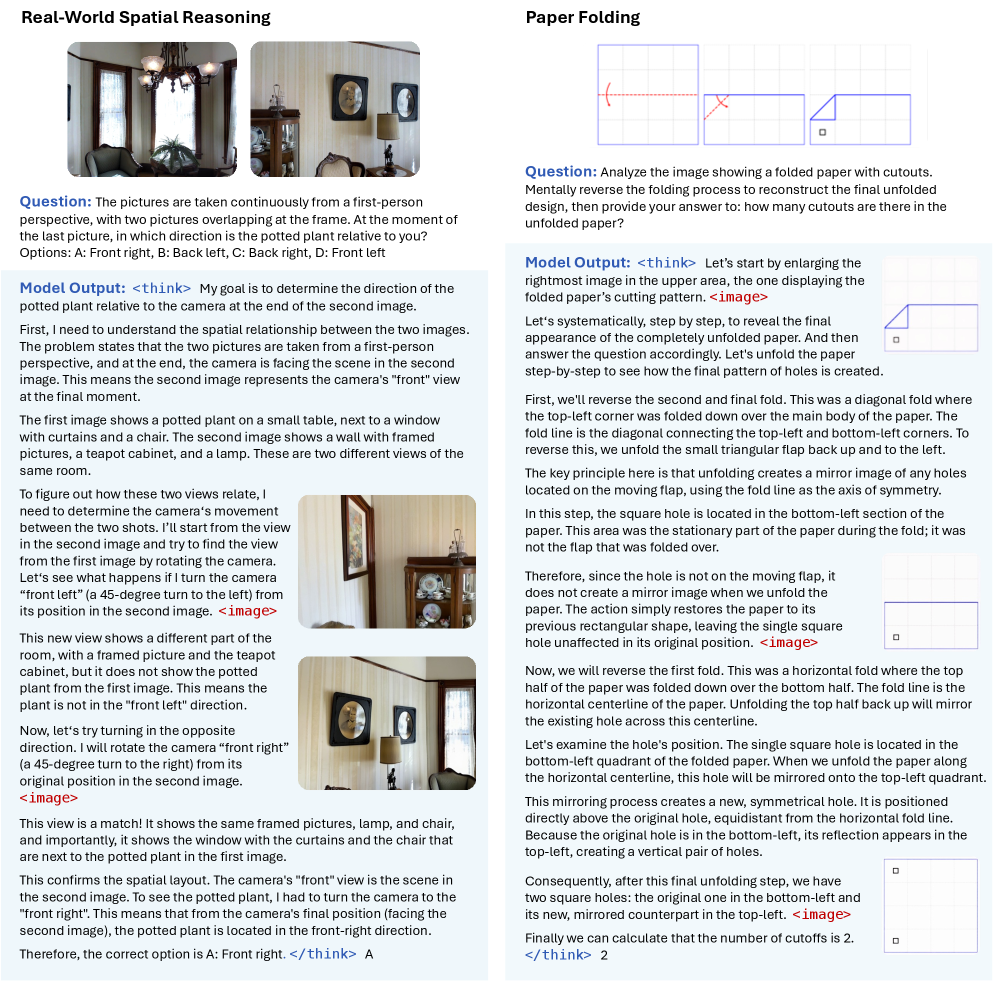
The image contains two distinct reasoning tasks:
1. **Real-World Spatial Reasoning**: Determining the direction of a potted plant relative to a camera based on overlapping images.
2. **Paper Folding**: Analyzing a folded paper with cutouts to reconstruct the original pattern.
Both sections include questions, model outputs (reasoning steps), and visual aids (images/diagrams).
---
### Components/Axes
#### Real-World Spatial Reasoning
- **Question**:
*"The pictures are taken continuously from a first-person perspective, with two pictures overlapping at the frame. At the moment of the last picture, in which direction is the potted plant relative to you? Options: A: Front right, B: Back left, C: Back right, D: Front left."*
- **Model Output**:
A detailed textual explanation of spatial reasoning, including:
- Camera movement analysis (45-degree turns).
- Identification of objects (framed pictures, lamp, teapot cabinet, curtains, chair).
- Final conclusion: *"Therefore, the correct option is: A: Front right."*
- **Images**:
- **Image 1**: Potted plant on a table next to a window with curtains and a chair.
- **Image 2**: Wall with framed pictures, teapot cabinet, and lamp.
- **Image 3**: Framed picture, lamp, teapot cabinet, and chair.
#### Paper Folding
- **Question**:
*"Analyze the image showing a folded paper with cutouts. Mentally reverse the folding process to reconstruct the final unfolded paper. How many cutouts are there in the unfolded paper?"*
- **Model Output**:
Step-by-step reasoning:
- Unfolding process (diagonal folds, mirror images of holes).
- Identification of stationary vs. moving flaps.
- Final count: *"Finally we can calculate that the number of cutoffs is 2."*
- **Diagram**:
- Folded paper with a square and triangular cutout.
- Visual representation of folding steps and hole positions.
---
### Detailed Analysis
#### Real-World Spatial Reasoning
1. **Model Reasoning**:
- The camera moves from the first image to the second, rotating 45 degrees left.
- The potted plant shifts from the "front left" in the first image to the "front right" in the second due to the camera's rotation.
- Final confirmation: The plant is in the "front right" direction.
2. **Image Details**:
- **Image 1**: Plant on a table, window with curtains, chair.
- **Image 2**: Wall with framed pictures, teapot cabinet, lamp.
- **Image 3**: Framed picture, lamp, teapot cabinet, chair.
#### Paper Folding
1. **Model Reasoning**:
- The folded paper has a diagonal fold (top-left corner folded down).
- The square cutout is in the stationary part of the paper (bottom-left section).
- The triangular cutout is in the moving flap (top-left quadrant).
- Unfolding reveals two cutouts: one in the bottom-left and one in the top-left.
2. **Diagram Details**:
- Folded paper shows a square and triangular cutout.
- Visual cues indicate fold lines and hole positions.
---
### Key Observations
1. **Spatial Reasoning**:
- The model correctly identifies the camera's movement and object positions using relative spatial cues (e.g., "front right" vs. "front left").
- Objects like the teapot cabinet and lamp help anchor the spatial context.
2. **Paper Folding**:
- The model distinguishes between stationary and moving flaps during unfolding.
- The final count of 2 cutouts aligns with the diagram's visual representation.
---
### Interpretation
1. **Spatial Reasoning**:
- Demonstrates the model's ability to infer object positions through camera movement and environmental context.
- Highlights the importance of relative positioning (e.g., 45-degree turns) in first-person perspective tasks.
2. **Paper Folding**:
- Illustrates the model's capacity to reverse-engineer folding processes by analyzing mirror images and flap dynamics.
- The final answer (2 cutouts) is validated by the diagram's structure and the model's step-by-step logic.
**Conclusion**: Both tasks showcase the model's proficiency in spatial reasoning and geometric problem-solving, leveraging visual cues and logical deduction to arrive at accurate conclusions.