\n
## Diagram: Logical Query Representation for Nobel Prize Winners
### Overview
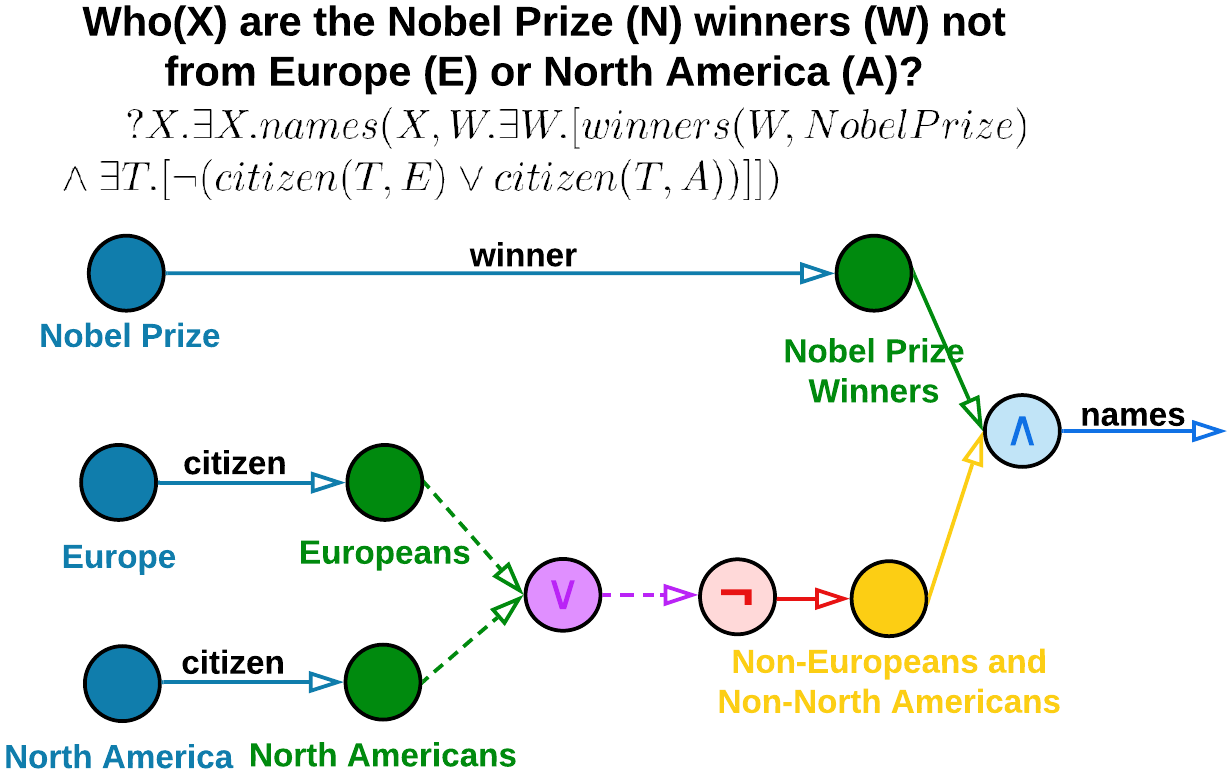
The image presents a diagram illustrating a logical query to identify Nobel Prize winners who are not from Europe or North America. The diagram uses a visual representation of predicate logic to break down the query into its constituent parts and relationships. It employs colored circles representing entities and arrows indicating relationships between them.
### Components/Axes
The diagram consists of several key components:
* **Entities:** Represented by colored circles. These include:
* Nobel Prize (Dark Blue)
* Europe (Dark Blue)
* North America (Dark Blue)
* Nobel Prize Winners (Green)
* Europeans (Green)
* North Americans (Green)
* Non-Europeans and Non-North Americans (Orange)
* **Relationships:** Represented by arrows. These indicate predicates or logical connections.
* "winner" (Black arrow)
* "citizen" (Black arrow)
* "names" (Blue arrow)
* Logical Operators:
* "Λ" (AND - Green arrow)
* "V" (OR - Dashed Black arrow)
* "¬" (NOT - Red arrow)
* **Query Statement:** Located at the top of the diagram: "Who(X) are the Nobel Prize (N) winners (W) not from Europe (E) or North America (A)?"
* **Logical Formula:** Below the query statement: "?X.names(X, W.∃W.winners(W, NobelPrize) ∧∃T.[¬(citizen(T, E) ∨ citizen(T, A))]".
### Detailed Analysis or Content Details
The diagram visually represents the following logical breakdown:
1. **Nobel Prize** is linked to **Nobel Prize Winners** via the "winner" relationship.
2. **Europe** and **North America** are each linked to their respective populations (**Europeans** and **North Americans**) via the "citizen" relationship.
3. **Europeans** and **North Americans** are combined using a logical OR ("V") operator.
4. The result of the OR operation is negated ("¬"), representing "not a citizen of Europe or North America".
5. The negated result is combined with the **Nobel Prize Winners** using a logical AND ("Λ") operator.
6. The final result is linked to the "names" of the winners.
The logical formula translates to: "Find X such that X's name is associated with a winner of the Nobel Prize, and there exists a person T such that T is not a citizen of Europe or North America."
### Key Observations
* The diagram clearly separates the entities and relationships involved in the query.
* The use of color-coding helps to visually distinguish between different types of entities.
* The logical operators are explicitly represented, making the query's structure easy to understand.
* The diagram effectively translates a complex logical query into a visual format.
### Interpretation
The diagram demonstrates a method for representing a complex query in a visual and logical manner. It's a form of knowledge representation, specifically using a graphical approach to predicate logic. The diagram's purpose is to clarify the conditions for identifying Nobel Prize winners who are not from Europe or North America. The use of logical operators (AND, OR, NOT) and relationships (winner, citizen) allows for a precise and unambiguous definition of the desired result set. The diagram could be used as a tool for database query optimization or for explaining complex logical concepts to a non-technical audience. The diagram is not presenting data, but rather a *method* for querying data. It's a conceptual model, not a data visualization.