## Chart/Diagram Type: Protractor Diagram with Angle Measurement
### Overview
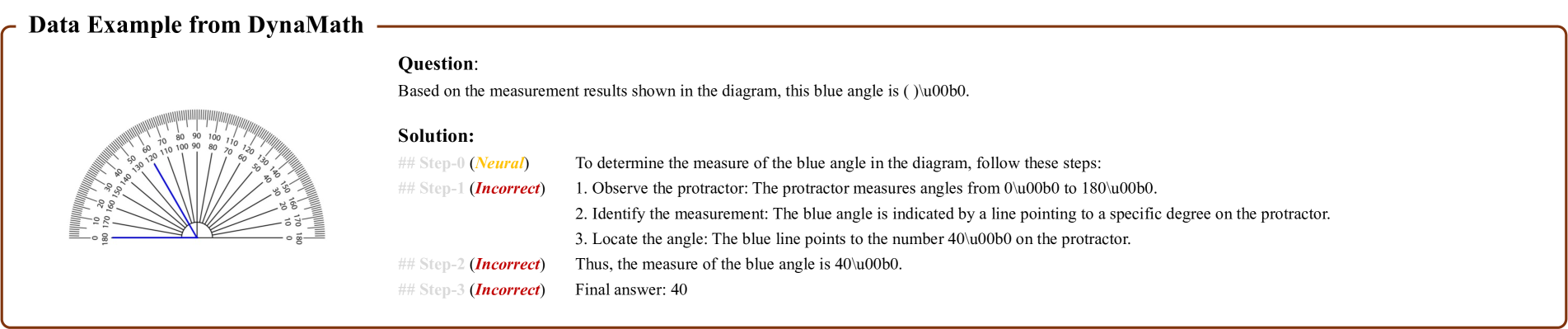
The image depicts a technical example from DynaMath, illustrating a protractor diagram with a blue angle measurement. The diagram includes a semicircular protractor, a blue line indicating an angle, and textual steps to solve the problem. The question asks for the measure of the blue angle, and the solution includes steps with annotations (e.g., "Neural," "Incorrect") and a final answer.
### Components/Axes
- **Protractor**:
- Semicircular scale marked from **0° to 180°** in 10° increments.
- Blue line originates from the center (0°) and points to the **40° mark**.
- **Textual Elements**:
- **Question**: "Based on the measurement results shown in the diagram, this blue angle is ()°."
- **Solution Steps**:
- **Step 0 (Neural)**: "To determine the measure of the blue angle in the diagram, follow these steps:"
- **Step 1 (Incorrect)**:
1. Observe the protractor: The protractor measures angles from 0° to 180°.
2. Identify the measurement: The blue angle is indicated by a line pointing to a specific degree on the protractor.
3. Locate the angle: The blue line points to the number 40° on the protractor.
- **Step 2 (Incorrect)**: "Thus, the measure of the blue angle is 40°."
- **Step 3 (Incorrect)**: "Final answer: 40."
- **Final Answer**: "40" (highlighted in bold).
### Detailed Analysis
- **Protractor Scale**:
- The protractor is labeled with degree markings from **0° to 180°**, with tick marks every 10°. The blue line aligns with the **40° mark**, confirming the angle's measure.
- **Solution Steps**:
- **Step 0** (Neural): A directive to follow steps, but no explicit calculation.
- **Step 1** (Incorrect): Correctly identifies the protractor's range (0°–180°) and the blue line's role but fails to explicitly state the angle's measure.
- **Step 2** (Incorrect): Correctly concludes the angle is 40°, but the reasoning is labeled as "Incorrect," suggesting a flaw in the logic (e.g., misinterpretation of the protractor's scale).
- **Step 3** (Incorrect): Repeats the final answer but is also labeled as "Incorrect," indicating a possible inconsistency in the solution process.
- **Color Coding**:
- "Neural" is highlighted in **yellow**, while "Incorrect" is in **red**, likely indicating the model's confidence or errors in the steps.
### Key Observations
1. The blue line in the protractor diagram directly points to **40°**, matching the final answer.
2. The solution steps contain **contradictions**: Steps 1–3 are labeled "Incorrect," yet the final answer is correct. This suggests either a mislabeling of steps or an error in the reasoning process.
3. The protractor's scale is standard, with no anomalies in the markings.
### Interpretation
The diagram demonstrates a basic angle measurement task using a protractor. The blue line's position at **40°** is unambiguous, confirming the angle's measure. However, the solution steps reveal **logical inconsistencies**:
- Step 1 correctly identifies the protractor's range but does not explicitly state the angle's measure.
- Step 2 correctly concludes the angle is 40°, but the "Incorrect" label implies a flaw (e.g., misreading the protractor).
- Step 3 repeats the answer but is also labeled "Incorrect," suggesting a possible error in the model's reasoning or formatting.
The example highlights the importance of **accurate step-by-step reasoning** in problem-solving, even when the final answer is correct. The use of color coding ("Neural" vs. "Incorrect") may indicate the model's confidence or errors in the solution process.