## Diagram: DynaMath Protractor Angle Measurement Problem
### Overview
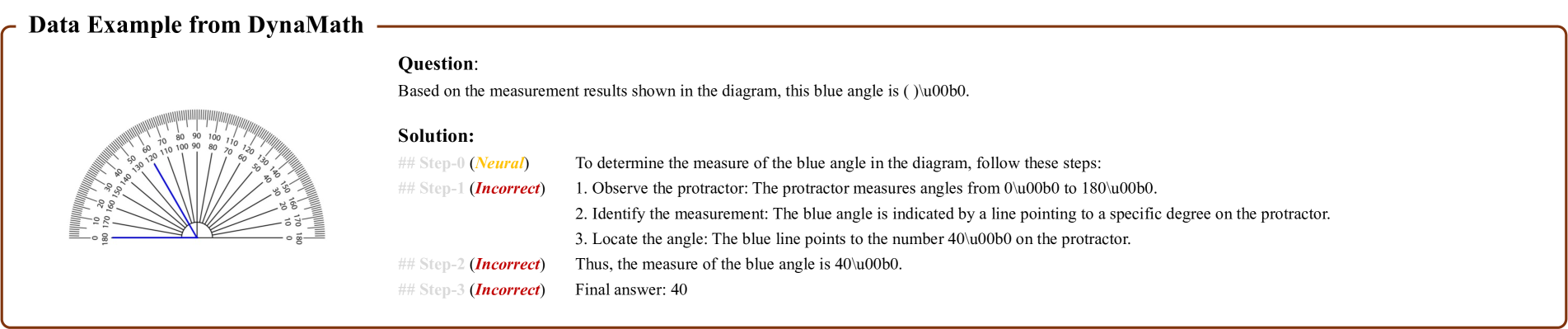
The image displays a mathematical problem from a source titled "Data Example from DynaMath." It consists of a diagram of a protractor measuring a blue angle, accompanied by a question and a multi-step solution. The solution steps are annotated with labels indicating their correctness.
### Components/Axes
1. **Header:** "Data Example from DynaMath" (top-left, bold, serif font).
2. **Diagram (Left Side):** A standard semicircular protractor.
* **Scale:** Marked from 0° to 180° in both clockwise and counterclockwise directions. Major tick marks are labeled every 10 degrees (0, 10, 20... 180). Smaller tick marks indicate individual degrees.
* **Angle:** A blue angle is drawn. One ray lies along the protractor's baseline (pointing to 0° on the inner scale and 180° on the outer scale). The other ray points upwards and to the left.
* **Measurement:** The second ray of the blue angle aligns precisely with the 40° mark on the protractor's inner scale (which corresponds to 140° on the outer scale).
3. **Text Block (Right Side):**
* **Question Label:** "Question:" (bold).
* **Question Text:** "Based on the measurement results shown in the diagram, this blue angle is ( )°."
* **Solution Label:** "Solution:" (bold).
* **Solution Steps:** A numbered list with annotations.
- Step-0 (Neural): "To determine the measure of the blue angle in the diagram, follow these steps:"
- Step-1 (Incorrect): "1. Observe the protractor: The protractor measures angles from 0° to 180°."
- Step-1 (Incorrect): "2. Identify the measurement: The blue angle is indicated by a line pointing to a specific degree on the protractor."
- Step-1 (Incorrect): "3. Locate the angle: The blue line points to the number 40° on the protractor."
- Step-2 (Incorrect): "Thus, the measure of the blue angle is 40°."
- Step-3 (Incorrect): "Final answer: 40"
### Detailed Analysis
* **Diagram Analysis:** The protractor is oriented with its baseline horizontal. The vertex of the angle is at the protractor's center point. The initial side (ray) is aligned with the 0° mark on the inner scale. The terminal side (ray) passes directly through the 40° mark on the same inner scale. Visually, this represents an acute angle of 40 degrees.
* **Text Transcription:**
* **Header:** Data Example from DynaMath
* **Question:** Based on the measurement results shown in the diagram, this blue angle is ( )°.
* **Solution Steps:**
- Step-0 (Neural): To determine the measure of the blue angle in the diagram, follow these steps:
- Step-1 (Incorrect): 1. Observe the protractor: The protractor measures angles from 0° to 180°.
- Step-1 (Incorrect): 2. Identify the measurement: The blue angle is indicated by a line pointing to a specific degree on the protractor.
- Step-1 (Incorrect): 3. Locate the angle: The blue line points to the number 40° on the protractor.
- Step-2 (Incorrect): Thus, the measure of the blue angle is 40°.
- Step-3 (Incorrect): Final answer: 40
### Key Observations
1. **Contradictory Annotations:** The solution steps are logically sound and correctly describe the process of reading the protractor to find a 40° angle. However, each step from 1 to 3 is explicitly labeled as **(Incorrect)** in red, italicized text. Step-0 is labeled **(Neural)** in yellow, italicized text.
2. **Spatial Layout:** The diagram is positioned to the left of the textual question and solution, creating a clear reference between the visual data and the problem statement.
3. **Precision:** The blue angle's terminal ray aligns exactly with the 40° tick mark, leaving no ambiguity in the measurement from the diagram.
### Interpretation
This image appears to be a critique or analysis of an AI-generated (or "Neural") solution to a simple geometry problem. The core factual content is the measurement of the angle, which is unambiguously 40 degrees based on the protractor diagram.
The key informational payload is not the angle measurement itself, but the **meta-commentary** provided by the annotations. The labels suggest that while the neural network's reasoning process (Step-0) and its final answer (40) are factually correct, the entire solution pathway is being classified as "Incorrect." This implies the image is likely from a dataset or research paper evaluating AI reasoning, where the "correctness" may be judged on criteria beyond factual accuracy—perhaps on the formality of the proof, the use of specific terminology, or adherence to a prescribed solution template. The repetition of "Step-1" for three sub-points also indicates a potential formatting or parsing error in the source material being analyzed. The image thus serves as a data point for examining the gap between correct factual output and formally validated reasoning in AI systems.