## Line Chart: Average Running Time vs. Number of Buckets
### Overview
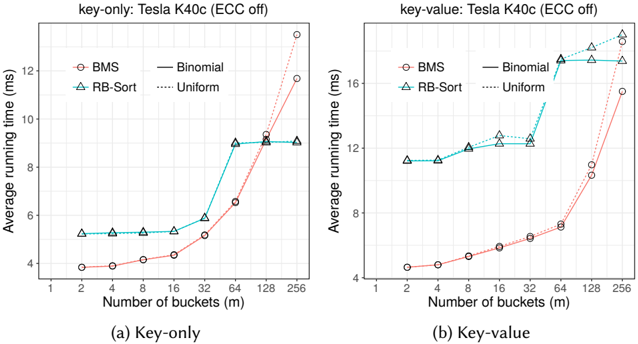
The image presents two line charts comparing the average running time of different sorting algorithms (BMS, RB-Sort, Binomial, Uniform) as a function of the number of buckets. The charts are side-by-side, one labeled "(a) Key-only" and the other "(b) Key-value". Both charts specify the hardware used: Tesla K40c with ECC off. The y-axis represents average running time in milliseconds (ms), and the x-axis represents the number of buckets (m).
### Components/Axes
* **Title (a):** key-only: Tesla K40c (ECC off)
* **Title (b):** key-value: Tesla K40c (ECC off)
* **X-axis Label:** Number of buckets (m)
* **Y-axis Label:** Average running time (ms)
* **X-axis Markers:** 1, 2, 4, 8, 16, 32, 64, 128, 256
* **Y-axis Scale:** Approximately 4 to 13 ms.
* **Legend:**
* BMS (Red Circle)
* Binomial (Blue Circle)
* RB-Sort (Black Triangle)
* Uniform (Light Blue Triangle)
### Detailed Analysis or Content Details
**Chart (a) - Key-only**
* **BMS (Red):** The line starts at approximately 4.2 ms at 1 bucket, remains relatively flat until 32 buckets (around 5.5 ms), then increases sharply to approximately 12.5 ms at 256 buckets.
* **Binomial (Blue):** The line starts at approximately 5.5 ms at 1 bucket, increases to a peak of around 9.5 ms at 64 buckets, then decreases slightly to approximately 9.2 ms at 256 buckets.
* **RB-Sort (Black):** The line starts at approximately 6.2 ms at 1 bucket, remains relatively flat until 16 buckets (around 6.0 ms), then increases to approximately 9.5 ms at 64 buckets, and remains relatively flat at around 9.3 ms until 256 buckets.
* **Uniform (Light Blue):** The line starts at approximately 5.8 ms at 1 bucket, increases steadily to approximately 8.5 ms at 64 buckets, and then increases sharply to approximately 12.0 ms at 256 buckets.
**Chart (b) - Key-value**
* **BMS (Red):** The line starts at approximately 4.1 ms at 1 bucket, remains relatively flat until 32 buckets (around 5.2 ms), then increases sharply to approximately 12.8 ms at 256 buckets.
* **Binomial (Blue):** The line starts at approximately 5.5 ms at 1 bucket, increases to a peak of around 12.5 ms at 64 buckets, then decreases to approximately 11.5 ms at 256 buckets.
* **RB-Sort (Black):** The line starts at approximately 6.2 ms at 1 bucket, remains relatively flat until 16 buckets (around 6.0 ms), then increases to approximately 14.5 ms at 64 buckets, and remains relatively flat at around 14.0 ms until 256 buckets.
* **Uniform (Light Blue):** The line starts at approximately 5.8 ms at 1 bucket, increases steadily to approximately 11.5 ms at 64 buckets, and then increases sharply to approximately 15.0 ms at 256 buckets.
### Key Observations
* In both charts, BMS exhibits the lowest running time for smaller numbers of buckets (1-32).
* As the number of buckets increases, the running time of BMS increases dramatically, surpassing the other algorithms at 256 buckets.
* RB-Sort and Uniform generally have higher running times than BMS and Binomial, especially at larger bucket sizes.
* Binomial shows a peak in running time around 64 buckets in both charts.
* The key-value chart (b) generally shows higher running times across all algorithms compared to the key-only chart (a).
### Interpretation
The data suggests that the choice of sorting algorithm and the number of buckets significantly impact performance. For small numbers of buckets, BMS appears to be the most efficient algorithm. However, as the number of buckets increases, the performance of BMS degrades rapidly, likely due to increased overhead. The key-value data (chart b) consistently shows higher running times than the key-only data (chart a), indicating that storing and accessing values alongside keys introduces additional computational cost. The peak observed in the Binomial algorithm's performance around 64 buckets could be due to a specific characteristic of the algorithm's implementation or the data distribution. The overall trend indicates a trade-off between the number of buckets and the running time, with an optimal bucket size likely existing somewhere between the tested values. The hardware specification (Tesla K40c with ECC off) provides context for the performance measurements, suggesting these results are specific to this hardware configuration.