## Grouped Bar Chart: Generative Accuracy by Transformation Type
### Overview
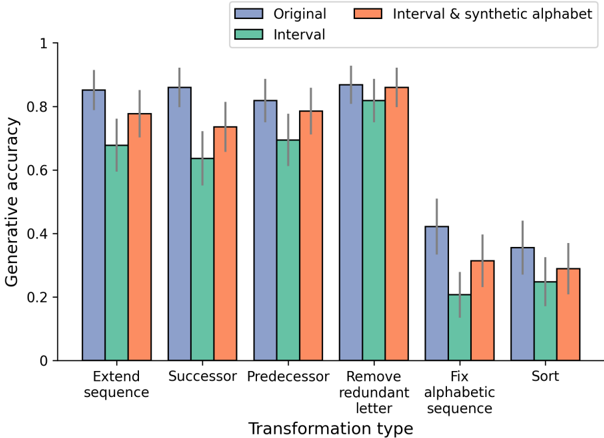
This image is a grouped bar chart with error bars, comparing the performance of three different methods ("Original," "Interval," and "Interval & synthetic alphabet") across six distinct transformation tasks. The chart measures "Generative accuracy" on a scale from 0 to 1.
### Components/Axes
* **Chart Type:** Grouped bar chart with error bars.
* **Y-Axis:**
* **Label:** "Generative accuracy"
* **Scale:** Linear, from 0 to 1, with major tick marks at 0, 0.2, 0.4, 0.6, 0.8, and 1.
* **X-Axis:**
* **Label:** "Transformation type"
* **Categories (from left to right):**
1. Extend sequence
2. Successor
3. Predecessor
4. Remove redundant letter
5. Fix alphabetic sequence
6. Sort
* **Legend:** Located at the top center of the chart.
* **Blue Bar:** "Original"
* **Green Bar:** "Interval"
* **Orange Bar:** "Interval & synthetic alphabet"
* **Error Bars:** Vertical lines extending above and below the top of each bar, indicating variability or uncertainty in the measurement.
### Detailed Analysis
The following values are approximate visual estimates from the chart. The error bars suggest a standard deviation or confidence interval of roughly ±0.05 to ±0.1 for most data points.
**1. Extend sequence:**
* **Original (Blue):** ~0.85
* **Interval (Green):** ~0.68
* **Interval & synthetic alphabet (Orange):** ~0.78
**2. Successor:**
* **Original (Blue):** ~0.86
* **Interval (Green):** ~0.63
* **Interval & synthetic alphabet (Orange):** ~0.74
**3. Predecessor:**
* **Original (Blue):** ~0.82
* **Interval (Green):** ~0.70
* **Interval & synthetic alphabet (Orange):** ~0.79
**4. Remove redundant letter:**
* **Original (Blue):** ~0.87
* **Interval (Green):** ~0.82
* **Interval & synthetic alphabet (Orange):** ~0.86
**5. Fix alphabetic sequence:**
* **Original (Blue):** ~0.42
* **Interval (Green):** ~0.20
* **Interval & synthetic alphabet (Orange):** ~0.31
**6. Sort:**
* **Original (Blue):** ~0.36
* **Interval (Green):** ~0.24
* **Interval & synthetic alphabet (Orange):** ~0.29
### Key Observations
* **Overall Performance Hierarchy:** The "Original" method (blue) consistently achieves the highest or near-highest generative accuracy across all six transformation types.
* **Task Difficulty:** There is a clear divide in task difficulty. The first four tasks ("Extend sequence," "Successor," "Predecessor," "Remove redundant letter") show high accuracy (generally >0.6) for all methods. The last two tasks ("Fix alphabetic sequence," "Sort") are significantly more challenging, with all methods scoring below 0.45.
* **Method Comparison:**
* The "Interval" method (green) is consistently the lowest-performing method, with a particularly large performance drop on the "Fix alphabetic sequence" task (~0.20).
* The "Interval & synthetic alphabet" method (orange) generally performs better than "Interval" alone but worse than "Original." Its performance is closest to "Original" on the "Remove redundant letter" task.
* **Error Bars:** The error bars are relatively consistent in size across most bars, suggesting similar levels of variance in the measurements. The "Fix alphabetic sequence" task shows slightly larger error bars for the "Original" method.
### Interpretation
The data suggests that the "Original" method is the most robust and accurate approach for the generative tasks evaluated. The "Interval" method appears to be a weaker baseline, and while augmenting it with a "synthetic alphabet" provides a measurable performance boost, it does not fully close the gap with the "Original" method.
The stark drop in accuracy for the "Fix alphabetic sequence" and "Sort" tasks indicates these transformations are fundamentally more complex for the models being tested. They likely require a deeper understanding of global sequence structure and ordering rules compared to the more local operations like "Successor" or "Remove redundant letter."
The chart effectively demonstrates that the choice of method has a significant impact on performance, and that this impact is modulated by the specific cognitive or linguistic transformation required. The "Original" method's consistent superiority implies it may have a better architectural or training foundation for these types of sequential reasoning tasks.