\n
## Bar Chart: Communication Parameters Comparison
### Overview
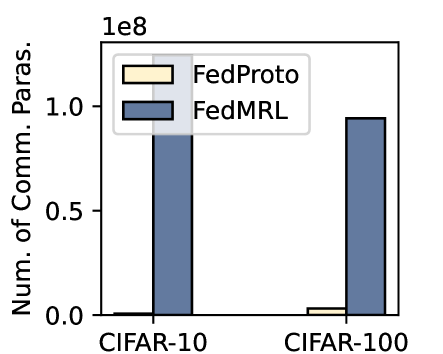
This is a bar chart comparing the number of communication parameters for two methods, FedProto and FedMRL, across two datasets, CIFAR-10 and CIFAR-100. The chart uses grouped bars to represent the parameter counts for each method within each dataset.
### Components/Axes
* **X-axis:** Datasets - CIFAR-10 and CIFAR-100.
* **Y-axis:** Number of Communication Parameters (Num. of Comm. Paras.), scaled from 0 to 1e8 (100,000,000).
* **Legend:**
* FedProto (represented by a light yellow color)
* FedMRL (represented by a dark blue color)
### Detailed Analysis
The chart consists of two groups of bars, one for CIFAR-10 and one for CIFAR-100.
**CIFAR-10:**
* **FedProto:** The bar is very short, approximately 0.02e8 (2,000,000).
* **FedMRL:** The bar is significantly taller, approximately 0.78e8 (78,000,000).
**CIFAR-100:**
* **FedProto:** The bar is very short, approximately 0.02e8 (2,000,000).
* **FedMRL:** The bar is significantly taller, approximately 0.95e8 (95,000,000).
The bars are positioned side-by-side within each dataset group, allowing for direct comparison between FedProto and FedMRL.
### Key Observations
* FedMRL consistently requires a substantially larger number of communication parameters than FedProto for both datasets.
* The number of communication parameters for FedMRL is similar for both CIFAR-10 and CIFAR-100, while FedProto remains consistently low.
* The difference in communication parameters between the two methods is much more pronounced than the difference between the datasets.
### Interpretation
The data suggests that FedMRL, while potentially offering other benefits, is significantly more communication-intensive than FedProto. This could be a critical consideration in scenarios where communication bandwidth is limited or expensive. The relatively stable parameter count for FedMRL across both datasets indicates that the increased communication overhead is inherent to the method itself, rather than being dataset-specific. The consistently low parameter count for FedProto suggests it is a more efficient method in terms of communication costs. This chart highlights a trade-off between communication efficiency and potentially other performance metrics (which are not shown in this chart). Further investigation would be needed to determine if the increased communication cost of FedMRL is justified by improvements in accuracy, convergence speed, or other relevant factors.