## Bar Chart: Communication Parameters Comparison (FedProto vs FedMRL)
### Overview
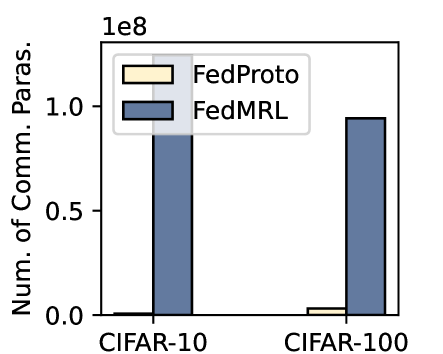
The chart compares the number of communication parameters (Num. of Comm. Paras.) between two federated learning methods, **FedProto** and **FedMRL**, across two datasets: **CIFAR-10** and **CIFAR-100**. The y-axis is scaled logarithmically up to 1e8 (100 million), while the x-axis categorizes the datasets. FedProto is represented by light yellow bars, and FedMRL by blue bars.
### Components/Axes
- **X-axis (Datasets)**:
- CIFAR-10 (left)
- CIFAR-100 (right)
- **Y-axis (Num. of Comm. Paras.)**:
- Logarithmic scale from 0 to 1e8.
- **Legend**:
- Top-right corner, with labels:
- **FedProto**: Light yellow
- **FedMRL**: Blue
### Detailed Analysis
- **CIFAR-10**:
- **FedProto**: Bar height ≈ 1e4–1e5 (extremely small, barely visible above the baseline).
- **FedMRL**: Bar height ≈ 1e8 (dominant, nearly reaching the y-axis maximum).
- **CIFAR-100**:
- **FedProto**: Bar height ≈ 1e5–1e6 (slightly larger than CIFAR-10 but still negligible).
- **FedMRL**: Bar height ≈ 1e8 (slightly taller than CIFAR-10, but still near the y-axis maximum).
### Key Observations
1. **FedMRL dominates in communication parameters**: Its values are orders of magnitude higher than FedProto in both datasets.
2. **CIFAR-100 amplifies the gap**: While FedMRL's parameters increase slightly for CIFAR-100, FedProto's increase is minimal, suggesting dataset size has a marginal impact on FedProto's communication overhead.
3. **FedProto's near-zero values**: Indicates negligible communication parameters, possibly due to parameter compression or sparse updates.
### Interpretation
The chart demonstrates that **FedMRL requires significantly more communication parameters than FedProto**, likely due to its reliance on more frequent or detailed parameter synchronization. The logarithmic y-axis emphasizes the stark disparity, with FedMRL's values approaching 1e8 (100 million) compared to FedProto's near-zero contributions. The slight increase in FedMRL's parameters for CIFAR-100 aligns with expectations for larger datasets, whereas FedProto's minimal growth suggests a design optimized for efficiency. This implies FedMRL may prioritize model accuracy at the cost of communication efficiency, while FedProto prioritizes lightweight communication, potentially at the expense of model performance.