\n
## Diagram: Dependency/Flow Chart
### Overview
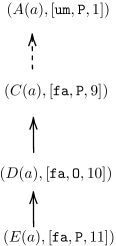
The image presents a diagram illustrating a sequence of dependencies or a flow of information. It consists of four labeled nodes (A, C, D, and E) connected by arrows indicating directionality. Each node is associated with a tuple containing a function call and a list of values.
### Components/Axes
The diagram consists of:
* **Nodes:** Labeled A, C, D, and E. Each node represents a function call with an argument 'a'.
* **Arrows:** Solid arrows indicating the direction of dependency or flow. A dashed arrow is present between A and C.
* **Tuples:** Each node is associated with a tuple in the format `(Function(a), [value1, value2, value3])`.
### Detailed Analysis or Content Details
The diagram shows the following dependencies and associated data:
1. **E(a), [fa, P, 11]**: The function E is called with argument 'a', and the associated list contains the values "fa", "P", and 11.
2. **D(a), [fa, 0, 10]**: The function D is called with argument 'a', and the associated list contains the values "fa", 0, and 10.
3. **C(a), [fa, P, 9]**: The function C is called with argument 'a', and the associated list contains the values "fa", "P", and 9. The arrow connecting C to A is dashed.
4. **A(a), [um, P, 1]**: The function A is called with argument 'a', and the associated list contains the values "um", "P", and 1.
The arrows indicate the following flow:
* E -> D
* D -> C
* C --(dashed)--> A
### Key Observations
* The functions called are A, C, D, and E.
* The argument passed to each function is 'a'.
* The lists associated with each function contain a mix of strings ("fa", "P", "um") and numbers (0, 9, 10, 11, 1).
* The dashed arrow between C and A suggests a different type of relationship than the solid arrows, potentially indicating a less direct or conditional dependency.
### Interpretation
This diagram likely represents a simplified dependency graph or a call stack in a program. The functions A, C, D, and E are executed in a specific order, with E being the starting point and A being the final destination (with a possible feedback loop indicated by the dashed arrow). The lists associated with each function could represent parameters, return values, or internal state information. The use of "fa", "P", "um" suggests these could be symbolic representations of data types or flags. The numerical values might represent quantities, indices, or other numerical data. The dashed arrow from C to A could indicate a recursive call or a conditional dependency where A is called based on the result of C. Without further context, it's difficult to determine the exact meaning of the diagram, but it clearly illustrates a sequence of operations and their interdependencies.