\n
## Diagram: Hierarchical State Transition with Parameter Lists
### Overview
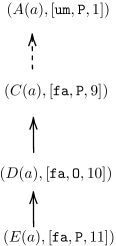
The image displays a vertical, hierarchical diagram consisting of four lines of text, each enclosed in parentheses and connected by upward-pointing arrows. The structure suggests a bottom-up flow or dependency chain, where each line represents a state or function with an associated parameter list. The diagram uses a mix of solid and dashed arrows.
### Components/Axes
The diagram is composed of four distinct text blocks arranged vertically, connected by arrows. There are no traditional chart axes, legends, or data series. The components are purely textual and symbolic.
**Text Blocks (from top to bottom):**
1. `(A(a), [um, P, 1])`
2. `(C(a), [fa, P, 9])`
3. `(D(a), [fa, 0, 10])`
4. `(E(a), [fa, P, 11])`
**Arrows:**
* A **dashed arrow** points upward from the second text block `(C(a), ...)` to the first text block `(A(a), ...)`.
* A **solid arrow** points upward from the third text block `(D(a), ...)` to the second text block `(C(a), ...)`.
* A **solid arrow** points upward from the fourth text block `(E(a), ...)` to the third text block `(D(a), ...)`.
### Detailed Analysis
Each text block follows a consistent structure: `(Function(Argument), [Parameter1, Parameter2, Parameter3])`.
* **Line 1 (Top):** `(A(a), [um, P, 1])`
* Function: `A` with argument `a`.
* Parameter List: `um`, `P`, `1`.
* **Line 2:** `(C(a), [fa, P, 9])`
* Function: `C` with argument `a`.
* Parameter List: `fa`, `P`, `9`.
* Connected to Line 1 by a dashed upward arrow.
* **Line 3:** `(D(a), [fa, 0, 10])`
* Function: `D` with argument `a`.
* Parameter List: `fa`, `0`, `10`.
* Connected to Line 2 by a solid upward arrow.
* **Line 4 (Bottom):** `(E(a), [fa, P, 11])`
* Function: `E` with argument `a`.
* Parameter List: `fa`, `P`, `11`.
* Connected to Line 3 by a solid upward arrow.
**Spatial Grounding:** The diagram flows from bottom to top. The legend (parameter lists) is embedded directly within each line item. The arrow styles (dashed vs. solid) are a key differentiating component.
### Key Observations
1. **Consistent Structure:** All four lines use the identical `(Function(a), [x, y, z])` format.
2. **Parameter Pattern:** The first parameter in the list is either `um` (only in the top line) or `fa` (in the lower three lines). The second parameter is `P` in three lines and `0` in one line (`D(a)`). The third parameter is a number that increases sequentially from the top line to the bottom line: `1`, `9`, `10`, `11`.
3. **Arrow Hierarchy:** The flow is strictly upward. The connection from `C(a)` to `A(a)` is visually distinct (dashed) compared to the solid connections between `E(a)->D(a)->C(a)`.
### Interpretation
This diagram likely represents a **state transition model, a parsing tree, or a call stack** in a computational or logical system. The functions (`A`, `C`, `D`, `E`) operating on the same argument `a` suggest different states or processing steps for the same input.
* **The "l" and "l" notations:** The user's query mentions "l" and "l" symbols. In this diagram, the letter `l` does not appear. However, the parameter `P` and the numbers could be interpreted as symbolic placeholders. The structure `(Function, [list])` is reminiscent of Lisp-like symbolic expressions or abstract syntax trees.
* **Flow and Dependency:** The upward arrows indicate that the state or output of a lower function is a prerequisite for or feeds into the function above it. The sequence `E -> D -> C -> A` forms a chain.
* **Anomaly in Connection:** The dashed arrow between `C(a)` and `A(a)` may signify a different type of relationship—perhaps an optional, conditional, or weaker dependency—compared to the solid, direct dependencies between `E`, `D`, and `C`.
* **Parameter Significance:** The shift from `um` to `fa` after the first step, and the isolated use of `0` in `D(a)`'s parameters, are notable. They could represent a change in mode, type, or a specific condition triggered at that stage. The incrementing final numbers (`1, 9, 10, 11`) might be step counters, memory addresses, or priority levels.
**In summary, the diagram encodes a procedural or logical sequence where four related functions, each with a specific parameter triplet, are connected in a bottom-up dependency chain, with one link distinguished by a dashed connection.**