# Technical Document Extraction: Heatmap Visualization of K₂ and E_F Parameters
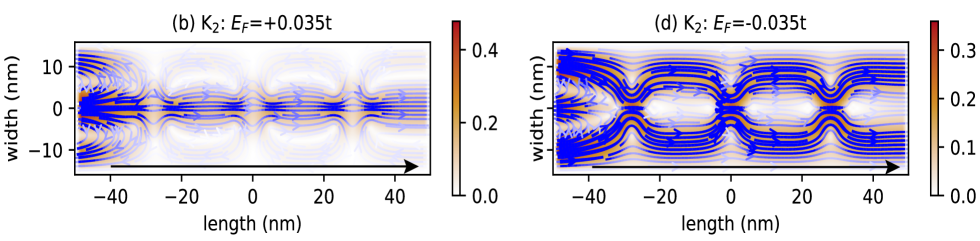
## Panel (b): K₂ with E_F = +0.035t
- **Title**: `(b) K₂: E_F = +0.035t`
- **Axes**:
- **X-axis**: `length (nm)` (range: -40 to +40 nm, arrow pointing right)
- **Y-axis**: `width (nm)` (range: -10 to +10 nm)
- **Color Scale**:
- **Legend**: Right of panel, gradient from `0.0` (white) to `0.4` (red)
- **Intensity**: Represents magnitude of K₂ parameter (higher values = redder regions)
- **Key Features**:
- Symmetric flow patterns along the length axis.
- Concentrated intensity near the center (width ≈ 0 nm).
- Gradual decay of intensity toward the edges (width ≈ ±10 nm).
## Panel (d): K₂ with E_F = -0.035t
- **Title**: `(d) K₂: E_F = -0.035t`
- **Axes**:
- **X-axis**: `length (nm)` (range: -40 to +40 nm, arrow pointing right)
- **Y-axis**: `width (nm)` (range: -10 to +10 nm)
- **Color Scale**:
- **Legend**: Right of panel, gradient from `0.0` (white) to `0.3` (red)
- **Intensity**: Represents magnitude of K₂ parameter (higher values = redder regions)
- **Key Features**:
- Asymmetric flow patterns with alternating high/low intensity regions.
- Two distinct intensity peaks near the center (width ≈ ±5 nm).
- Reduced overall intensity compared to panel (b).
## Cross-Reference Analysis
- **Legend Consistency**:
- Panel (b) uses a broader color scale (0.0–0.4) than panel (d) (0.0–0.3), reflecting differing parameter ranges.
- Red regions in both panels correspond to the highest measured K₂ values under their respective E_F conditions.
- **Flow Direction**:
- Arrows on the x-axis confirm data flow from left (-40 nm) to right (+40 nm).
- No explicit flow vectors in the heatmaps; intensity gradients imply directional trends.
## Observations
1. **E_F Influence**:
- Positive E_F (+0.035t) in panel (b) produces more uniform intensity distribution.
- Negative E_F (-0.035t) in panel (d) introduces asymmetry and localized intensity peaks.
2. **Parameter Sensitivity**:
- K₂ values are highly dependent on the sign and magnitude of E_F.
- Intensity thresholds (color scale maxima) vary between panels, suggesting differing measurement scales or normalization.
## Notes
- No explicit data table or numerical values are provided; interpretation relies on color gradients and axis labels.
- Time dependence (`t`) in E_F suggests dynamic conditions, though temporal resolution is not visualized.