## Flow Diagram: ReAct Loop
### Overview
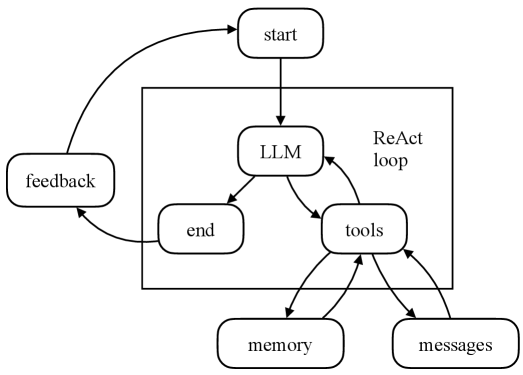
The image is a flow diagram illustrating the ReAct loop. It shows the interaction between different components, including "start," "LLM," "tools," "memory," "messages," "feedback," and "end." The diagram highlights the cyclical nature of the ReAct process, with a central loop involving the LLM and tools.
### Components/Axes
* **Nodes:** The diagram consists of rounded rectangle nodes representing different states or components. These nodes are labeled as:
* start
* LLM (inside the ReAct loop)
* tools (inside the ReAct loop)
* memory
* messages
* feedback
* end (inside the ReAct loop)
* **Edges:** Arrows indicate the flow of information or control between the nodes.
* **ReAct loop:** A rectangular box encloses the "LLM," "tools," and "end" nodes, labeled as "ReAct loop."
### Detailed Analysis
* **Start:** The process begins at the "start" node.
* **LLM:** From "start," the flow proceeds to the "LLM" (Large Language Model) node.
* **Tools:** The "LLM" node connects to the "tools" node, indicating the LLM's interaction with external tools.
* **Memory and Messages:** The "tools" node connects to both "memory" and "messages" nodes.
* **Feedback:** The "feedback" node connects back to the "start" node, creating a loop.
* **End:** The "LLM" node also connects to the "end" node, which is part of the ReAct loop.
* **ReAct Loop:** The "tools" node connects back to the "LLM" node, completing the ReAct loop. The "tools" node also connects to the "messages" node, and the "messages" node connects back to the "tools" node.
**Flow of Information:**
1. The process starts at the "start" node.
2. The flow moves from "start" to "LLM."
3. The "LLM" interacts with "tools."
4. "Tools" interacts with "memory" and "messages."
5. "Tools" can also return to "LLM," forming a loop.
6. "LLM" can lead to "end."
7. "Feedback" loops back to "start."
8. "Messages" can return to "tools."
### Key Observations
* The "ReAct loop" is a central component, involving the LLM and tools.
* The "feedback" loop allows for iterative refinement of the process.
* "Memory" and "messages" are external components that the "tools" interact with.
* The "end" node represents a possible termination point within the ReAct loop.
### Interpretation
The diagram illustrates the ReAct (Reason + Act) framework, a process where a language model interacts with its environment to solve tasks. The LLM reasons about the task, decides which tool to use, and then acts by using the tool. The results of the action are then fed back to the LLM, allowing it to refine its reasoning and actions in subsequent iterations. The "memory" and "messages" components likely represent the system's ability to store and retrieve information and communicate with external entities. The "feedback" loop suggests a mechanism for incorporating external input or evaluation to improve the overall performance of the system. The "end" node suggests a possible termination point within the ReAct loop, possibly when a satisfactory solution is found or a maximum number of iterations is reached.