\n
## Diagram: ReAct Loop Architecture
### Overview
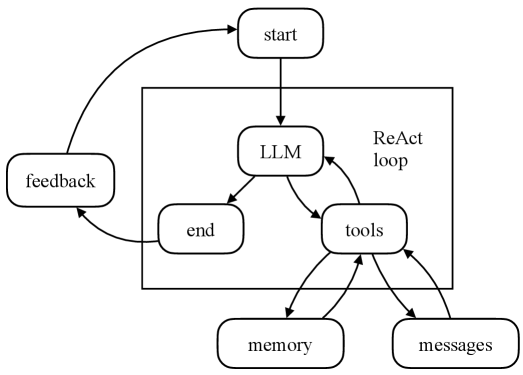
The image depicts a diagram illustrating the architecture of a ReAct (Reason + Act) loop, a framework for Large Language Models (LLMs). The diagram shows the flow of information between different components within the loop, and how external feedback is incorporated. It is a flowchart-style diagram using rounded rectangles to represent components and arrows to indicate the direction of information flow.
### Components/Axes
The diagram consists of the following components:
* **Start:** The initial state of the process.
* **LLM:** Large Language Model - the core reasoning engine.
* **Tools:** External tools accessible to the LLM.
* **Memory:** A storage component for retaining information.
* **Messages:** A component for handling input and output messages.
* **End:** The terminal state of the process.
* **Feedback:** External feedback loop.
* **ReAct loop:** A label indicating the enclosed components form the ReAct loop.
The arrows indicate the direction of data flow between these components.
### Detailed Analysis or Content Details
The diagram shows the following flow:
1. The process begins at "Start".
2. An arrow leads from "Start" to the "LLM" component, initiating the loop.
3. The "LLM" has bidirectional arrows connecting it to "Tools" and "Memory". This suggests a two-way interaction where the LLM can both utilize tools and access/store information in memory.
4. The "LLM" also has a unidirectional arrow leading to "Messages", indicating the LLM generates messages.
5. "Tools" has unidirectional arrows leading to both "Memory" and "Messages", suggesting tools can update memory and generate messages.
6. "Memory" has a unidirectional arrow leading to "Messages", indicating memory can contribute to message generation.
7. "End" is connected to the "LLM" with an arrow, suggesting the LLM can terminate the loop.
8. An external "Feedback" component is connected to "Start" with an arrow, indicating that feedback can restart or influence the loop.
9. The components "LLM", "Tools", "Memory", "Messages", and "End" are enclosed within a rectangular box labeled "ReAct loop".
### Key Observations
The diagram highlights the iterative nature of the ReAct loop. The LLM is central to the process, interacting with tools, memory, and messages. The feedback loop suggests a continuous improvement or refinement process. The bidirectional arrows between the LLM and Tools/Memory indicate a dynamic interaction.
### Interpretation
The diagram illustrates a closed-loop system where an LLM interacts with its environment (through tools) and maintains a state (through memory) to achieve a goal. The ReAct loop enables the LLM to reason about its actions and adapt its behavior based on feedback. The inclusion of "Messages" suggests the loop is designed for interaction, potentially with a user or another system. The diagram emphasizes the importance of iterative refinement and the role of feedback in improving the LLM's performance. The architecture suggests a system capable of complex problem-solving by combining reasoning, action, and memory.