## Korean Text Document Analysis: Exam/Assessment Content
### Overview
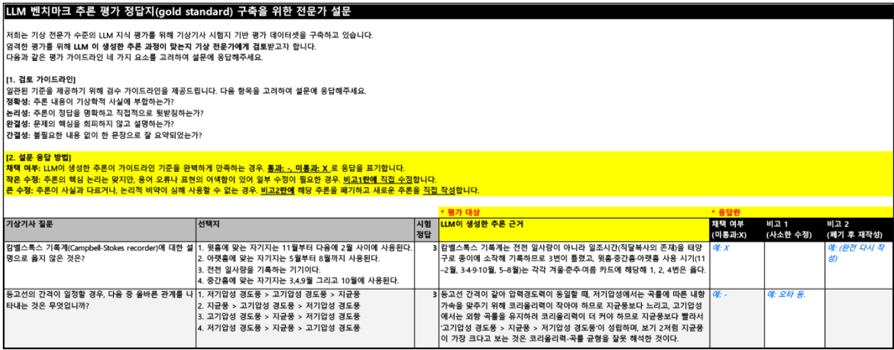
The image shows a Korean document containing text, a table with structured data, and highlighted sections. The content appears to be related to an exam or assessment for "LLM" (Large Language Model) standards, with sections on evaluation criteria, questions, answers, and responses.
### Components/Axes
1. **Header**:
- Text: "LLM 벤치마크 주된 평가 정답지(gold standard) 구축을 위한 전문가 설문"
- Translation: "LLM Benchmark Main Evaluation Answer Key (Gold Standard) Construction Expert Survey"
2. **Yellow Highlighted Section**:
- Text: "채택 여부: LLM이 생성한 주문이 가이드라인 기준을 완벽하게 만족하는 경우, 통과: X, 미통과: X로 응답을 표기합니다."
- Translation: "Adoption Decision: If LLM-generated requests fully meet guideline standards, mark 'X' for 'Pass' and 'X' for 'Fail' in responses."
3. **Table Structure**:
- **Columns**:
- **기상기사 질문** (Weather Reporter Questions):
- Example: "캠벨스톡스 기록계(Campbell-Stokes recorder)에 대한 설명으로 옳지 않은 것은?" (Which description about Campbell-Stokes recorder is incorrect?)
- **선택지** (Options):
- Example: "1. 맞춤형에 맞는 자기지는 11월부터 다음에 2월 사이에 사용된다." (1. Customized items are used between February and November.)
- **시험정답** (Exam Answers):
- Example: "3. 전천 일사량을 기록하는 기기이다." (3. It is a device for recording total solar radiation.)
- **LLM이 생성한 주문 근거** (LLM-Generated Order Rationale):
- Example: "1. 저기압성 경도동 > 고기압성 경도동 > 지균풍" (1. Low-pressure geostrophic wind > High-pressure geostrophic wind > Trade wind)
- **채택 여부** (Adoption Decision):
- Example: "X" (Marked for evaluation)
- **비고 1** (Note 1):
- Example: "X" (Marked for evaluation)
- **비고 2** (Note 2):
- Example: "X" (Marked for evaluation)
4. **Highlighted Sections**:
- **평가 대상** (Evaluation Target):
- Text: "LLM이 생성한 주문 근거" (LLM-Generated Order Rationale)
- **응답한** (Responded):
- Text: "채택 여부: X" (Adoption Decision: X)
### Detailed Analysis
- **Header**: The document is titled as a survey for constructing an LLM benchmark evaluation standard.
- **Yellow Highlight**: Indicates the adoption decision criteria for LLM-generated responses.
- **Table**:
- **Questions**: Focus on weather-related topics (e.g., Campbell-Stokes recorder, geostrophic wind).
- **Options**: Provide multiple-choice answers.
- **Exam Answers**: Correct answers are listed (e.g., option 3 for the first question).
- **LLM-Generated Rationale**: Shows how LLM would justify its responses (e.g., geostrophic wind hierarchy).
- **Adoption Decision**: Marks responses for evaluation (e.g., "X" indicates evaluation).
- **Notes**: Additional comments (e.g., "X" for evaluation).
### Key Observations
- The document is structured as an assessment for evaluating LLM performance against predefined guidelines.
- The "평가 대상" (Evaluation Target) column highlights the LLM's generated rationale for responses.
- The "응답한" column marks which responses were evaluated (e.g., "X" indicates evaluation).
- The "비고" (Notes) column includes additional annotations (e.g., "X" for evaluation).
### Interpretation
- The document appears to be part of a quality control process for LLM-generated content, ensuring adherence to specific standards.
- The table serves as a rubric for evaluating LLM responses against expert-curated answers.
- The highlighted sections emphasize the importance of adoption decisions and evaluation criteria.
- The use of "X" marks suggests a binary evaluation system (pass/fail) for LLM-generated responses.
## Conclusion
This document outlines a structured approach to assessing LLM performance in generating weather-related content. It combines textual analysis with tabular data to evaluate adherence to guidelines, with clear markers for evaluation and decision-making.