\n
## Line Chart: Accuracy vs. Attack Ratio for Federated Learning Defenses
### Overview
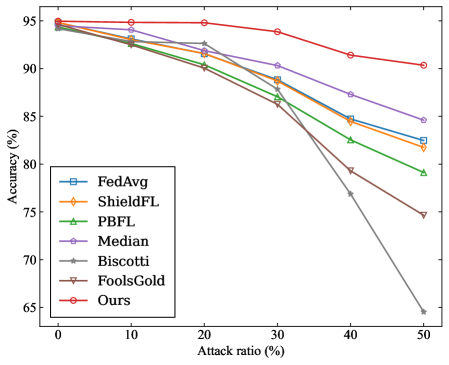
This image presents a line chart comparing the accuracy of several federated learning defense mechanisms under varying attack ratios. The x-axis represents the attack ratio (as a percentage), and the y-axis represents the accuracy (also as a percentage). Six different defense strategies are plotted, allowing for a direct comparison of their resilience to attacks.
### Components/Axes
* **X-axis:** "Attack ratio (%)" - Scale ranges from 0% to 50%, with markers at 0, 10, 20, 30, 40, and 50.
* **Y-axis:** "Accuracy (%)" - Scale ranges from 65% to 95%, with markers at 65, 70, 75, 80, 85, 90, and 95.
* **Legend (bottom-left):** Lists the defense mechanisms and their corresponding line colors:
* FedAvg (Blue Square)
* ShieldFL (Orange Diamond)
* PBFL (Green Triangle)
* Median (Purple Circle)
* Biscotti (Gray Star)
* FoolsGold (Brown Inverted Triangle)
* Ours (Red Circle)
### Detailed Analysis
Here's a breakdown of each line's trend and approximate data points, verified against the legend colors:
* **FedAvg (Blue Square):** The line slopes downward, indicating decreasing accuracy with increasing attack ratio.
* 0% Attack: ~94% Accuracy
* 10% Attack: ~93% Accuracy
* 20% Attack: ~91% Accuracy
* 30% Attack: ~88% Accuracy
* 40% Attack: ~85% Accuracy
* 50% Attack: ~82% Accuracy
* **ShieldFL (Orange Diamond):** The line shows a more rapid decline in accuracy compared to FedAvg.
* 0% Attack: ~94% Accuracy
* 10% Attack: ~92% Accuracy
* 20% Attack: ~89% Accuracy
* 30% Attack: ~84% Accuracy
* 40% Attack: ~78% Accuracy
* 50% Attack: ~72% Accuracy
* **PBFL (Green Triangle):** The line initially remains relatively stable, then declines sharply after 30% attack ratio.
* 0% Attack: ~94% Accuracy
* 10% Attack: ~93% Accuracy
* 20% Attack: ~91% Accuracy
* 30% Attack: ~88% Accuracy
* 40% Attack: ~80% Accuracy
* 50% Attack: ~75% Accuracy
* **Median (Purple Circle):** The line exhibits a moderate downward slope, similar to FedAvg but slightly steeper.
* 0% Attack: ~94% Accuracy
* 10% Attack: ~92% Accuracy
* 20% Attack: ~90% Accuracy
* 30% Attack: ~86% Accuracy
* 40% Attack: ~83% Accuracy
* 50% Attack: ~80% Accuracy
* **Biscotti (Gray Star):** This line demonstrates a very steep decline in accuracy, becoming significantly lower than other methods at higher attack ratios.
* 0% Attack: ~94% Accuracy
* 10% Attack: ~92% Accuracy
* 20% Attack: ~88% Accuracy
* 30% Attack: ~78% Accuracy
* 40% Attack: ~68% Accuracy
* 50% Attack: ~65% Accuracy
* **FoolsGold (Brown Inverted Triangle):** The line shows a moderate decline in accuracy, similar to Median.
* 0% Attack: ~94% Accuracy
* 10% Attack: ~93% Accuracy
* 20% Attack: ~91% Accuracy
* 30% Attack: ~88% Accuracy
* 40% Attack: ~84% Accuracy
* 50% Attack: ~80% Accuracy
* **Ours (Red Circle):** This line exhibits the most stable accuracy across all attack ratios, showing the smallest decline.
* 0% Attack: ~94% Accuracy
* 10% Attack: ~94% Accuracy
* 20% Attack: ~93% Accuracy
* 30% Attack: ~91% Accuracy
* 40% Attack: ~90% Accuracy
* 50% Attack: ~89% Accuracy
### Key Observations
* The "Ours" defense mechanism consistently outperforms all other methods across all attack ratios, maintaining a high level of accuracy even under significant attack.
* Biscotti is the most vulnerable defense, experiencing a dramatic drop in accuracy as the attack ratio increases.
* FedAvg, Median, and FoolsGold show similar performance, with moderate declines in accuracy.
* ShieldFL and PBFL exhibit intermediate vulnerability, declining more rapidly than FedAvg but less drastically than Biscotti.
### Interpretation
The chart demonstrates the effectiveness of the proposed defense mechanism ("Ours") against attacks in a federated learning environment. The consistently high accuracy suggests that this method is robust and can maintain performance even when a significant portion of the participating clients are compromised. The stark contrast between "Ours" and Biscotti highlights the importance of choosing a resilient defense strategy. The data suggests that the proposed defense is superior in mitigating the impact of attacks on model accuracy. The relatively stable performance of "Ours" could be due to a more sophisticated attack mitigation strategy, such as robust aggregation rules or anomaly detection. The rapid decline of Biscotti suggests it may be susceptible to a specific type of attack or lack sufficient defenses against malicious participants. The chart provides valuable insights for practitioners seeking to deploy secure federated learning systems.