\n
## Diagram: Hexagonal Lattice with Directed Edges
### Overview
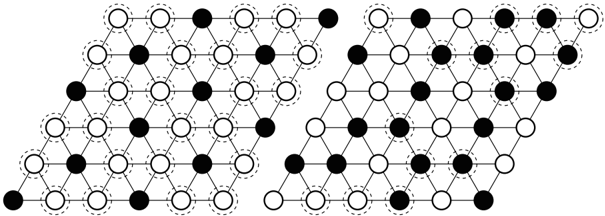
The image depicts a hexagonal lattice structure composed of interconnected nodes (circles). Some nodes are filled black, while others are outlined only. Directed arrows connect the nodes, indicating a flow or relationship between them. The lattice appears to be truncated, forming a roughly triangular shape.
### Components/Axes
There are no explicit axes or labels in the traditional sense. The diagram consists of:
* **Nodes:** Circles, either filled black or outlined.
* **Edges:** Directed arrows connecting the nodes.
* **Lattice Structure:** A repeating hexagonal pattern.
### Detailed Analysis or Content Details
The diagram consists of a hexagonal lattice. The nodes are arranged in rows, with the number of nodes in each row increasing and then decreasing. The leftmost node is black. The nodes alternate between black and white (outlined) in a regular pattern within each row.
The directed arrows point predominantly to the right, with some pointing diagonally upwards to the right. The arrows are not present on every edge, and their presence seems to follow a pattern. The arrows are dashed.
Let's attempt to quantify the structure:
* **Rows:** Approximately 10 rows are visible.
* **Nodes per Row:** The number of nodes per row increases from 1 to approximately 8, then decreases back to 1.
* **Total Nodes:** Approximately 50-60 nodes are visible.
* **Black Nodes:** Approximately 25-30 nodes are black.
* **White Nodes:** Approximately 20-30 nodes are white (outlined).
* **Arrows:** Approximately 40-50 arrows are visible. The arrows are not uniformly distributed.
The pattern of arrows is as follows:
* Arrows are present on edges connecting black nodes to white nodes.
* Arrows are present on edges connecting white nodes to black nodes.
* Arrows are not present on edges connecting nodes of the same color.
### Key Observations
* The lattice structure is not perfectly regular; there is some truncation on the right side.
* The alternating pattern of black and white nodes suggests a binary state or classification.
* The directed arrows indicate a flow or relationship between nodes, potentially representing a process or network.
* The absence of arrows between nodes of the same color suggests a constraint or rule governing the flow.
### Interpretation
This diagram likely represents a state transition diagram or a network flow model. The black and white nodes could represent different states or categories, and the directed arrows could represent transitions between these states. The hexagonal lattice structure suggests a spatial or relational context.
The pattern of arrows indicates that transitions are only allowed between nodes of different states. This could represent a system where a change in state requires an interaction or exchange. The truncation of the lattice suggests that the system is either finite or that the diagram only shows a portion of a larger, infinite system.
The diagram could be used to model various phenomena, such as:
* A chemical reaction network
* A social network with directed relationships
* A computational model with state transitions
* A physical system with energy flow
Without additional context, it is difficult to determine the specific meaning of the diagram. However, the structure and patterns suggest a well-defined system with specific rules governing its behavior. The diagram is a visual representation of a complex system, and its interpretation requires a deeper understanding of the underlying principles.