## Bar Charts: Comparative Performance of Base Model + Reasoning vs ARTIST
### Overview
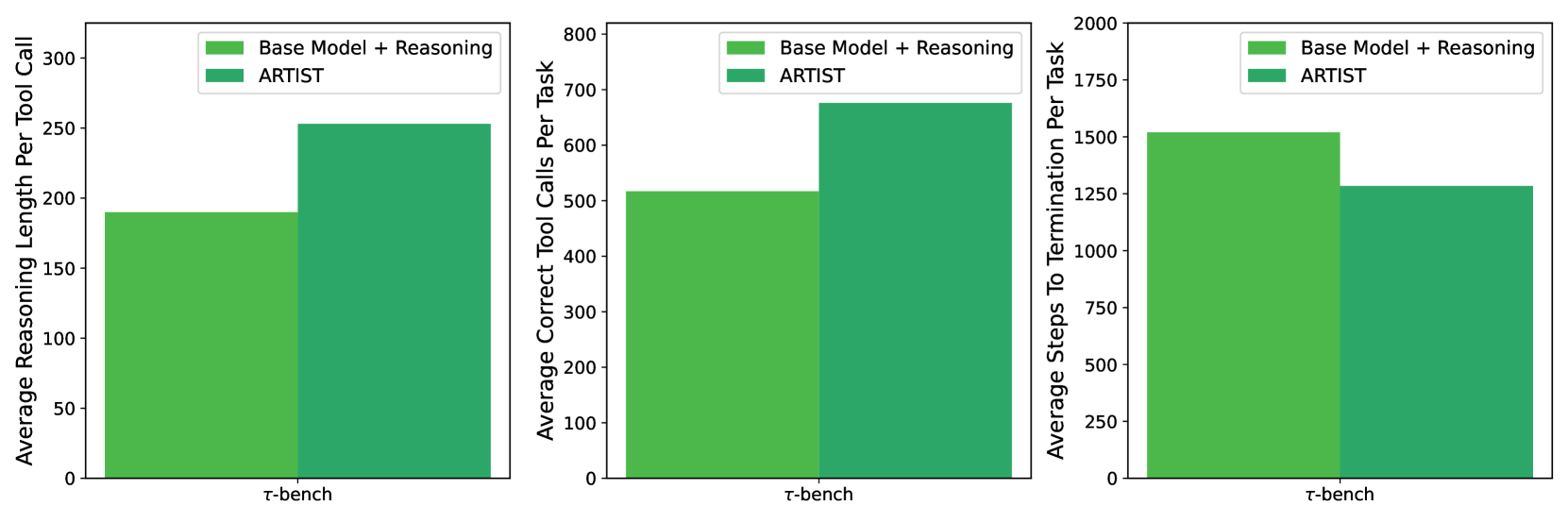
The image contains three grouped bar charts comparing two models ("Base Model + Reasoning" and "ARTIST") across three metrics:
1. Average Reasoning Length Per Tool Call
2. Average Correct Tool Calls Per Task
3. Average Steps To Termination Per Task
Each chart uses a consistent color scheme (green for Base Model, teal for ARTIST) and shares the x-axis label "τ-bench".
---
### Components/Axes
- **X-Axis**: Labeled "τ-bench" (appears identical across all charts).
- **Y-Axes**:
1. First chart: "Average Reasoning Length Per Tool Call" (0–300 scale).
2. Second chart: "Average Correct Tool Calls Per Task" (0–800 scale).
3. Third chart: "Average Steps To Termination Per Task" (0–2000 scale).
- **Legends**: Positioned in the top-right corner of each chart.
- Green: "Base Model + Reasoning"
- Teal: "ARTIST"
---
### Detailed Analysis
#### Chart 1: Average Reasoning Length Per Tool Call
- **τ-bench**:
- Base Model + Reasoning: ~190 (green bar).
- ARTIST: ~250 (teal bar).
#### Chart 2: Average Correct Tool Calls Per Task
- **τ-bench**:
- Base Model + Reasoning: ~510 (green bar).
- ARTIST: ~680 (teal bar).
#### Chart 3: Average Steps To Termination Per Task
- **τ-bench**:
- Base Model + Reasoning: ~1500 (green bar).
- ARTIST: ~1250 (teal bar).
---
### Key Observations
1. **ARTIST outperforms Base Model + Reasoning** in the first two metrics (reasoning length and correct tool calls).
2. **Base Model + Reasoning requires more steps to termination** (~1500 vs. ~1250 for ARTIST).
3. All values are approximate, with uncertainty due to visual estimation from the bar heights.
---
### Interpretation
The data suggests a trade-off between **thoroughness** and **efficiency**:
- **ARTIST** generates longer reasoning traces and more correct tool calls, indicating superior problem-solving depth.
- However, it terminates tasks faster (~1250 steps vs. ~1500 for Base Model), implying better optimization for task completion.
- The Base Model + Reasoning may prioritize exhaustive reasoning at the cost of longer termination times.
This pattern could reflect architectural differences (e.g., ARTIST’s design for parallel processing) or training objectives favoring precision over speed. Further analysis of task complexity or error rates would clarify these dynamics.