\n
## Diagram: Neuromorphic Computing Architecture
### Overview
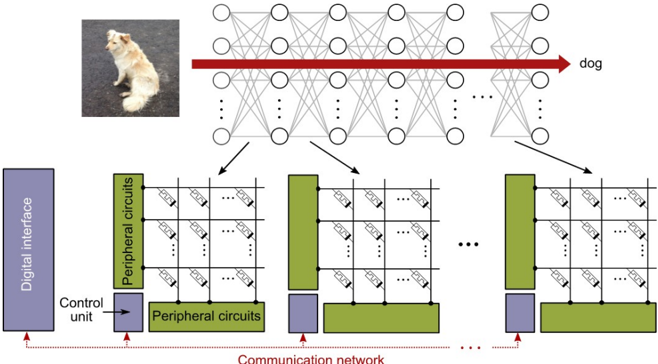
The image depicts a conceptual diagram of a neuromorphic computing architecture, illustrating how an image of a dog is processed through layers of artificial neurons and peripheral circuits. The diagram highlights the flow of information from a digital interface, through a control unit, into a network of peripheral circuits, and finally to a classification output ("dog").
### Components/Axes
The diagram consists of the following key components:
* **Digital Interface:** A dark purple rectangle on the left side, representing the input source.
* **Control Unit:** A dark blue rectangle connected to the digital interface.
* **Peripheral Circuits:** Multiple green rectangles, each containing a grid of smaller squares representing individual processing elements. These are arranged in a repeating pattern.
* **Communication Network:** A dotted red line connecting the peripheral circuits.
* **Artificial Neural Network:** Layers of white circles representing neurons, with connections between them. A red arrow indicates the flow of information.
* **Image Input:** A photograph of a dog in the top-left corner.
* **Output Label:** The word "dog" is written to the right of the final layer of the neural network.
There are no explicit axes or scales in this diagram. It is a schematic representation of a system rather than a data visualization.
### Detailed Analysis / Content Details
The diagram shows a multi-layered system.
1. **Input:** An image of a dog is presented as the initial input.
2. **Neural Network:** The image is processed through multiple layers of interconnected neurons (white circles). The connections between neurons are represented by lines. The red arrow indicates the direction of information flow.
3. **Peripheral Circuits:** The output of the neural network is then fed into a series of peripheral circuits (green rectangles). Each circuit appears to contain a grid of processing elements (small squares). The arrangement of these elements within the circuits is consistent across all shown circuits.
4. **Communication Network:** The peripheral circuits are interconnected via a communication network (dotted red line).
5. **Control Unit & Digital Interface:** The entire system is controlled by a control unit (dark blue rectangle) which receives input from a digital interface (dark purple rectangle).
The diagram shows a repeating pattern of peripheral circuits, indicated by the ellipsis ("...") suggesting that the system can be scaled. The number of neurons in each layer of the neural network appears to decrease as the information flows through the layers. The exact number of neurons in each layer is difficult to determine due to the schematic nature of the diagram.
### Key Observations
* The diagram emphasizes the parallel processing nature of the architecture, with multiple peripheral circuits operating concurrently.
* The use of a neural network suggests that the system is designed for pattern recognition and classification tasks.
* The diagram does not provide specific details about the algorithms or hardware used in the system. It is a high-level conceptual overview.
* The image of the dog is used as a specific example to illustrate the system's ability to recognize objects.
### Interpretation
This diagram illustrates a neuromorphic computing architecture designed to mimic the structure and function of the biological brain. The key idea is to move away from traditional von Neumann architectures, which separate processing and memory, and towards architectures where processing and memory are co-located, as in the brain.
The neural network layers perform feature extraction and pattern recognition, while the peripheral circuits likely implement the actual computation and memory storage. The communication network allows the circuits to exchange information and coordinate their activities. The control unit manages the overall operation of the system.
The use of an image of a dog as an example suggests that the system is intended for image recognition tasks. However, the architecture is general enough to be applied to other types of data and tasks.
The diagram highlights the potential advantages of neuromorphic computing, such as low power consumption, high parallelism, and robustness to noise. However, it also reveals the challenges of designing and building such systems, such as the complexity of the hardware and the difficulty of programming them. The diagram is a conceptual illustration and does not provide enough detail to assess the performance or feasibility of the architecture. It is a high-level overview of a potential approach to building more brain-like computers.