TECHNICAL ASSET FINGERPRINT
22d07cfc4c40e97186f559b2
Click to view fullscreen
Press ESC or click to close
FOUND IN PAPERS
EXPERT: gemma-3-27b-it-free VERSION 1
RUNTIME: google-free/gemma-3-27b-it
INTEL_VERIFIED
\n
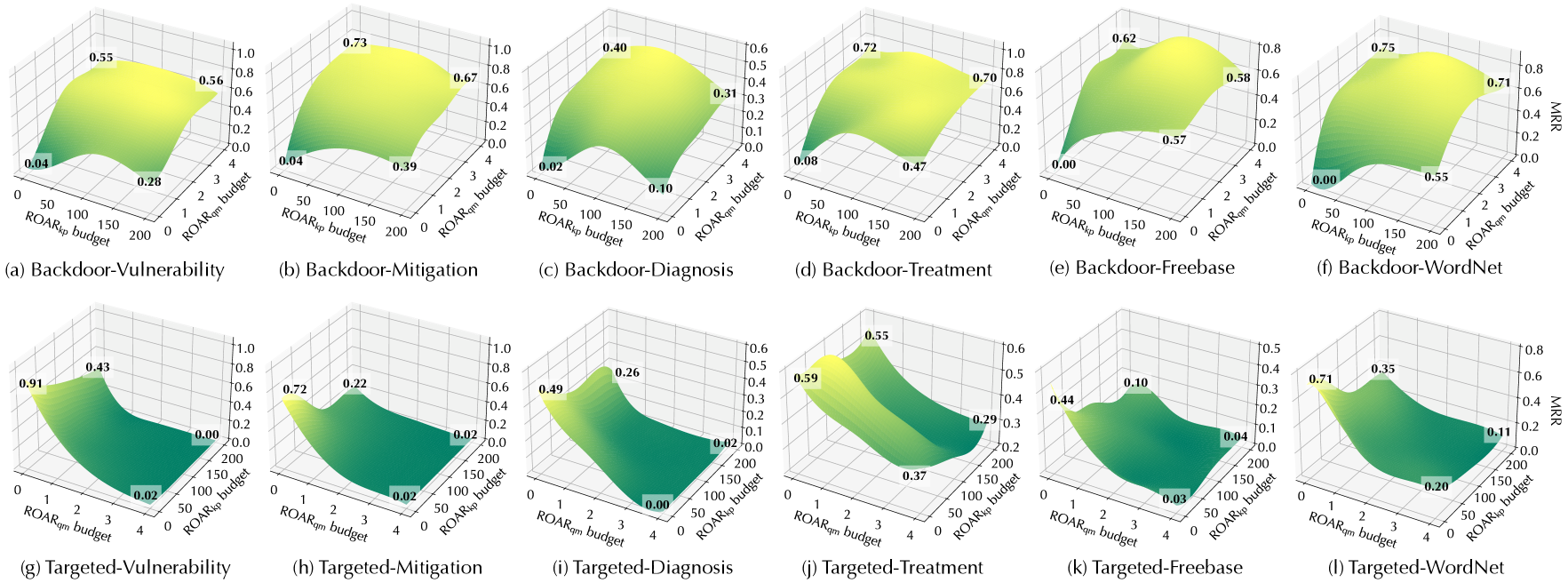
## Heatmaps: Backdoor Attack Performance under Different Budgets
### Overview
The image presents a series of six heatmaps, arranged in a 2x3 grid, visualizing the performance of different backdoor attack and defense strategies. Each heatmap represents a scenario, with the x and y axes representing "ROAR<sub>exp</sub> budget" and "ROAR<sub>att</sub> budget" respectively. The color intensity indicates the "MRR" (Mean Reciprocal Rank) score, ranging from 0.0 to 1.0, with warmer colors (green) indicating higher performance (higher MRR) and cooler colors (purple) indicating lower performance. Below the first row of heatmaps are six more, representing different targetted attacks.
### Components/Axes
* **X-axis:** ROAR<sub>att</sub> budget (ranging from 0 to 4, with markers at 0, 1, 2, 3, and 4).
* **Y-axis:** ROAR<sub>exp</sub> budget (ranging from 0 to 200, with markers at 0, 50, 100, 150, and 200).
* **Color Scale:** MRR (Mean Reciprocal Rank), ranging from 0.0 (purple) to 1.0 (green).
* **Heatmap Titles:**
* (a) Backdoor-Vulnerability
* (b) Backdoor-Mitigation
* (c) Backdoor-Diagnosis
* (d) Backdoor-Treatment
* (e) Backdoor-Freebase
* (f) Backdoor-WordNet
* (g) Targetted-Vulnerability
* (h) Targetted-Mitigation
* (i) Targetted-Diagnosis
* (j) Targetted-Treatment
* (k) Targetted-Freebase
* (l) Targetted-WordNet
### Detailed Analysis or Content Details
**Row 1:**
* **(a) Backdoor-Vulnerability:** The heatmap shows a generally increasing MRR with increasing ROAR<sub>exp</sub> budget. The highest MRR (~0.73) is located at ROAR<sub>exp</sub> budget = 4 and ROAR<sub>att</sub> budget = 0. A low MRR (~0.04) is observed at ROAR<sub>exp</sub> budget = 0 and ROAR<sub>att</sub> budget = 0.
* **(b) Backdoor-Mitigation:** The MRR is relatively low across the board, with a peak of ~0.67 at ROAR<sub>exp</sub> budget = 4 and ROAR<sub>att</sub> budget = 0. The lowest MRR (~0.04) is at ROAR<sub>exp</sub> budget = 0 and ROAR<sub>att</sub> budget = 0.
* **(c) Backdoor-Diagnosis:** The MRR is generally low, with a peak of ~0.40 at ROAR<sub>exp</sub> budget = 4 and ROAR<sub>att</sub> budget = 0. The lowest MRR (~0.02) is at ROAR<sub>exp</sub> budget = 0 and ROAR<sub>att</sub> budget = 0.
* **(d) Backdoor-Treatment:** The MRR increases with increasing ROAR<sub>exp</sub> budget, peaking at ~0.72 at ROAR<sub>exp</sub> budget = 4 and ROAR<sub>att</sub> budget = 0. The lowest MRR (~0.08) is at ROAR<sub>exp</sub> budget = 0 and ROAR<sub>att</sub> budget = 0.
* **(e) Backdoor-Freebase:** The MRR is relatively high, peaking at ~0.62 at ROAR<sub>exp</sub> budget = 4 and ROAR<sub>att</sub> budget = 0. The lowest MRR (~0.00) is at ROAR<sub>exp</sub> budget = 0 and ROAR<sub>att</sub> budget = 0.
* **(f) Backdoor-WordNet:** The MRR is relatively high, peaking at ~0.75 at ROAR<sub>exp</sub> budget = 4 and ROAR<sub>att</sub> budget = 0. The lowest MRR (~0.55) is at ROAR<sub>exp</sub> budget = 0 and ROAR<sub>att</sub> budget = 0.
**Row 2:**
* **(g) Targetted-Vulnerability:** The MRR is relatively high, peaking at ~0.91 at ROAR<sub>exp</sub> budget = 0 and ROAR<sub>att</sub> budget = 0. The lowest MRR (~0.22) is at ROAR<sub>exp</sub> budget = 200 and ROAR<sub>att</sub> budget = 4.
* **(h) Targetted-Mitigation:** The MRR is relatively low, peaking at ~0.43 at ROAR<sub>exp</sub> budget = 0 and ROAR<sub>att</sub> budget = 0. The lowest MRR (~0.10) is at ROAR<sub>exp</sub> budget = 200 and ROAR<sub>att</sub> budget = 4.
* **(i) Targetted-Diagnosis:** The MRR is relatively low, peaking at ~0.69 at ROAR<sub>exp</sub> budget = 0 and ROAR<sub>att</sub> budget = 0. The lowest MRR (~0.26) is at ROAR<sub>exp</sub> budget = 200 and ROAR<sub>att</sub> budget = 4.
* **(j) Targetted-Treatment:** The MRR is relatively low, peaking at ~0.53 at ROAR<sub>exp</sub> budget = 0 and ROAR<sub>att</sub> budget = 0. The lowest MRR (~0.44) is at ROAR<sub>exp</sub> budget = 200 and ROAR<sub>att</sub> budget = 4.
* **(k) Targetted-Freebase:** The MRR is relatively low, peaking at ~0.39 at ROAR<sub>exp</sub> budget = 0 and ROAR<sub>att</sub> budget = 0. The lowest MRR (~0.10) is at ROAR<sub>exp</sub> budget = 200 and ROAR<sub>att</sub> budget = 4.
* **(l) Targetted-WordNet:** The MRR is relatively low, peaking at ~0.71 at ROAR<sub>exp</sub> budget = 0 and ROAR<sub>att</sub> budget = 0. The lowest MRR (~0.35) is at ROAR<sub>exp</sub> budget = 200 and ROAR<sub>att</sub> budget = 4.
### Key Observations
* For the "Backdoor" series, increasing the ROAR<sub>exp</sub> budget generally improves MRR, suggesting that more exploration helps.
* The "Targetted" series generally shows higher MRR values at lower budgets, and a decrease in MRR as budgets increase.
* "Backdoor-WordNet" and "Targetted-WordNet" consistently show higher MRR values compared to other strategies.
* "Backdoor-Mitigation", "Backdoor-Diagnosis", and "Backdoor-Treatment" have relatively low MRR values across all budget combinations.
### Interpretation
The heatmaps demonstrate the effectiveness of different backdoor attack and defense strategies under varying resource constraints (ROAR<sub>exp</sub> and ROAR<sub>att</sub> budgets). The MRR score serves as a proxy for the success of the attack or defense.
The positive correlation between ROAR<sub>exp</sub> budget and MRR in the "Backdoor" series suggests that increased exploration of the model's vulnerabilities leads to more successful attacks. Conversely, the negative correlation in the "Targetted" series indicates that focused attacks may become less effective as more resources are allocated to both exploration and attack.
The consistently high performance of "WordNet" strategies suggests that this approach is particularly robust or effective in exploiting/mitigating backdoor vulnerabilities. The lower performance of "Mitigation" and "Diagnosis" strategies indicates that these defenses may be less effective in practice, or require significantly more resources to achieve comparable results.
The differences between the "Backdoor" and "Targetted" series highlight the importance of considering the attack strategy when evaluating defense mechanisms. A defense that is effective against general backdoor attacks may not be as effective against targeted attacks, and vice versa. The data suggests a trade-off between exploration and attack budgets, and the optimal strategy may depend on the specific context and available resources.
DECODING INTELLIGENCE...