## Mathematical Problem and Solution
### Overview
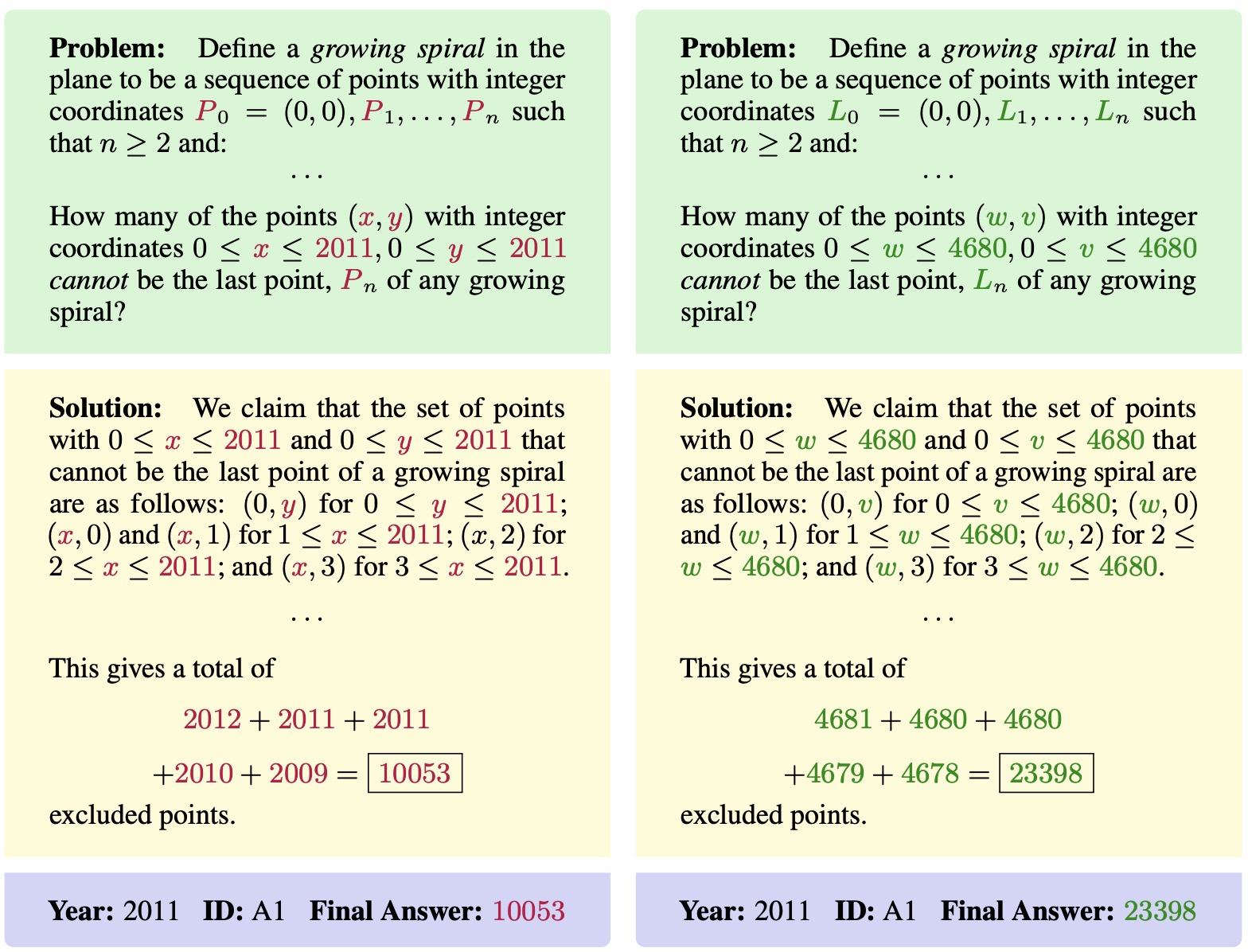
The image presents two similar mathematical problems and their solutions, side by side. Both problems involve defining a growing spiral in a plane and determining the number of points with integer coordinates that cannot be the last point of any growing spiral, given certain constraints. The left problem uses variables x and y with a maximum coordinate of 2011, while the right problem uses variables w and v with a maximum coordinate of 4680.
### Components/Axes
**Left Problem:**
* **Problem Statement:** Defines a growing spiral as a sequence of points P0, P1, ..., Pn with integer coordinates, where n ≥ 2. Asks how many points (x, y) with 0 ≤ x ≤ 2011 and 0 ≤ y ≤ 2011 cannot be the last point Pn of any growing spiral.
* **Solution:** Claims that the set of points with 0 ≤ x ≤ 2011 and 0 ≤ y ≤ 2011 that cannot be the last point of a growing spiral are: (0, y) for 0 ≤ y ≤ 2011; (x, 0) and (x, 1) for 1 ≤ x ≤ 2011; (x, 2) for 2 ≤ x ≤ 2011; and (x, 3) for 3 ≤ x ≤ 2011.
* **Calculation:** 2012 + 2011 + 2011 + 2010 + 2009 = 10053
* **Final Answer:** Year: 2011, ID: A1, Final Answer: 10053
**Right Problem:**
* **Problem Statement:** Defines a growing spiral as a sequence of points L0, L1, ..., Ln with integer coordinates, where n ≥ 2. Asks how many points (w, v) with 0 ≤ w ≤ 4680 and 0 ≤ v ≤ 4680 cannot be the last point Ln of any growing spiral.
* **Solution:** Claims that the set of points with 0 ≤ w ≤ 4680 and 0 ≤ v ≤ 4680 that cannot be the last point of a growing spiral are: (0, v) for 0 ≤ v ≤ 4680; (w, 0) and (w, 1) for 1 ≤ w ≤ 4680; (w, 2) for 2 ≤ w ≤ 4680; and (w, 3) for 3 ≤ w ≤ 4680.
* **Calculation:** 4681 + 4680 + 4680 + 4679 + 4678 = 23398
* **Final Answer:** Year: 2011, ID: A1, Final Answer: 23398
### Detailed Analysis or ### Content Details
**Left Problem:**
* The problem defines a growing spiral and asks for the number of points that cannot be the last point of such a spiral within the given coordinate constraints.
* The solution identifies specific sets of points: (0, y), (x, 0), (x, 1), (x, 2), and (x, 3) within the range 0 to 2011 for x and y.
* The calculation sums the number of points in each set: 2012 (for (0, y)) + 2011 (for (x, 0)) + 2011 (for (x, 1)) + 2010 (for (x, 2)) + 2009 (for (x, 3)).
* The final answer is 10053.
**Right Problem:**
* The problem is analogous to the left problem but with different coordinate constraints (0 to 4680 for w and v).
* The solution identifies similar sets of points: (0, v), (w, 0), (w, 1), (w, 2), and (w, 3) within the range 0 to 4680 for w and v.
* The calculation sums the number of points in each set: 4681 (for (0, v)) + 4680 (for (w, 0)) + 4680 (for (w, 1)) + 4679 (for (w, 2)) + 4678 (for (w, 3)).
* The final answer is 23398.
### Key Observations
* Both problems follow the same structure and logic.
* The only difference is the coordinate range, which affects the number of points in each set and the final answer.
* The solutions identify specific sets of points that cannot be the last point of a growing spiral.
* The calculations correctly sum the number of points in each set to arrive at the final answer.
### Interpretation
The problems demonstrate a method for determining the number of points that cannot be the last point of a growing spiral within a given coordinate range. The solutions identify specific sets of points that satisfy this condition and provide a clear calculation to arrive at the final answer. The similarity between the two problems highlights the generalizability of the method, with the coordinate range being the only variable that changes. The problems likely relate to a specific mathematical concept or theorem regarding growing spirals and their properties.