## Mathematical Problem Set: Growing Spirals
### Overview
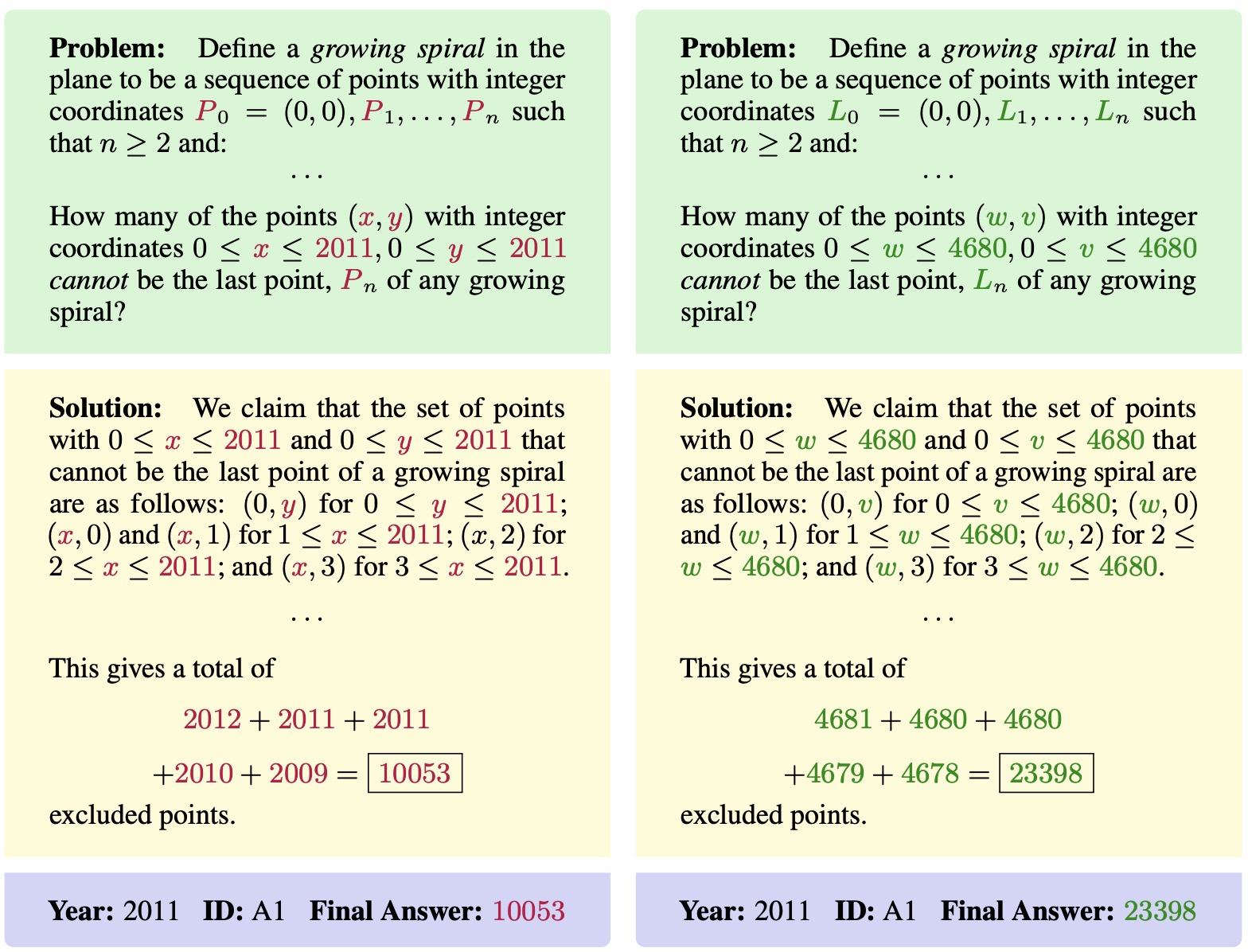
The image displays two parallel mathematical problem statements and their corresponding solutions, presented in a side-by-side, two-column format. The left column uses red text for key variables and numbers, while the right column uses green text. Both problems are about defining a "growing spiral" and counting points within a specified integer grid that cannot be the last point of such a spiral. The layout is structured with distinct colored background sections for the problem, solution, and final answer.
### Components/Layout
The image is divided into two primary vertical columns of equal width.
**Left Column (Red Theme):**
* **Top Section (Light Green Background):** Contains the problem statement.
* **Middle Section (Light Yellow Background):** Contains the solution.
* **Bottom Section (Light Purple Background):** Contains the year, ID, and final answer.
**Right Column (Green Theme):**
* **Top Section (Light Green Background):** Contains a parallel problem statement.
* **Middle Section (Light Yellow Background):** Contains the corresponding solution.
* **Bottom Section (Light Purple Background):** Contains the year, ID, and final answer.
**Common Elements:**
* Ellipses (`...`) are used in both the problem and solution sections, indicating omitted intermediate steps or definitions.
* The final numerical answer in each solution is enclosed in a box.
### Detailed Analysis / Content Details
#### **Left Column (Red Text Elements)**
**Problem Statement:**
* **Text:** "Problem: Define a *growing spiral* in the plane to be a sequence of points with integer coordinates `P₀ = (0, 0), P₁, ..., Pₙ` such that `n ≥ 2` and: `...`"
* **Question:** "How many of the points `(x, y)` with integer coordinates `0 ≤ x ≤ 2011, 0 ≤ y ≤ 2011` *cannot* be the last point, `Pₙ` of any growing spiral?"
**Solution:**
* **Claim:** "We claim that the set of points with `0 ≤ x ≤ 2011` and `0 ≤ y ≤ 2011` that cannot be the last point of a growing spiral are as follows:"
* `(0, y)` for `0 ≤ y ≤ 2011`;
* `(x, 0)` and `(x, 1)` for `1 ≤ x ≤ 2011`;
* `(x, 2)` for `2 ≤ x ≤ 2011`; and
* `(x, 3)` for `3 ≤ x ≤ 2011`.
* **Calculation:** "This gives a total of `2012 + 2011 + 2011 + 2010 + 2009 = 10053` excluded points."
**Footer:**
* **Text:** "Year: 2011 ID: A1 Final Answer: 10053"
#### **Right Column (Green Text Elements)**
**Problem Statement:**
* **Text:** "Problem: Define a *growing spiral* in the plane to be a sequence of points with integer coordinates `L₀ = (0, 0), L₁, ..., Lₙ` such that `n ≥ 2` and: `...`"
* **Question:** "How many of the points `(w, v)` with integer coordinates `0 ≤ w ≤ 4680, 0 ≤ v ≤ 4680` *cannot* be the last point, `Lₙ` of any growing spiral?"
**Solution:**
* **Claim:** "We claim that the set of points with `0 ≤ w ≤ 4680` and `0 ≤ v ≤ 4680` that cannot be the last point of a growing spiral are as follows:"
* `(0, v)` for `0 ≤ v ≤ 4680`;
* `(w, 0)` and `(w, 1)` for `1 ≤ w ≤ 4680`;
* `(w, 2)` for `2 ≤ w ≤ 4680`; and
* `(w, 3)` for `3 ≤ w ≤ 4680`.
* **Calculation:** "This gives a total of `4681 + 4680 + 4680 + 4679 + 4678 = 23398` excluded points."
**Footer:**
* **Text:** "Year: 2011 ID: A1 Final Answer: 23398"
### Key Observations
1. **Parallel Structure:** The two columns present identical problem structures with different numerical parameters (2011 vs. 4680) and variable names (`P` vs. `L`, `x,y` vs. `w,v`).
2. **Color Coding:** Red and green text are used consistently to differentiate the two problem instances, likely for visual comparison or to denote variants.
3. **Pattern in Excluded Points:** The solution for both problems identifies the same pattern of excluded points: the entire y-axis (or v-axis), and the first four rows (y=0,1,2,3 or v=0,1,2,3) for positive x (or w) values.
4. **Arithmetic Progression:** The totals are sums of five consecutive integers. For the left column: 2012, 2011, 2011, 2010, 2009. For the right column: 4681, 4680, 4680, 4679, 4678.
### Interpretation
This image appears to be a comparative display of two solutions to a combinatorial geometry problem, likely from a mathematics competition (indicated by "Year: 2011 ID: A1"). The problem asks for the count of integer lattice points within a square that are invalid as endpoints of a specific type of path ("growing spiral").
The solutions demonstrate that the invalid points form a specific "L-shaped" region along the axes and the first few horizontal lines. The core mathematical insight is that the structure of a "growing spiral" imposes constraints that prevent it from ending at points very close to the origin or along the axes. The two examples show how the solution scales with the size of the grid (from 2011 to 4680), with the total count of excluded points increasing accordingly. The side-by-side presentation emphasizes the generalizable pattern of the solution, independent of the specific grid size parameter. The ellipses (`...`) suggest that the full definition of a "growing spiral" (which likely involves conditions on step lengths or directions) is provided elsewhere, and the focus here is on the counting argument and final result.