\n
## Technical Specification Diagram: Task Assignment System Formalization
### Overview
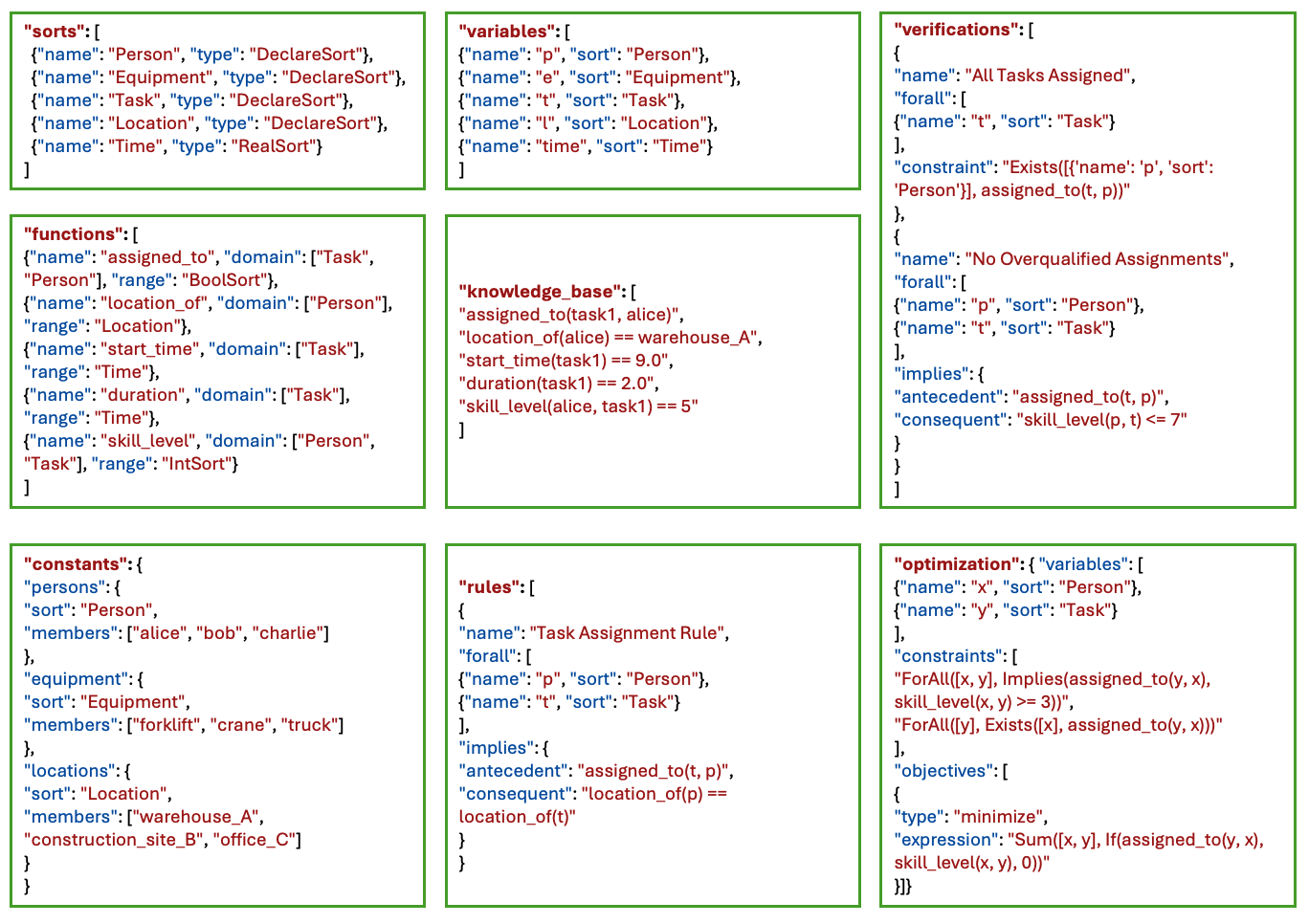
The image displays a structured, formal specification for a task assignment system, presented as nine distinct green-bordered rectangular panels arranged in a 3x3 grid. Each panel contains a JSON-like data structure defining a specific component of the system's logic, including sorts, variables, functions, constants, a knowledge base, rules, verifications, and an optimization problem. The content is entirely textual and symbolic, representing a formal logic or constraint satisfaction model.
### Components/Axes
The image is segmented into nine independent panels, each with a clear title in quotes. The panels are organized as follows:
* **Top Row (Left to Right):** "sorts", "variables", "verifications" (part 1).
* **Middle Row (Left to Right):** "functions", "knowledge_base", "verifications" (part 2, continuing from top-right).
* **Bottom Row (Left to Right):** "constants", "rules", "optimization".
### Detailed Analysis / Content Details
Below is a precise transcription of the content within each panel.
**1. Top-Left Panel: "sorts"**
```json
"sorts": [
{"name": "Person", "type": "DeclareSort"},
{"name": "Equipment", "type": "DeclareSort"},
{"name": "Task", "type": "DeclareSort"},
{"name": "Location", "type": "DeclareSort"},
{"name": "Time", "type": "RealSort"}
]
```
* **Content:** Defines five fundamental data types (sorts) for the domain: Person, Equipment, Task, Location (all declared sorts), and Time (a real-number sort).
**2. Top-Middle Panel: "variables"**
```json
"variables": [
{"name": "p", "sort": "Person"},
{"name": "e", "sort": "Equipment"},
{"name": "t", "sort": "Task"},
{"name": "l", "sort": "Location"},
{"name": "time", "sort": "Time"}
]
```
* **Content:** Declares five variables (`p`, `e`, `t`, `l`, `time`) corresponding to the previously defined sorts.
**3. Top-Right & Middle-Right Panels: "verifications"**
This section spans two panels. The top-right panel begins the list, and the middle-right panel contains the second entry.
```json
"verifications": [
{
"name": "All Tasks Assigned",
"forall": [
{"name": "t", "sort": "Task"}
],
"constraint": "Exists([{'name': 'p', 'sort': 'Person'}], assigned_to(t, p))"
},
{
"name": "No Overqualified Assignments",
"forall": [
{"name": "p", "sort": "Person"},
{"name": "t", "sort": "Task"}
],
"implies": {
"antecedent": "assigned_to(t, p)",
"consequent": "skill_level(p, t) <= 7"
}
}
]
```
* **Content:** Defines two verification rules (constraints that must hold true).
1. **All Tasks Assigned:** For every task `t`, there must exist a person `p` such that `assigned_to(t, p)` is true.
2. **No Overqualified Assignments:** For any person `p` and task `t`, if `p` is assigned to `t`, then the `skill_level` of `p` for `t` must be less than or equal to 7.
**4. Middle-Left Panel: "functions"**
```json
"functions": [
{"name": "assigned_to", "domain": ["Task", "Person"], "range": "BoolSort"},
{"name": "location_of", "domain": ["Person"], "range": "Location"},
{"name": "start_time", "domain": ["Task"], "range": "Time"},
{"name": "duration", "domain": ["Task"], "range": "Time"},
{"name": "skill_level", "domain": ["Person", "Task"], "range": "IntSort"}
]
```
* **Content:** Defines five functions mapping inputs (domains) to outputs (ranges).
* `assigned_to(Task, Person)`: Returns a Boolean (true/false).
* `location_of(Person)`: Returns a Location.
* `start_time(Task)`: Returns a Time.
* `duration(Task)`: Returns a Time.
* `skill_level(Person, Task)`: Returns an Integer.
**5. Center Panel: "knowledge_base"**
```json
"knowledge_base": [
"assigned_to(task1, alice)",
"location_of(alice) == warehouse_A",
"start_time(task1) == 9.0",
"duration(task1) == 2.0",
"skill_level(alice, task1) == 5"
]
```
* **Content:** Lists specific, ground facts about the current state:
* Task `task1` is assigned to person `alice`.
* Alice is located at `warehouse_A`.
* Task `task1` starts at time `9.0`.
* Task `task1` has a duration of `2.0` time units.
* Alice's skill level for task `task1` is `5`.
**6. Bottom-Left Panel: "constants"**
```json
"constants": {
"persons": {
"sort": "Person",
"members": ["alice", "bob", "charlie"]
},
"equipment": {
"sort": "Equipment",
"members": ["forklift", "crane", "truck"]
},
"locations": {
"sort": "Location",
"members": ["warehouse_A", "construction_site_B", "office_C"]
}
}
```
* **Content:** Defines the specific instances (constants) for three sorts.
* **Persons:** alice, bob, charlie.
* **Equipment:** forklift, crane, truck.
* **Locations:** warehouse_A, construction_site_B, office_C.
**7. Bottom-Middle Panel: "rules"**
```json
"rules": [
{
"name": "Task Assignment Rule",
"forall": [
{"name": "p", "sort": "Person"},
{"name": "t", "sort": "Task"}
],
"implies": {
"antecedent": "assigned_to(t, p)",
"consequent": "location_of(p) == location_of(t)"
}
}
]
```
* **Content:** Defines a logical rule. For any person `p` and task `t`, if `p` is assigned to `t`, then the location of `p` must equal the location of `t`. This enforces a spatial constraint for assignments.
**8. Bottom-Right Panel: "optimization"**
```json
"optimization": {
"variables": [
{"name": "x", "sort": "Person"},
{"name": "y", "sort": "Task"}
],
"constraints": [
"ForAll([x, y], Implies(assigned_to(y, x), skill_level(x, y) >= 3))",
"ForAll([y], Exists([x], assigned_to(y, x)))"
],
"objectives": [
{
"type": "minimize",
"expression": "Sum([x, y], If(assigned_to(y, x), skill_level(x, y), 0))"
}
]
}
```
* **Content:** Defines an optimization problem.
* **Variables:** `x` (Person), `y` (Task).
* **Constraints:**
1. For all assignments, the person's skill level for the task must be at least 3.
2. Every task must be assigned to at least one person.
* **Objective:** Minimize the sum of skill levels for all assignments. The expression sums `skill_level(x, y)` for every pair `(x, y)` where `assigned_to(y, x)` is true, otherwise adding 0.
### Key Observations
1. **Formal Structure:** The specification uses a consistent, formal syntax resembling first-order logic and constraint programming.
2. **Interconnected Components:** The panels are not independent. The `sorts` and `constants` define the universe of discourse. The `functions` and `variables` operate within that universe. The `knowledge_base`, `rules`, and `verifications` define the system's state and constraints. The `optimization` panel builds upon all previous elements to define a goal.
3. **Specific Instance:** The `knowledge_base` provides a snapshot with concrete data (alice, task1, warehouse_A), while other panels define general rules and structures.
4. **Constraint Hierarchy:** There are multiple layers of constraints: basic verification rules (e.g., all tasks assigned), logical rules (e.g., location matching), and optimization constraints (e.g., minimum skill level of 3).
### Interpretation
This image represents a **formal model for a constrained task allocation problem**. It is likely used in fields like operations research, AI planning, or logistics software specification.
* **What it Demonstrates:** The model captures a real-world scenario where tasks must be assigned to qualified personnel at specific locations and times, subject to various business rules (skill matching, location proximity, no over-qualification). The inclusion of an optimization objective (minimizing total skill level used) suggests an aim for efficiency, perhaps to assign the most appropriately skilled (not over-skilled) workers to tasks.
* **Relationships Between Elements:** The `sorts` and `constants` establish the "vocabulary" of the domain. The `functions` define the "properties" and "relationships" between entities. The `knowledge_base` is a specific "fact sheet." The `rules` and `verifications` are the "laws" the system must obey. The `optimization` block is the "goal" the system should strive for when making assignments.
* **Notable Anomalies/Tensions:** There is a potential tension between the `verifications` rule "No Overqualified Assignments" (skill <= 7) and the `optimization` constraint requiring skill >= 3. This defines an acceptable skill range of [3, 7] for assignments. The optimization goal to *minimize* the sum of skill levels would push assignments towards the lower end of this range (skill level 3), which aligns with the business logic of using appropriately, not excessively, skilled labor.
* **Peircean Investigation:** The model is a **symbolic representation** (a sign) of a physical task assignment system. Its **interpretant** would be the software or algorithm that processes this specification to produce valid and optimal assignment schedules. The **object** it refers to is the real-world set of people, tasks, equipment, and locations. The specification's value lies in making the implicit rules of task assignment explicit, machine-readable, and optimizable.