## Configuration Data: Task Assignment Problem
### Overview
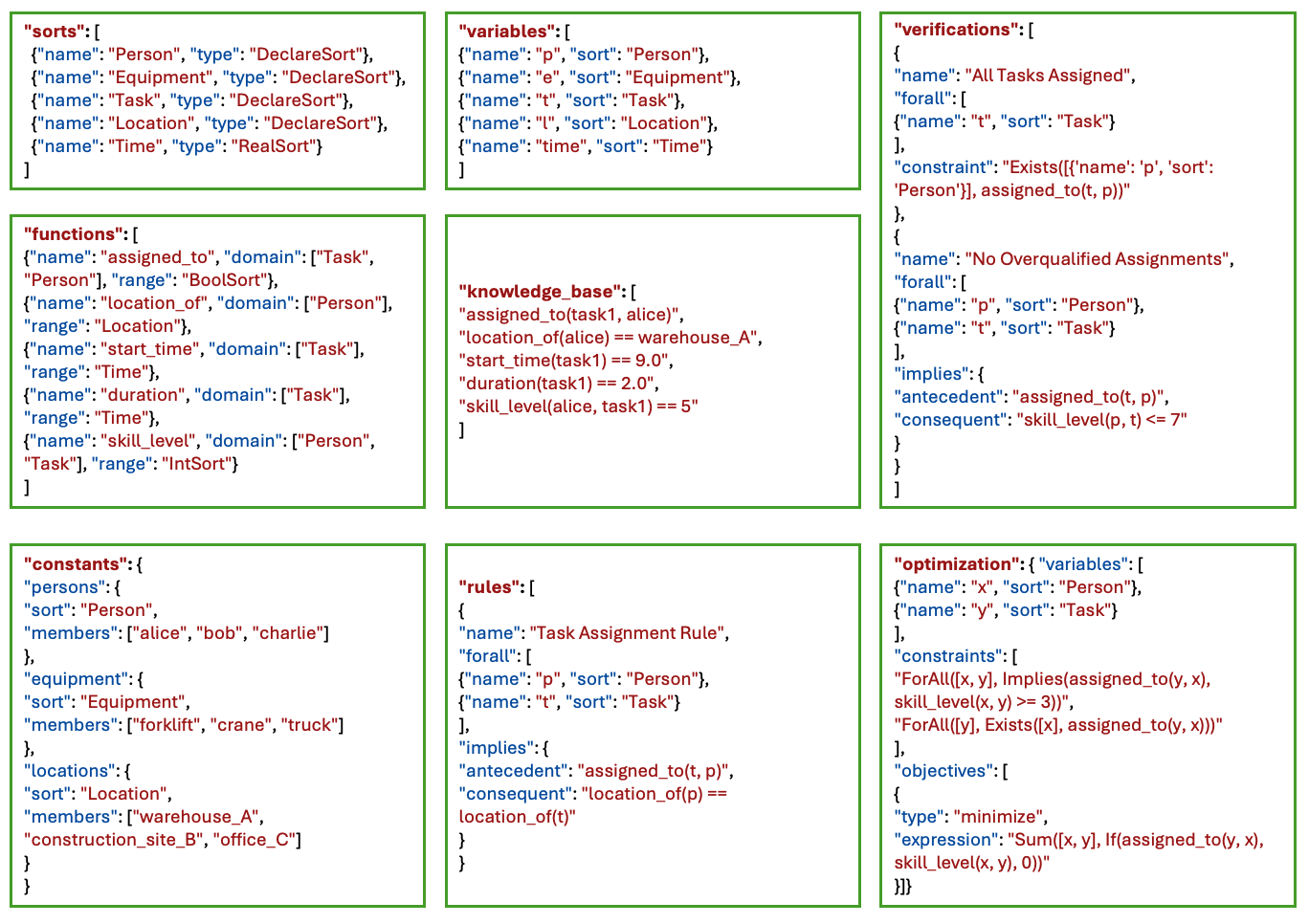
The image presents a configuration for a task assignment problem, likely for an automated planning or optimization system. It defines the sorts of objects, variables, functions, knowledge base, rules, constraints, and optimization objectives. The configuration is structured in a JSON-like format, with each section enclosed in a green border.
### Components/Axes
* **"sorts"**: Defines the types of objects in the problem.
* "Person": Type "DeclareSort"
* "Equipment": Type "DeclareSort"
* "Task": Type "DeclareSort"
* "Location": Type "DeclareSort"
* "Time": Type "RealSort"
* **"variables"**: Declares the variables used in the rules and constraints.
* "p": Sort "Person"
* "e": Sort "Equipment"
* "t": Sort "Task"
* "l": Sort "Location"
* "time": Sort "Time"
* **"functions"**: Defines the functions used to represent relationships and properties.
* "assigned\_to": Domain \["Task", "Person"], Range "BoolSort"
* "location\_of": Domain \["Person"], Range "Location"
* "start\_time": Domain \["Task"], Range "Time"
* "duration": Domain \["Task"], Range "Time"
* "skill\_level": Domain \["Person", "Task"], Range "IntSort"
* **"knowledge\_base"**: Contains specific facts and initial conditions.
* "assigned\_to(task1, alice)"
* "location\_of(alice) == warehouse\_A"
* "start\_time(task1) == 9.0"
* "duration(task1) == 2.0"
* "skill\_level(alice, task1) == 5"
* **"constants"**: Defines constant values for the problem.
* "persons": Sort "Person", Members \["alice", "bob", "charlie"]
* "equipment": Sort "Equipment", Members \["forklift", "crane", "truck"]
* "locations": Sort "Location", Members \["warehouse\_A", "construction\_site\_B", "office\_C"]
* **"rules"**: Defines logical rules for the task assignment.
* "Task Assignment Rule":
* "forall": \["p": "Person", "t": "Task"]
* "implies": If "assigned\_to(t, p)", then "location\_of(p) == location\_of(t)"
* **"verifications"**: Defines constraints to verify the solution.
* "All Tasks Assigned":
* "forall": \["t": "Task"]
* "constraint": Exists \["p": "Person"], "assigned\_to(t, p)"
* "No Overqualified Assignments":
* "forall": \["p": "Person", "t": "Task"]
* "implies": If "assigned\_to(t, p)", then "skill\_level(p, t) <= 7"
* **"optimization"**: Defines the optimization objective and constraints.
* "variables": \["x": "Person", "y": "Task"]
* "constraints":
* "ForAll(\[x, y], Implies(assigned\_to(y, x), skill\_level(x, y) >= 3))"
* "ForAll(\[y], Exists(\[x], assigned\_to(y, x)))"
* "objectives":
* "type": "minimize"
* "expression": "Sum(\[x, y], If(assigned\_to(y, x), skill\_level(x, y), 0))"
### Detailed Analysis or ### Content Details
The configuration defines a task assignment problem where people are assigned to tasks, equipment and locations are considered, and time constraints may exist. The knowledge base provides specific instances, such as "task1" being assigned to "alice," and their skill level. The rules enforce logical constraints, such as a person's location matching the task's location if assigned. The verifications ensure all tasks are assigned and no one is overqualified. The optimization aims to minimize the sum of skill levels for assigned tasks.
### Key Observations
* The configuration uses a declarative approach, defining the problem's components rather than specifying a solution algorithm.
* The "knowledge\_base" section provides specific instances, suggesting this configuration might be used for a particular scenario.
* The "optimization" section indicates that the goal is to find the best assignment based on skill levels.
### Interpretation
This configuration provides a structured representation of a task assignment problem. It is designed to be used by an automated system that can reason about the problem, apply the rules and constraints, and find an optimal solution. The configuration allows for defining various aspects of the problem, including the types of objects, their relationships, and the optimization goals. The level of detail suggests a complex problem with multiple constraints and objectives. The use of "DeclareSort" suggests that the system using this configuration supports type checking and validation.