## JSON Data Structure: Task Assignment Configuration
### Overview
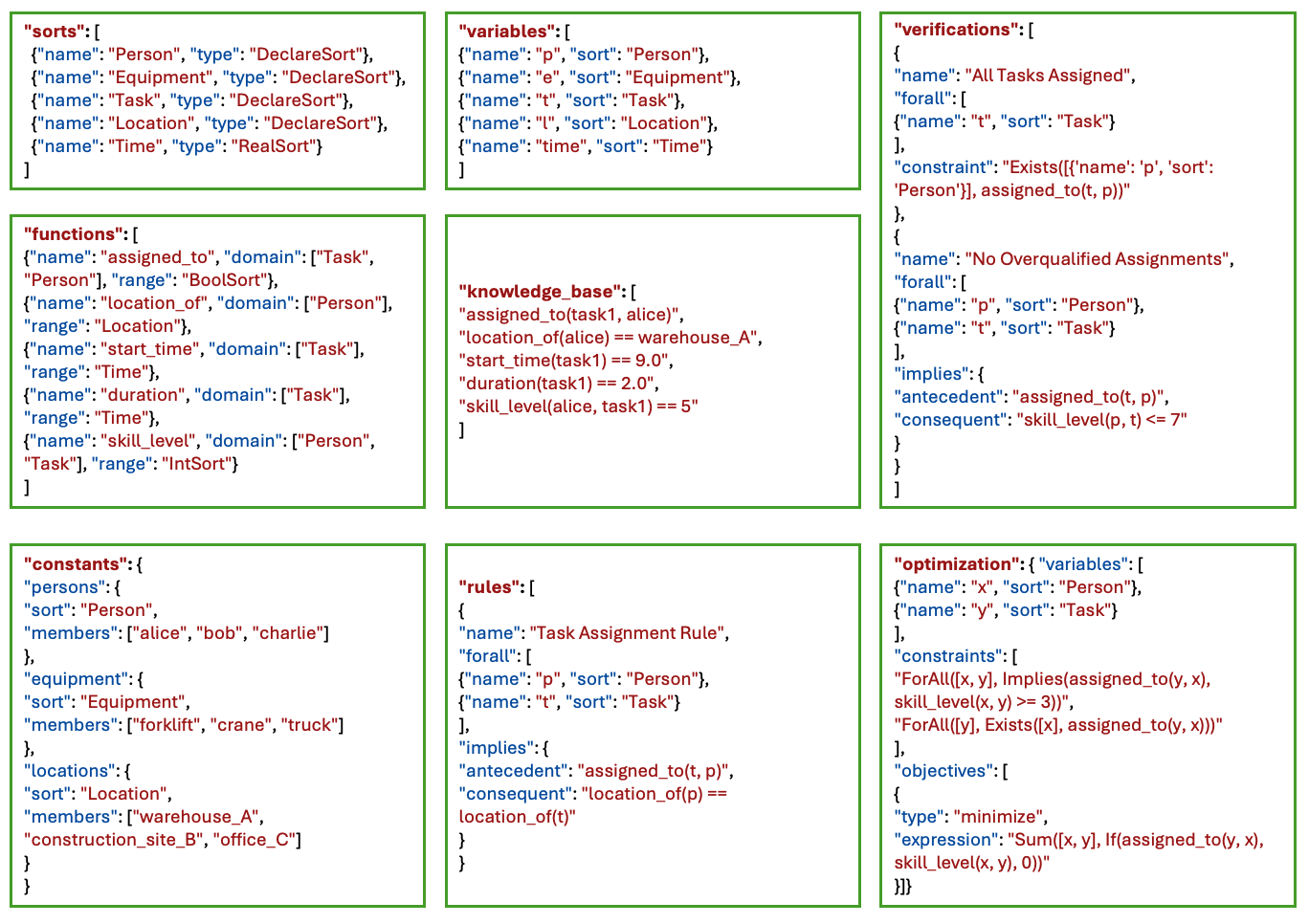
The image presents a structured JSON (JavaScript Object Notation) data configuration, likely for a task assignment or scheduling problem. The data is organized into several key sections: `sorts`, `variables`, `functions`, `knowledge_base`, `constants`, `rules`, and `optimization`. Each section defines specific elements used in a constraint satisfaction or optimization process. The layout is a grid of colored blocks, each representing a JSON object or array.
### Components/Axes
The image doesn't have traditional axes like a chart. Instead, it's a visual representation of a JSON structure. The main components are:
* **`sorts`**: Defines the types of objects involved (Person, Equipment, Task, Location, Time).
* **`variables`**: Defines the variables used in the problem, their types, and their associated sorts.
* **`functions`**: Defines functions that map between sorts.
* **`knowledge_base`**: Contains initial facts or assertions about the problem.
* **`constants`**: Defines specific instances of sorts (e.g., specific people, equipment, locations).
* **`rules`**: Defines logical rules that govern the assignment process.
* **`optimization`**: Defines the objective function to be optimized.
* **`verifications`**: Defines constraints that must be satisfied.
The blocks are arranged in a 3x3 grid.
### Detailed Analysis or Content Details
Here's a detailed transcription of the JSON data, section by section:
**1. `sorts` (Top-Left, Green)**
```json
[
{"name": "Person", "type": "DeclareSort"},
{"name": "Equipment", "type": "DeclareSort"},
{"name": "Task", "type": "DeclareSort"},
{"name": "Location", "type": "DeclareSort"},
{"name": "Time", "type": "RealSort"}
]
```
**2. `variables` (Top-Center, Yellow)**
```json
[
{"name": "p", "sort": "Person"},
{"name": "e", "sort": "Equipment"},
{"name": "t", "sort": "Task"},
{"name": "l", "sort": "Location"},
{"name": "time", "sort": "Time"}
]
```
**3. `verifications` (Top-Right, Light Blue)**
```json
{
"name": "All Tasks Assigned",
"forall": [
{"name": "t", "sort": "Task"}
],
"constraint": "Exists([{\"name\": \"p\", \"sort\": \"Person\"}], assigned_to(t, p))"
},
{
"name": "No Overqualified Assignments",
"forall": [
{"name": "p", "sort": "Person"},
{"name": "t", "sort": "Task"}
],
"implies": {
"antecedent": "assigned_to(t, p)",
"consequent": "skill_level(p) <= 7"
}
}
```
**4. `functions` (Middle-Left, Green)**
```json
[
{"name": "assigned_to", "domain": ["Task", "Person"], "range": "BoolSort"},
{"name": "location_of", "domain": ["Person"], "range": "Location"},
{"name": "start_time", "domain": ["Task"], "range": "Time"},
{"name": "duration", "domain": ["Task"], "range": "Time"},
{"name": "skill_level", "domain": ["Person"], "range": "IntSort"}
]
```
**5. `knowledge_base` (Middle-Center, Yellow)**
```json
{
"assigned_to(task1, alice)",
"location_of(alice) == warehouse_A",
"start_time(task1) == 9.0",
"duration(task1) == 2.0",
"skill_level(alice, task1) == 5"
}
```
**6. `optimization` (Middle-Right, Light Blue)**
```json
{
"variables": [
{"name": "y", "sort": "Person"},
{"name": "x", "sort": "Task"}
],
"constraints": [
"ForAll(x, y), implies(assigned_to(x, y), skill_level(y, x) <= 3)"
],
"cost": "skill_level(y, x)"
}
```
**7. `constants` (Bottom-Left, Green)**
```json
{
"persons": {
"sort": "Person",
"members": ["alice", "bob", "charlie"]
},
"equipment": {
"sort": "Equipment",
"members": ["forklift", "crane", "truck"]
},
"locations": {
"sort": "Location",
"members": ["warehouse_A", "warehouse_B", "yard"]
},
"tasks": {
"sort": "Task",
"members": ["task1", "task2", "task3"]
}
}
```
**8. `rules` (Bottom-Center, Yellow)**
```json
{
"name": "Task Assignment Rule",
"forall": [
{"name": "p", "sort": "Person"},
{"name": "t", "sort": "Task"}
],
"implies": {
"antecedent": "skill_level(p, t) >= 5",
"consequent": "assigned_to(t, p)"
}
}
```
**9. `verifications` (Bottom-Right, Light Blue)**
```json
[
{"name": "Time Constraint", "constraint": "time >= 0"}
]
```
### Key Observations
* The data defines a task assignment problem with constraints on skill levels and task assignments.
* The `knowledge_base` provides an initial assignment (task1 to alice) and associated data.
* The `optimization` section suggests an attempt to minimize the skill level required for a task.
* The `rules` section defines a simple rule: if a person has a skill level of 5 or greater for a task, they are assigned to it.
* The `verifications` section ensures all tasks are assigned and that no one is overqualified.
### Interpretation
This JSON configuration represents a simplified task assignment problem. The goal is to assign tasks to people based on their skill levels, while adhering to certain constraints. The `optimization` section suggests a desire to assign tasks to individuals with the *lowest* necessary skill level, potentially to maximize resource utilization or minimize training costs. The `rules` and `verifications` sections define the logic and constraints that govern the assignment process. The `knowledge_base` provides a starting point for the assignment, and the overall structure suggests a system designed to find an optimal or feasible solution to the task assignment problem. The use of `DeclareSort` indicates a formal specification language is being used, likely for automated reasoning or constraint solving. The data is well-structured and appears to be designed for programmatic processing.