# Technical Document: Diagram Analysis
## Diagram Structure Overview
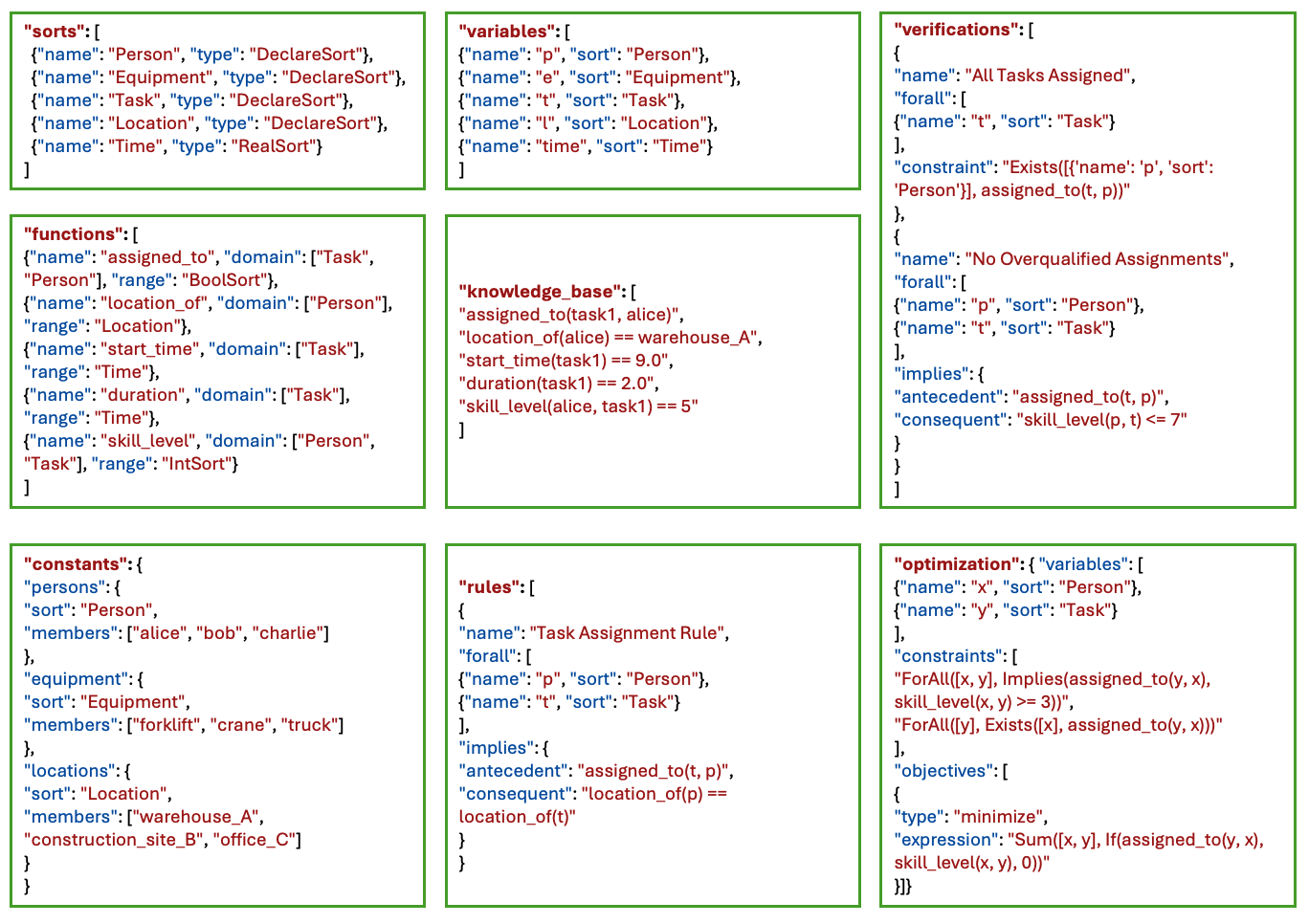
The image represents a structured data model using a domain-specific language (likely Datalog or similar logic programming syntax). It contains seven primary sections with nested hierarchical data:
---
### 1. `sorts` Section
```json
{
"sorts": [
{"name": "Person", "type": "DeclareSort"},
{"name": "Equipment", "type": "DeclareSort"},
{"name": "Task", "type": "DeclareSort"},
{"name": "Location", "type": "DeclareSort"},
{"name": "Time", "type": "RealSort"}
]
}
```
### 2. `variables` Section
```json
{
"variables": [
{"name": "p", "sort": "Person"},
{"name": "e", "sort": "Equipment"},
{"name": "t", "sort": "Task"},
{"name": "l", "sort": "Location"},
{"name": "time", "sort": "Time"}
]
}
```
### 3. `functions` Section
```json
{
"functions": [
{"name": "assigned_to", "domain": ["Task", "Person"], "range": "BoolSort"},
{"name": "location_of", "domain": ["Person"], "range": "Location"},
{"name": "start_time", "domain": ["Task"], "range": "Time"},
{"name": "duration", "domain": ["Task"], "range": "Time"},
{"name": "skill_level", "domain": ["Person", "Task"], "range": "IntSort"}
]
}
```
### 4. `knowledge_base` Section
```json
{
"knowledge_base": [
"assigned_to(task1, alice)",
"location_of(alice) == warehouse_A",
"start_time(task1) == 9.0",
"duration(task1) == 2.0",
"skill_level(alice, task1) == 5"
]
}
```
### 5. `verifications` Section
```json
{
"verifications": [
{
"name": "All Tasks Assigned",
"forall": [{"name": "t", "sort": "Task"}],
"constraint": "Exists([{'name': 'p', 'sort': 'Person'}], assigned_to(t, p))"
},
{
"name": "No Overqualified Assignments",
"forall": [{"name": "p", "sort": "Person"}],
"implies": {
"antecedent": "assigned_to(t, p)",
"consequent": "skill_level(p, t) <= 7"
}
}
]
}
```
### 6. `constants` Section
```json
{
"constants": {
"persons": {
"sort": "Person",
"members": ["alice", "bob", "charlie"]
},
"equipment": {
"sort": "Equipment",
"members": ["forklift", "crane", "truck"]
},
"locations": {
"sort": "Location",
"members": ["warehouse_A", "construction_site_B", "office_C"]
}
}
}
```
### 7. `rules` Section
```json
{
"rules": [
{
"name": "Task Assignment Rule",
"forall": [
{"name": "p", "sort": "Person"},
{"name": "t", "sort": "Task"}
],
"implies": {
"antecedent": "assigned_to(t, p)",
"consequent": "location_of(p) == location_of(t)"
}
}
]
}
```
### 8. `optimization` Section
```json
{
"optimization": {
"variables": [
{"name": "x", "sort": "Person"},
{"name": "y", "sort": "Task"}
],
"constraints": [
{
"name": "Minimum Skill Requirement",
"forall": [{"x", "Person"}, {"y", "Task"}],
"implies": [
"assigned_to(y, x)",
"skill_level(x, y) >= 3"
]
},
{
"name": "Task Coverage",
"forall": [{"y", "Task"}],
"exists": [{"x", "Person"}],
"implies": "assigned_to(y, x)"
}
],
"objectives": [
{
"name": "Minimize Skill Utilization",
"type": "minimize",
"expression": "Sum([x, y], If(assigned_to(y, x), skill_level(x, y), 0))"
}
]
}
}
```
---
## Key Observations
1. **Domain Modeling**: The diagram defines a task assignment system with entities (Persons, Tasks, Locations) and relationships (assignment, location constraints).
2. **Temporal Constraints**: Time is modeled as a real-valued sort with start/end times for tasks.
3. **Skill Management**: Skill levels are integer-valued and constrained to prevent overqualification.
4. **Optimization Objective**: The system aims to minimize total skill utilization while ensuring all tasks are assigned to qualified personnel.
## Technical Notes
- All data types follow a `DeclareSort` pattern for type safety.
- Temporal relationships use real-valued time measurements.
- Location constraints enforce spatial consistency between assigned persons and tasks.
- The optimization problem combines hard constraints with a soft objective function.
This structured representation enables formal verification of task assignment policies and automated optimization of resource allocation.