## Diagram: Knowledge Distillation Architecture
### Overview
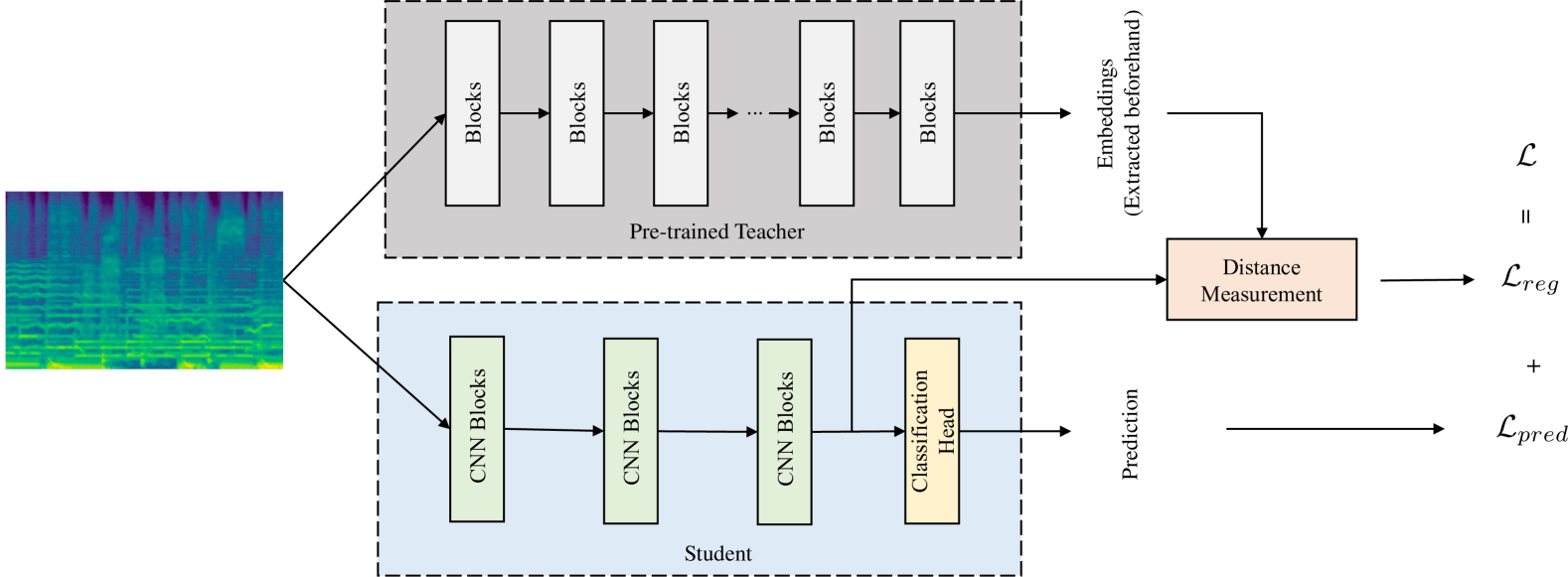
The diagram illustrates a knowledge distillation framework where a pre-trained teacher model transfers knowledge to a student model. The architecture includes multiple processing blocks, embedding extraction, distance measurement, and loss functions. Input data flows through both models, with the student learning from the teacher's intermediate representations.
### Components/Axes
1. **Input Data**: A spectrogram-like visualization (left side) representing raw data.
2. **Pre-trained Teacher**:
- Multiple "Blocks" (gray rectangles) connected sequentially.
- Outputs "Embeddings (Extracted beforehand)".
3. **Student Model**:
- Four "CNN Blocks" (light green rectangles) connected sequentially.
- Final "Classification Head" (orange rectangle) for prediction.
4. **Distance Measurement**: A component (peach rectangle) comparing teacher embeddings to student predictions.
5. **Loss Functions**:
- Regularization loss (`L_reg`) from distance measurement.
- Prediction loss (`L_pred`) from the student's classification head.
- Total loss: `L = L_reg + L_pred`.
### Detailed Analysis
- **Teacher Model**:
- Processes input through multiple blocks to generate embeddings.
- Embeddings are extracted before the final block (as noted in parentheses).
- **Student Model**:
- Uses CNN blocks for feature extraction.
- Final classification head produces predictions.
- **Knowledge Transfer**:
- Distance measurement quantifies similarity between teacher embeddings and student predictions.
- Regularization loss (`L_reg`) enforces alignment between teacher and student representations.
- Prediction loss (`L_pred`) ensures the student learns the final task.
### Key Observations
1. **Architecture Complexity**:
- Teacher model has more blocks than the student, suggesting a larger capacity.
- Student model uses CNN blocks, indicating convolutional feature learning.
2. **Embedding Alignment**:
- Teacher embeddings are used as a target for the student's intermediate representations.
3. **Loss Function Design**:
- Combined loss (`L = L_reg + L_pred`) balances representation learning and task performance.
4. **Flow Direction**:
- Input → Teacher Blocks → Embeddings → Distance Measurement → Loss.
- Input → Student CNN Blocks → Classification Head → Prediction → Loss.
### Interpretation
This architecture demonstrates a standard knowledge distillation setup where:
- The **teacher model** acts as a knowledge source, providing high-quality intermediate representations (embeddings).
- The **student model** learns to mimic both the teacher's embeddings (via regularization loss) and the final task predictions (via prediction loss).
- The **distance measurement** module is critical for quantifying the gap between teacher and student representations, guiding the distillation process.
- The use of **CNN blocks** in the student suggests a focus on spatial feature learning, while the teacher's generic "Blocks" may represent transformer or other architectures.
The diagram emphasizes the importance of intermediate representation alignment in transfer learning, ensuring the student retains the teacher's learned features while adapting to the target task.