## Line Chart: Model Performance Comparison
### Overview
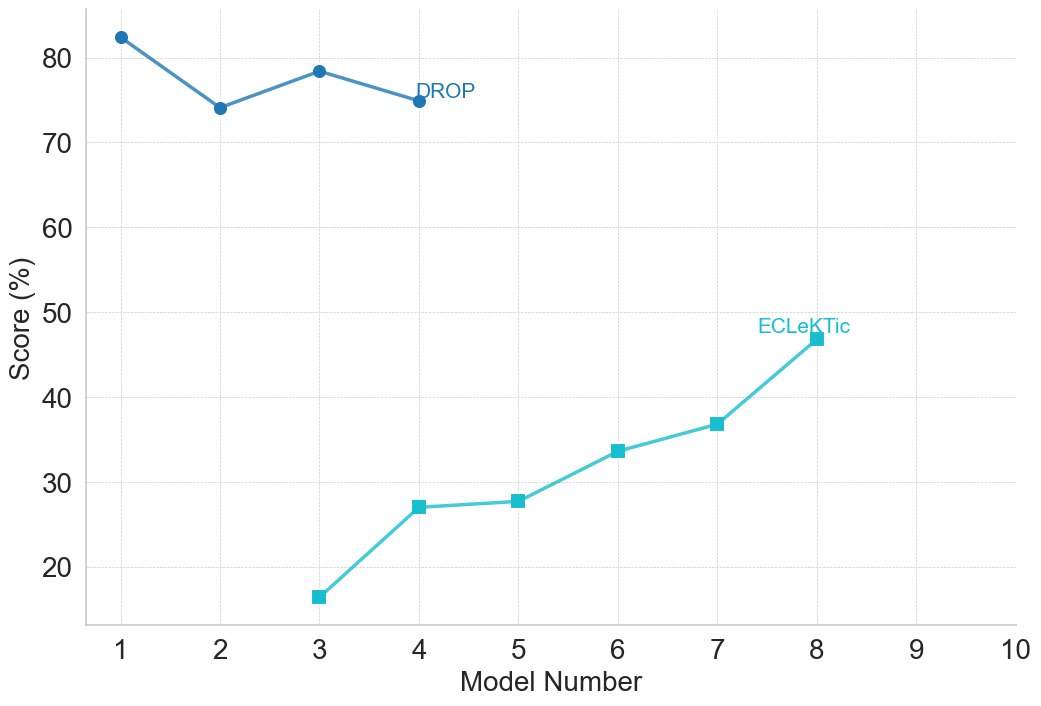
The image is a line chart comparing the performance of two models, "DROP" and "ECLEKTic", across different model numbers (presumably iterations or variations). The y-axis represents the score in percentage, and the x-axis represents the model number.
### Components/Axes
* **X-axis:** "Model Number", ranging from 1 to 10.
* **Y-axis:** "Score (%)", ranging from 20 to 80, with gridlines at intervals of 10.
* **Data Series 1:** "DROP" (represented by a blue line with circular markers).
* **Data Series 2:** "ECLEKTic" (represented by a teal line with square markers).
### Detailed Analysis
* **DROP:**
* Model 1: Score approximately 82%.
* Model 2: Score approximately 74%.
* Model 4: Score approximately 78%.
* Model 5: Score approximately 75%.
* Trend: The DROP model's performance starts high, decreases slightly, increases again, and then decreases slightly again.
* **ECLEKTic:**
* Model 3: Score approximately 16%.
* Model 4: Score approximately 27%.
* Model 5: Score approximately 28%.
* Model 6: Score approximately 34%.
* Model 7: Score approximately 37%.
* Model 8: Score approximately 46%.
* Trend: The ECLEKTic model's performance consistently increases as the model number increases.
### Key Observations
* The DROP model generally outperforms the ECLEKTic model across the tested model numbers.
* The ECLEKTic model shows a clear upward trend, indicating improvement with increasing model number.
* The DROP model's performance is relatively stable, with minor fluctuations.
### Interpretation
The chart suggests that the DROP model initially performs better than the ECLEKTic model. However, the ECLEKTic model demonstrates a consistent improvement in performance as the model number increases, potentially indicating a learning or optimization process. The DROP model's relatively stable performance might suggest that it has reached a plateau or that further iterations are not significantly improving its score. The data implies that further development of the ECLEKTic model might lead to it eventually surpassing the DROP model's performance.