## Diagram: CPU-GPU Threading Model for Rendering
### Overview
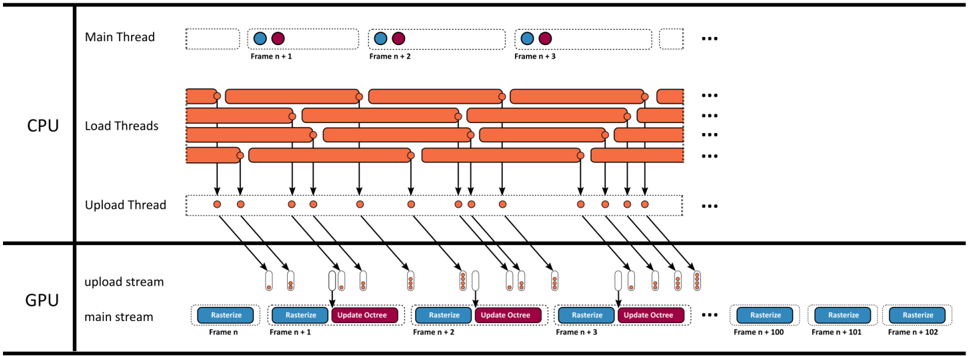
The image illustrates a CPU-GPU threading model for rendering, showing how tasks are distributed across different threads and streams to achieve parallel processing. The diagram is divided into two main sections: the CPU side and the GPU side, separated by a horizontal line. It depicts the flow of data and operations from the CPU to the GPU for rendering frames.
### Components/Axes
* **CPU:**
* **Main Thread:** Responsible for high-level tasks, processing frames sequentially.
* **Load Threads:** Multiple threads that load data in parallel.
* **Upload Thread:** Transfers data from the CPU to the GPU.
* **GPU:**
* **Upload Stream:** Receives data uploaded from the CPU.
* **Main Stream:** Executes rendering tasks, including rasterization and octree updates.
* **Frames:** The diagram shows the processing of multiple frames (Frame n, Frame n+1, Frame n+2, Frame n+3, Frame n+100, Frame n+101, Frame n+102, and so on).
* **Tasks:**
* **Rasterize:** A rendering task.
* **Update Octree:** A rendering task related to octree data structures.
### Detailed Analysis
**CPU Side:**
* **Main Thread:**
* Processes frames sequentially (Frame n+1, Frame n+2, Frame n+3, ...).
* Each frame involves two tasks, represented by a blue and a red circle.
* **Load Threads:**
* Multiple parallel threads (approximately 8-10 shown) load data.
* Each thread contributes to the data required for rendering.
* **Upload Thread:**
* A single thread responsible for transferring data to the GPU.
* Represented by a series of orange dots.
**GPU Side:**
* **Upload Stream:**
* Receives data from the CPU's upload thread.
* Data is represented as small vertical bars.
* **Main Stream:**
* Processes rendering tasks for each frame.
* Tasks alternate between "Rasterize" (blue rounded rectangle) and "Update Octree" (purple rounded rectangle).
* The sequence of tasks for each frame is: Rasterize, Update Octree, Rasterize, Update Octree, and so on.
* Frames are processed sequentially (Frame n, Frame n+1, Frame n+2, Frame n+3, ..., Frame n+100, Frame n+101, Frame n+102).
### Key Observations
* The CPU utilizes multiple load threads to parallelize data loading.
* The GPU's main stream alternates between rasterization and octree updates.
* The diagram illustrates a pipelined approach, where the CPU prepares data while the GPU renders previous frames.
### Interpretation
The diagram illustrates a common technique for accelerating rendering by distributing tasks between the CPU and GPU. The CPU handles data loading and preparation, while the GPU focuses on the computationally intensive rendering tasks. The use of multiple load threads on the CPU and the pipelined execution on the GPU contribute to improved performance. The alternation between rasterization and octree updates suggests that the rendering process involves dynamic scene updates or level-of-detail adjustments using an octree data structure.