\n
## Diagram: Workflow Comparison
### Overview
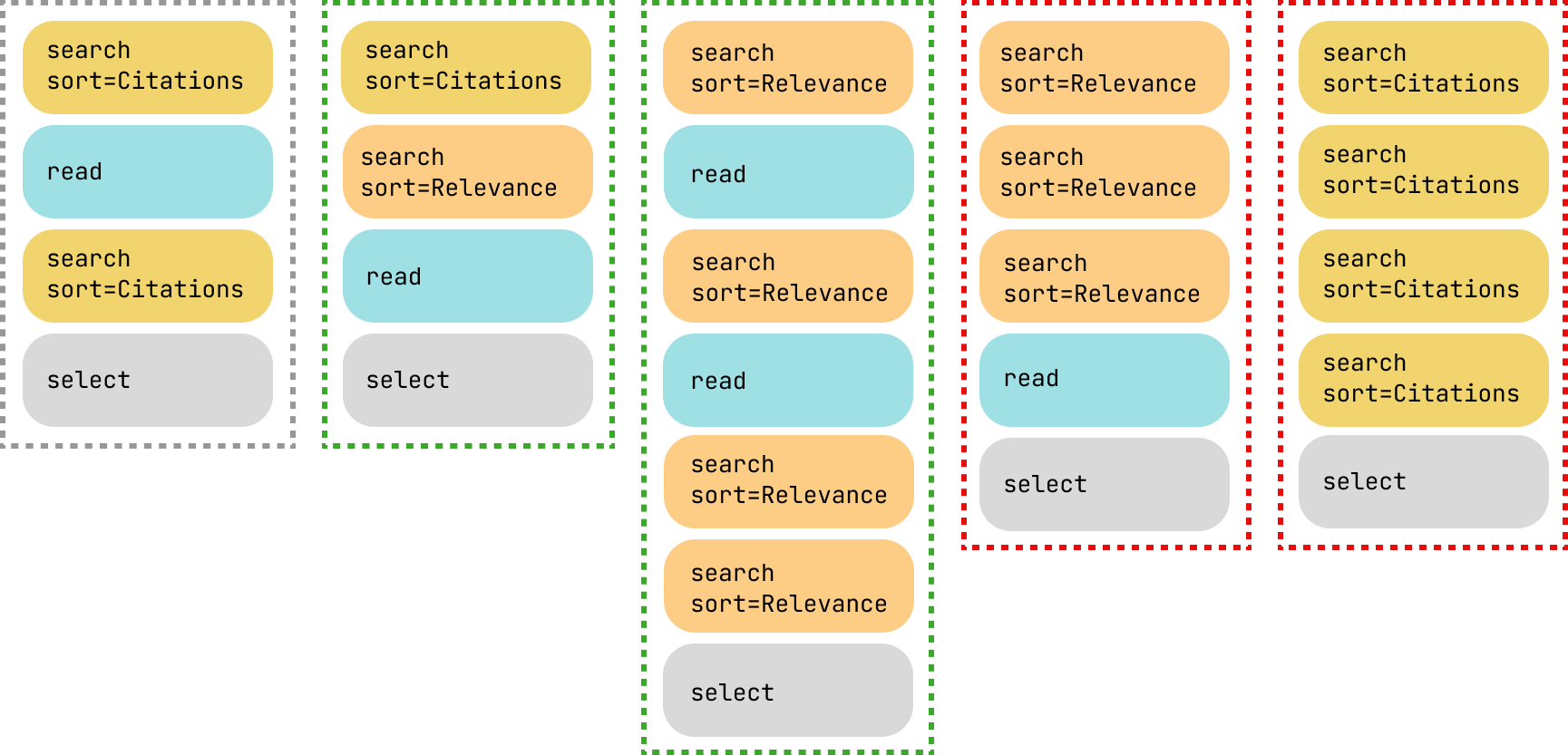
The image presents a visual comparison of three workflows, delineated by color-coded rectangular blocks. Each workflow consists of a sequence of actions represented by text labels within the blocks. The workflows are arranged in three vertical columns, visually separated by dashed lines. The diagram appears to illustrate different approaches to a task, potentially information retrieval or document processing.
### Components/Axes
The diagram consists of three distinct workflows, visually separated by dashed vertical lines. Each workflow is represented by a series of rectangular blocks. The colors used are:
* **Blue:** Workflow 1
* **Green:** Workflow 2
* **Red:** Workflow 3
Each block contains one of the following actions:
* search sort=Citations
* search sort=Relevance
* read
* select
### Detailed Analysis or Content Details
**Workflow 1 (Blue):**
The workflow consists of 6 blocks arranged vertically.
1. search sort=Citations
2. read
3. search sort=Citations
4. select
5. select
6. select
**Workflow 2 (Green):**
The workflow consists of 7 blocks arranged vertically.
1. search sort=Citations
2. search sort=Relevance
3. read
4. search sort=Relevance
5. search sort=Relevance
6. select
7. select
**Workflow 3 (Red):**
The workflow consists of 6 blocks arranged vertically.
1. search sort=Citations
2. search sort=Relevance
3. search sort=Relevance
4. read
5. read
6. select
### Key Observations
* All three workflows begin with a "search" action, but differ in the sorting criteria ("Citations" or "Relevance").
* Workflow 2 is the longest, containing 7 steps, while Workflows 1 and 3 have 6 steps each.
* The "read" action appears in all workflows, but its placement varies.
* The "select" action appears multiple times in Workflows 1 and 2, but only once in Workflow 3.
* Workflow 1 and 3 both start with "search sort=Citations"
* Workflow 2 and 3 both have "search sort=Relevance" in the second step.
### Interpretation
The diagram likely represents a comparison of different search and selection strategies. The varying sorting criteria ("Citations" vs. "Relevance") suggest different priorities in the search process. "Citations" might prioritize academic or authoritative sources, while "Relevance" might prioritize results that closely match the search query. The number of "select" actions could indicate the level of refinement or filtering applied in each workflow.
The differences in workflow length and action sequence suggest that each approach has its own strengths and weaknesses. Workflow 2, being the longest, might be more thorough but also more time-consuming. Workflows 1 and 3 might be more efficient but potentially less comprehensive.
The diagram doesn't provide quantitative data, so it's difficult to determine which workflow is "best." However, it highlights the trade-offs between different search and selection strategies and suggests that the optimal approach depends on the specific task and user needs. The diagram is a high-level illustration of process flows, and doesn't contain any numerical data or statistical analysis.