\n
## Diagram: Domain Categorization for AI/ML Applications
### Overview
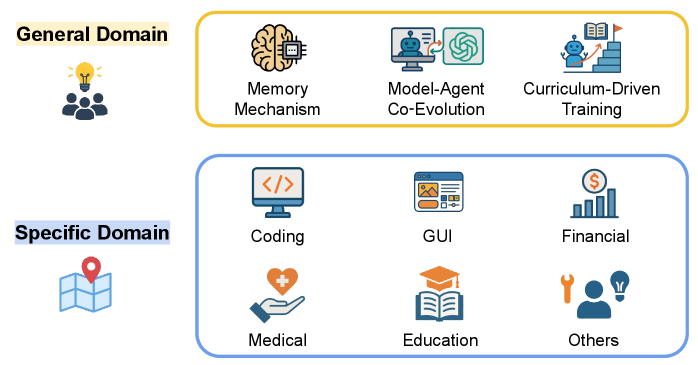
The image is a diagram categorizing domains for AI/ML applications. It is divided into two main sections: "General Domain" and "Specific Domain". Each domain is represented by an icon and a text label. The diagram visually organizes different areas where AI/ML techniques are applied.
### Components/Axes
The diagram consists of two rectangular blocks, one labeled "General Domain" (top, yellow background) and the other labeled "Specific Domain" (bottom, blue background). Each block contains several icons with corresponding text labels.
* **General Domain:**
* Icon: People with a lightbulb. Label: "Foundation Models"
* Icon: Brain with circuit board. Label: "Memory Mechanism"
* Icon: Two robots interacting with circular arrows. Label: "Model-Agent Co-Evolution"
* Icon: Robot climbing a flag. Label: "Curriculum-Driven Training"
* **Specific Domain:**
* Icon: Code brackets. Label: "Coding"
* Icon: Computer screen with windows. Label: "GUI"
* Icon: Dollar sign. Label: "Financial"
* Icon: Heart in hands. Label: "Medical"
* Icon: Open book. Label: "Education"
* Icon: Person with a wrench and lightbulb. Label: "Others"
* Icon: Map marker. Label: "Location-Based Services"
### Detailed Analysis or Content Details
The diagram presents a hierarchical categorization of AI/ML application domains. The "General Domain" represents foundational techniques or approaches, while the "Specific Domain" lists areas where these techniques are applied.
The "General Domain" includes:
* **Foundation Models:** Representing the base models used for various tasks.
* **Memory Mechanism:** Focusing on AI systems that can store and retrieve information.
* **Model-Agent Co-Evolution:** Describing the iterative development of models and agents.
* **Curriculum-Driven Training:** Highlighting the use of structured learning approaches.
The "Specific Domain" includes:
* **Coding:** AI applications in software development.
* **GUI:** AI applications in graphical user interface design and interaction.
* **Financial:** AI applications in finance and investment.
* **Medical:** AI applications in healthcare and diagnostics.
* **Education:** AI applications in learning and teaching.
* **Others:** A catch-all category for other AI applications.
* **Location-Based Services:** AI applications that utilize geographical data.
### Key Observations
The diagram provides a high-level overview of the diverse applications of AI/ML. It highlights the distinction between fundamental techniques and specific use cases. The "Others" category suggests that the field is rapidly expanding beyond the listed domains.
### Interpretation
The diagram suggests a structured approach to understanding the AI/ML landscape. It implies that advancements in "General Domain" techniques drive innovation in "Specific Domain" applications. The categorization is useful for researchers, developers, and investors seeking to identify opportunities and understand the relationships between different areas of AI/ML. The diagram doesn't provide quantitative data, but rather a qualitative organization of the field. It serves as a conceptual map rather than a data-driven analysis. The inclusion of "Others" indicates the dynamic and evolving nature of the field, with new applications emerging constantly.