## Diagram: Domain Classification Structure
### Overview
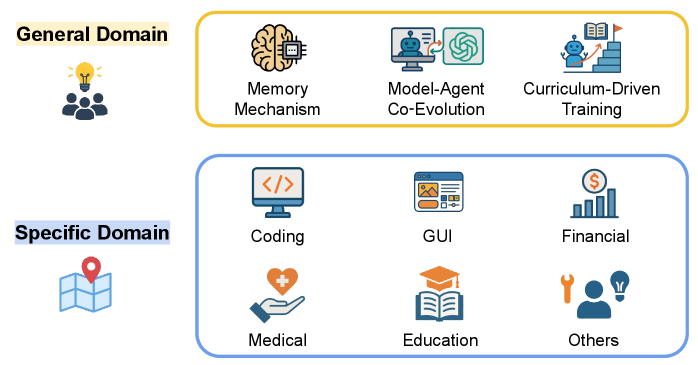
The diagram illustrates a hierarchical classification of domains into two primary categories: **General Domain** and **Specific Domain**. Each category contains subcategories represented by icons and labels, emphasizing conceptual relationships between broad and specialized fields.
### Components/Axes
- **General Domain** (Top Section):
- **Memory Mechanism**: Icon of a brain with circuit patterns.
- **Model-Agent Co-Evolution**: Icon of a robot interacting with a neural network.
- **Curriculum-Driven Training**: Icon of a robot ascending stairs with a book.
- **Specific Domain** (Bottom Section):
- **Coding**: Icon of a computer screen with code symbols.
- **GUI**: Icon of a webpage with charts and buttons.
- **Financial**: Icon of bar graphs with dollar signs.
- **Medical**: Icon of a hand holding a heart with a cross.
- **Education**: Icon of an open book with a graduation cap.
- **Others**: Icon of a person with a lightbulb and wrench.
### Detailed Analysis
- **General Domain** focuses on foundational concepts:
- **Memory Mechanism**: Likely represents cognitive or computational memory systems.
- **Model-Agent Co-Evolution**: Suggests iterative development between models and agents.
- **Curriculum-Driven Training**: Implies structured, progressive learning frameworks.
- **Specific Domain** categorizes applied fields:
- **Coding**, **GUI**, and **Financial** relate to technical and business applications.
- **Medical**, **Education**, and **Others** represent specialized industries or domains.
### Key Observations
- The diagram uses spatial separation to distinguish **General Domain** (top) from **Specific Domain** (bottom).
- Icons are designed to visually reinforce the textual labels (e.g., a brain for "Memory Mechanism").
- No numerical data or quantitative trends are present; the structure is purely categorical.
### Interpretation
The diagram emphasizes the relationship between **broad theoretical frameworks** (General Domain) and **practical applications** (Specific Domain). For example:
- **Memory Mechanism** and **Model-Agent Co-Evolution** underpin advanced AI/ML systems, which may inform specialized domains like **Medical** (e.g., diagnostic tools) or **Education** (e.g., adaptive learning platforms).
- The inclusion of **GUI** and **Financial** in Specific Domain highlights the intersection of technical design and real-world utility.
- The "Others" category suggests flexibility for unlisted domains, indicating the diagram’s adaptability.
This structure could serve as a foundational taxonomy for organizing research, development, or educational curricula across interdisciplinary fields.