## Dependency Diagram and Formalization Status Table: Python Module Structure
### Overview
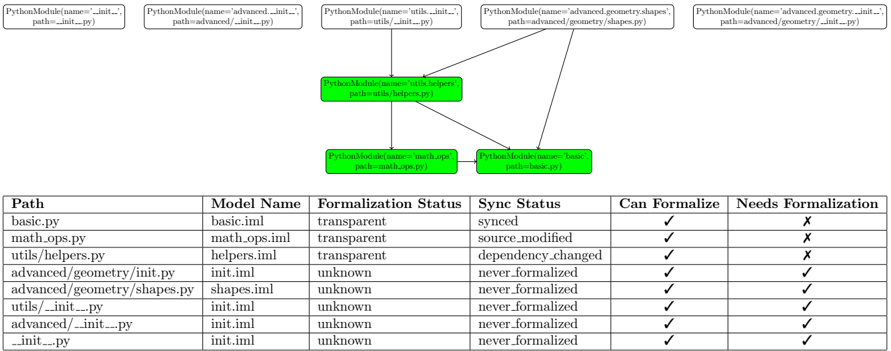
The image contains two primary components:
1. A **dependency diagram** showing Python module relationships and imports
2. A **data table** detailing formalization status, synchronization status, and actionable metadata for each module
### Components/Axes
#### Diagram Elements
- **Nodes**:
- Labeled with Python module paths (e.g., `basic.py`, `advanced/geometry/shapes.py`)
- Green boxes highlight core modules:
- `utils/helpers.py`
- `math_ops.py`
- `basic.py`
- **Edges**:
- Arrows indicate import dependencies (e.g., `utils/helpers.py` → `basic.py`)
- No explicit legend for edge types, but color consistency suggests uniform dependency relationships
#### Table Structure
| Path | Model Name | Formalization Status | Sync Status | Can Formalize | Needs Formalization |
|-----------------------|------------------|----------------------|----------------------|---------------|---------------------|
| `basic.py` | `basic.iml` | transparent | synced | ✓ | ✗ |
| `math_ops.py` | `math_ops.iml` | transparent | source_modified | ✓ | ✗ |
| `utils/helpers.py` | `helpers.iml` | transparent | dependency_changed | ✓ | ✗ |
| `advanced/geometry/init.py` | `init.iml` | unknown | never_formalized | ✓ | ✓ |
| `advanced/geometry/shapes.py` | `shapes.iml` | unknown | never_formalized | ✓ | ✓ |
| `utils/__init__.py` | `init.iml` | unknown | never_formalized | ✓ | ✓ |
| `advanced/__init__.py`| `init.iml` | unknown | never_formalized | ✓ | ✓ |
| `__init__.py` | `init.iml` | unknown | never_formalized | ✓ | ✓ |
### Detailed Analysis
#### Diagram Flow
1. **Central Hub**: `utils/helpers.py` acts as a dependency hub, imported by:
- `basic.py`
- `advanced/geometry/shapes.py`
2. **Module Hierarchy**:
- `advanced/geometry` contains submodules `init.py` and `shapes.py`
- `__init__.py` files exist at multiple levels (root, `utils`, `advanced`, `advanced/geometry`)
#### Table Insights
1. **Formalization Status**:
- 3 modules (`basic`, `math_ops`, `helpers`) have transparent formalization status and are synced
- 5 modules (`init.iml` variants) have unknown formalization status and are never formalized
2. **Actionable Metadata**:
- All modules can be formalized (`✓` in "Can Formalize")
- 6 modules require formalization (`✓` in "Needs Formalization"), including critical dependencies like `utils/__init__.py`
### Key Observations
1. **Dependency Risks**:
- `utils/helpers.py` (a core dependency) has a "dependency_changed" sync status, suggesting potential instability
- Unformalized modules (`init.iml` variants) depend on unstable or evolving codebases
2. **Formalization Gaps**:
- Geometry-related modules (`shapes.py`, `advanced/geometry/init.py`) remain unformalized despite being part of advanced functionality
- Root `__init__.py` and `utils/__init__.py` lack formalization despite being foundational
### Interpretation
This visualization reveals a Python codebase in transition:
- **Stable Core**: The `basic`, `math_ops`, and `helpers` modules form a formalized, synced foundation
- **Evolving Dependencies**: The `utils/helpers.py` module’s "dependency_changed" status indicates active development, risking downstream modules
- **Formalization Priorities**:
- Immediate action needed for `utils/__init__.py` and `advanced/geometry/init.py` to stabilize dependencies
- Geometry modules (`shapes.py`) require formalization to ensure advanced functionality reliability
- **Structural Redundancy**: Multiple `__init__.py` files suggest potential code duplication or inconsistent initialization logic
The data underscores a need to prioritize formalization of dependency-critical modules while monitoring the stability of core components like `utils/helpers.py`.