## Chart: Spearman Correlation vs. Model Size
### Overview
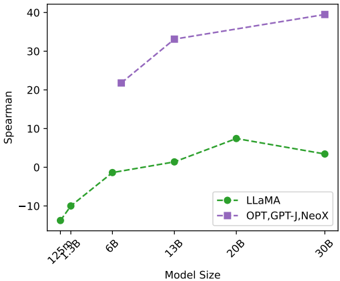
The image is a line chart comparing the Spearman correlation of two model families (LLaMA and OPT/GPT-J/NeoX) against their model size, which ranges from 1.25/1.3B to 30B parameters. The chart shows how the Spearman correlation changes as the model size increases for each family.
### Components/Axes
* **X-axis:** Model Size (in billions of parameters). The markers are at 1.25/1.3B, 6B, 13B, 20B, and 30B.
* **Y-axis:** Spearman correlation. The scale ranges from -10 to 40.
* **Legend:** Located in the bottom-right corner.
* Green line with circle markers: LLaMA
* Purple line with square markers: OPT, GPT-J, NeoX
### Detailed Analysis
* **LLaMA (Green Line):**
* Trend: Initially increases sharply, then plateaus and slightly decreases.
* Data Points:
* 1.25/1.3B: Approximately -13
* 6B: Approximately -1
* 13B: Approximately 1
* 20B: Approximately 8
* 30B: Approximately 4
* **OPT, GPT-J, NeoX (Purple Line):**
* Trend: Increases sharply, then plateaus.
* Data Points:
* 6B: Approximately 22
* 13B: Approximately 33
* 30B: Approximately 40
### Key Observations
* The OPT/GPT-J/NeoX models consistently outperform LLaMA models in terms of Spearman correlation across all model sizes shown.
* The Spearman correlation for OPT/GPT-J/NeoX increases significantly between 6B and 13B parameters, then plateaus.
* The Spearman correlation for LLaMA increases sharply between 1.25/1.3B and 20B parameters, but then decreases slightly at 30B.
### Interpretation
The chart suggests that increasing model size generally improves the Spearman correlation for both model families, but the effect is more pronounced for OPT/GPT-J/NeoX. The plateauing effect observed for both families indicates that there may be diminishing returns to increasing model size beyond a certain point, at least in terms of Spearman correlation. The slight decrease in Spearman correlation for LLaMA at 30B could indicate overfitting or other issues related to model training. The OPT/GPT-J/NeoX family appears to be more effective at leveraging increased model size to improve Spearman correlation compared to the LLaMA family.