## Bar Chart: Self-Cognition vs. No Self-Cognition by Instruction Prompt ID
### Overview
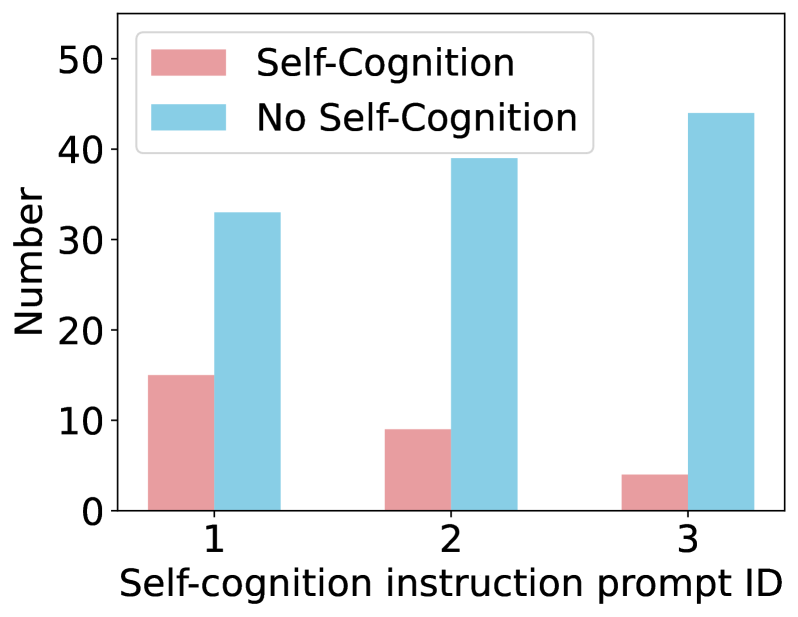
The image is a bar chart comparing the number of instances of "Self-Cognition" and "No Self-Cognition" across three different "Self-cognition instruction prompt IDs" (1, 2, and 3). The chart uses different colored bars to represent each category: light red for "Self-Cognition" and light blue for "No Self-Cognition".
### Components/Axes
* **X-axis:** "Self-cognition instruction prompt ID" with values 1, 2, and 3.
* **Y-axis:** "Number" ranging from 0 to 50, with tick marks at intervals of 10.
* **Legend:** Located in the top-left corner, indicating light red for "Self-Cognition" and light blue for "No Self-Cognition".
### Detailed Analysis
Here's a breakdown of the data for each prompt ID:
* **Prompt ID 1:**
* "Self-Cognition" (light red): Approximately 15
* "No Self-Cognition" (light blue): Approximately 33
* **Prompt ID 2:**
* "Self-Cognition" (light red): Approximately 9
* "No Self-Cognition" (light blue): Approximately 39
* **Prompt ID 3:**
* "Self-Cognition" (light red): Approximately 4
* "No Self-Cognition" (light blue): Approximately 44
### Key Observations
* For all three prompt IDs, the number of instances of "No Self-Cognition" is significantly higher than "Self-Cognition".
* The number of "Self-Cognition" instances decreases as the prompt ID increases.
* The number of "No Self-Cognition" instances increases as the prompt ID increases.
### Interpretation
The data suggests that as the "Self-cognition instruction prompt ID" increases from 1 to 3, the occurrence of "Self-Cognition" decreases, while the occurrence of "No Self-Cognition" increases. This could indicate that the prompts are becoming less effective at eliciting self-cognition or that the prompts are designed to reduce self-cognition as the ID increases. The consistent disparity between "Self-Cognition" and "No Self-Cognition" across all prompts suggests a strong bias or inherent difference in the conditions being measured.