\n
## Bar Chart: Self-Cognition vs. No Self-Cognition by Prompt ID
### Overview
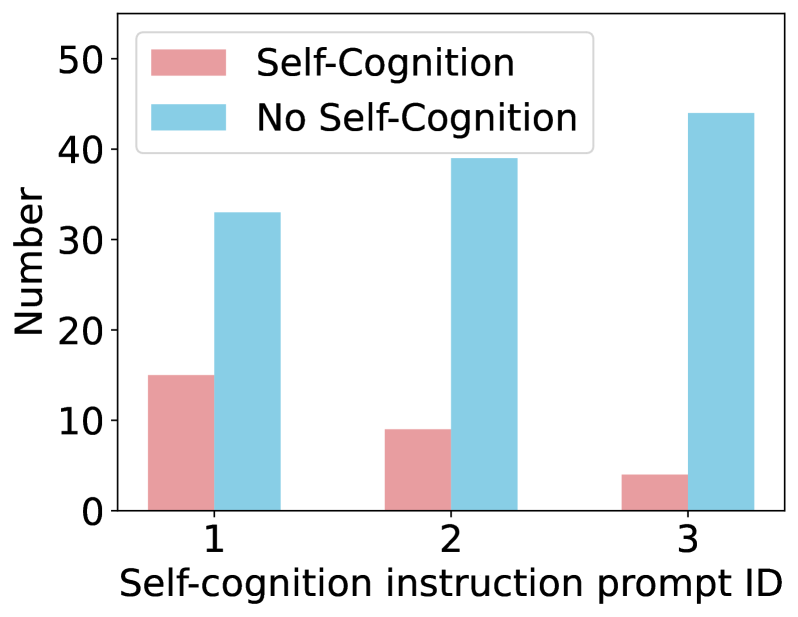
This bar chart compares the number of instances of "Self-Cognition" and "No Self-Cognition" across three different "Self-cognition instruction prompt IDs" (1, 2, and 3). The chart uses paired bars for each prompt ID, allowing for a direct comparison between the two categories.
### Components/Axes
* **X-axis:** "Self-cognition instruction prompt ID" with markers 1, 2, and 3.
* **Y-axis:** "Number" with a scale ranging from 0 to 50, incrementing by 10.
* **Legend:** Located at the top-center of the chart.
* "Self-Cognition" - represented by a light red color.
* "No Self-Cognition" - represented by a light blue color.
### Detailed Analysis
The chart consists of six bars, grouped by prompt ID.
* **Prompt ID 1:**
* "Self-Cognition": Approximately 16.
* "No Self-Cognition": Approximately 33.
* **Prompt ID 2:**
* "Self-Cognition": Approximately 9.
* "No Self-Cognition": Approximately 40.
* **Prompt ID 3:**
* "Self-Cognition": Approximately 5.
* "No Self-Cognition": Approximately 44.
The "No Self-Cognition" bars are consistently taller than the "Self-Cognition" bars for all three prompt IDs. The "No Self-Cognition" count increases steadily from Prompt ID 1 to Prompt ID 3. The "Self-Cognition" count decreases from Prompt ID 1 to Prompt ID 3.
### Key Observations
* "No Self-Cognition" is the dominant category across all prompt IDs.
* The difference between the two categories widens as the prompt ID increases.
* The number of "Self-Cognition" instances is relatively low and decreasing.
### Interpretation
The data suggests that the self-cognition instruction prompts are largely ineffective in eliciting self-cognition responses. The number of instances where self-cognition is *not* present is significantly higher than those where it is present, and this disparity grows with each prompt ID. This could indicate that the prompts themselves are flawed, or that the task is inherently difficult for the model to perform. The decreasing trend in "Self-Cognition" instances across prompts suggests that the prompts may be inadvertently suppressing self-cognition. Further investigation is needed to understand why these prompts are not achieving the desired outcome. The consistent dominance of "No Self-Cognition" suggests a fundamental limitation in the model's ability to demonstrate self-awareness or understanding of its own internal states, given these prompts.