## Grouped Bar Chart: Self-Cognition vs. No Self-Cognition by Prompt ID
### Overview
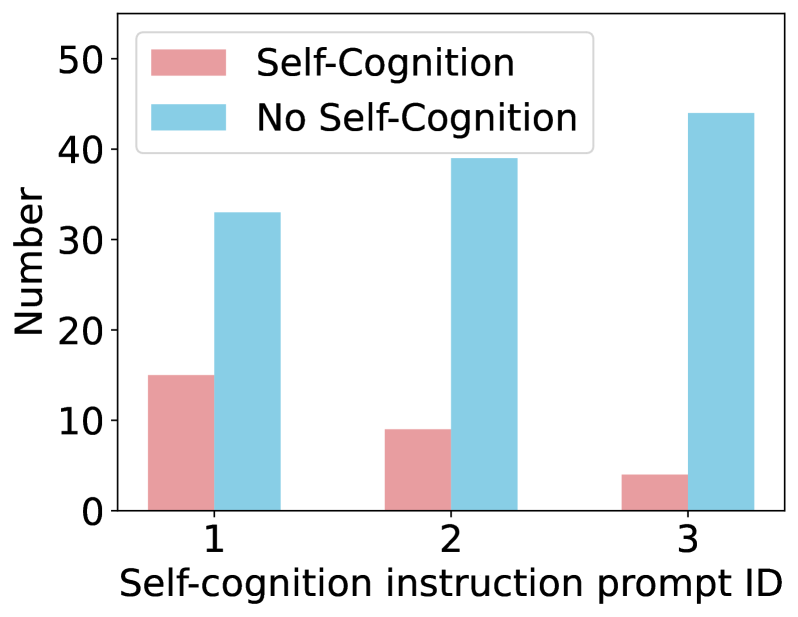
The image displays a grouped bar chart comparing the frequency ("Number") of two categories—"Self-Cognition" and "No Self-Cognition"—across three distinct "Self-cognition instruction prompt IDs" (1, 2, and 3). The chart visually demonstrates an inverse relationship between the two categories as the prompt ID increases.
### Components/Axes
* **Chart Type:** Grouped vertical bar chart.
* **X-Axis:** Labeled **"Self-cognition instruction prompt ID"**. It has three categorical tick marks: **1**, **2**, and **3**.
* **Y-Axis:** Labeled **"Number"**. It is a linear scale with major tick marks at intervals of 10, ranging from **0** to **50**.
* **Legend:** Positioned in the **top-left corner** of the chart area.
* A pink/salmon-colored rectangle corresponds to the label **"Self-Cognition"**.
* A light blue/cyan-colored rectangle corresponds to the label **"No Self-Cognition"**.
* **Data Series:** For each prompt ID on the x-axis, there are two adjacent bars:
* The left bar (pink) represents the "Self-Cognition" count.
* The right bar (light blue) represents the "No Self-Cognition" count.
### Detailed Analysis
**Data Point Extraction (Approximate Values):**
| Self-cognition instruction prompt ID | Self-Cognition (Pink Bar) | No Self-Cognition (Light Blue Bar) |
| :--- | :--- | :--- |
| **1** | ~15 | ~33 |
| **2** | ~9 | ~39 |
| **3** | ~4 | ~44 |
**Trend Verification:**
* **Self-Cognition (Pink) Trend:** The height of the pink bars **slopes downward** from left to right. The value decreases from approximately 15 at ID 1, to 9 at ID 2, to 4 at ID 3.
* **No Self-Cognition (Light Blue) Trend:** The height of the light blue bars **slopes upward** from left to right. The value increases from approximately 33 at ID 1, to 39 at ID 2, to 44 at ID 3.
### Key Observations
1. **Inverse Relationship:** There is a clear and consistent inverse correlation between the two categories. As the prompt ID number increases, the count for "Self-Cognition" decreases while the count for "No Self-Cognition" increases.
2. **Magnitude Shift:** The "No Self-Cognition" category is consistently the dominant (higher) value for all three prompt IDs. The gap between the two categories widens significantly with each subsequent prompt ID.
3. **Linear Progression:** Both trends appear roughly linear across the three data points. The "Self-Cognition" count drops by approximately 6 then 5, while the "No Self-Cognition" count rises by approximately 6 then 5.
### Interpretation
The data suggests that the three "Self-cognition instruction prompts" (IDs 1, 2, 3) have a progressively stronger effect on suppressing or reducing instances labeled as "Self-Cognition," while simultaneously increasing instances labeled as "No Self-Cognition." This could imply that the prompts are designed to steer a system's output away from self-referential or introspective responses.
The consistent increase in the "No Self-Cognition" count, which starts high and grows higher, indicates that this is the primary or default state being measured, and the prompts are effective at reinforcing it. The corresponding decrease in "Self-Cognition" shows that this state is being actively diminished. The widening gap suggests that prompt ID 3 is the most effective of the three at achieving this directional shift in the measured outcome. Without additional context on what constitutes a "prompt ID" or how "Number" is quantified (e.g., frequency in a text corpus, model response count), the precise mechanism remains inferential, but the directional trend is unambiguous.