## Bar Chart: Self-Cognition vs No Self-Cognition by Prompt ID
### Overview
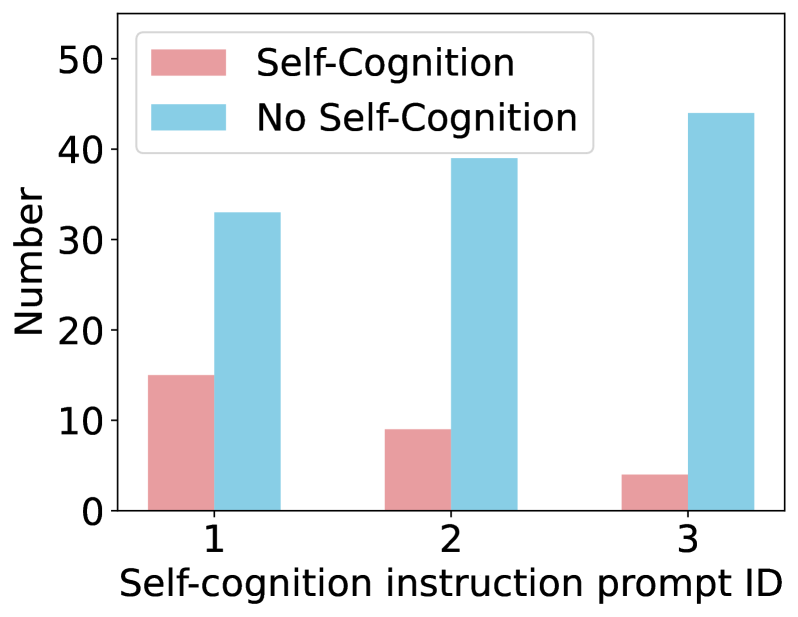
The chart compares the number of instances of "Self-Cognition" (pink) and "No Self-Cognition" (blue) across three categories of "Self-cognition instruction prompt ID" (1, 2, 3). The y-axis represents the count (0–50), while the x-axis categorizes prompts by ID. The legend in the top-left corner distinguishes the two data series.
### Components/Axes
- **X-axis**: Labeled "Self-cognition instruction prompt ID" with categories 1, 2, 3.
- **Y-axis**: Labeled "Number" with a scale from 0 to 50.
- **Legend**: Top-left, with pink for "Self-Cognition" and blue for "No Self-Cognition".
- **Bars**: Two bars per category (pink and blue), aligned vertically.
### Detailed Analysis
- **Category 1**:
- Self-Cognition: ~15 (pink bar).
- No Self-Cognition: ~33 (blue bar).
- **Category 2**:
- Self-Cognition: ~9 (pink bar).
- No Self-Cognition: ~40 (blue bar).
- **Category 3**:
- Self-Cognition: ~4 (pink bar).
- No Self-Cognition: ~45 (blue bar).
### Key Observations
1. **Trend for Self-Cognition**: The pink bars (Self-Cognition) decrease consistently from Category 1 (~15) to Category 3 (~4).
2. **Trend for No Self-Cognition**: The blue bars (No Self-Cognition) increase steadily from Category 1 (~33) to Category 3 (~45).
3. **Divergence**: The gap between Self-Cognition and No Self-Cognition widens as the prompt ID increases (e.g., ~18 difference in Category 1 vs. ~41 in Category 3).
### Interpretation
The data suggests that higher prompt IDs (3) are associated with significantly fewer instances of Self-Cognition and more instances of No Self-Cognition compared to lower IDs (1). This could imply that the instructions for higher IDs are less effective at eliciting self-cognitive responses or inadvertently suppress them. The stark divergence in trends highlights a potential inverse relationship between prompt ID and self-cognitive outcomes. Further investigation into the content of the prompts (e.g., wording, complexity) may clarify whether the design of the instructions directly influences cognitive states.