## Diagram: Vision-Language Model Architecture for Image-Text Question Answering
### Overview
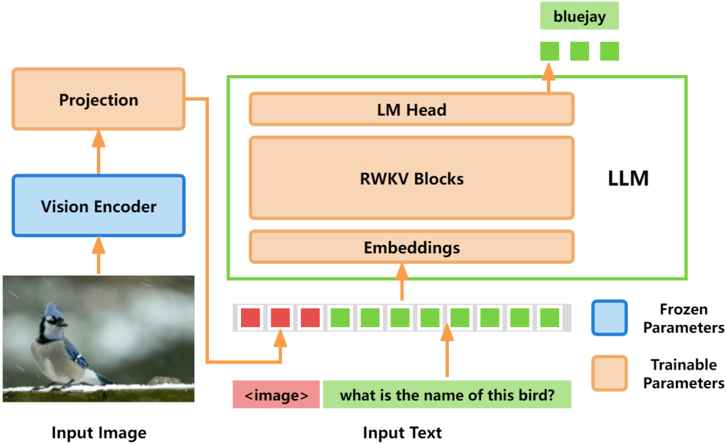
The diagram illustrates a vision-language model (VLM) architecture designed to answer questions about input images. It shows the flow of data from raw image input through a vision encoder, projection layer, and language model components to generate textual answers. The system distinguishes between frozen (pre-trained) and trainable parameters.
### Components/Axes
1. **Input Image**: Bottom-left corner, showing a blue jay bird on a snowy surface.
2. **Input Text**: Middle-bottom, containing the question "<image> what is the name of this bird?" with "<image>" in red and the question in green.
3. **Vision Encoder**: Blue box labeled "Vision Encoder" with frozen parameters (blue legend).
4. **Projection**: Orange box labeled "Projection" connecting Vision Encoder to Embeddings.
5. **LM Head**: Orange box labeled "LM Head" at the top of the language model stack.
6. **RWKV Blocks**: Large orange box labeled "RWKV Blocks" forming the core of the language model.
7. **Embeddings**: Orange box labeled "Embeddings" between Projection and RWKV Blocks.
8. **LLM**: Green box labeled "LLM" containing the RWKV Blocks and LM Head.
9. **Output**: Top-right corner showing the answer "bluejay" in green text.
10. **Legend**: Bottom-right corner with:
- Blue square: "Frozen Parameters"
- Orange square: "Trainable Parameters"
### Detailed Analysis
- **Data Flow**:
1. Input image → Vision Encoder (frozen parameters)
2. Vision Encoder output → Projection → Embeddings
3. Embeddings → RWKV Blocks (trainable parameters)
4. RWKV Blocks → LM Head → LLM
5. LLM generates final answer "bluejay"
- **Parameter Trainability**:
- Vision Encoder: All parameters frozen (blue)
- Projection, RWKV Blocks, LM Head: All parameters trainable (orange)
### Key Observations
1. The system uses a modular architecture with clear separation between vision and language components.
2. The vision encoder appears to be a pre-trained model (frozen parameters), while the language model components are trainable.
3. The input text format explicitly separates image reference (<image>) from the question text.
4. The output answer is generated directly from the LLM without additional processing steps.
### Interpretation
This architecture demonstrates a typical vision-language model design where:
- Pre-trained vision components (frozen parameters) extract image features
- Trainable language components (RWKV Blocks, LM Head) process both image embeddings and text
- The system is optimized for image-text question answering tasks
- The blue jay example shows successful cross-modal understanding, correctly identifying the bird species from visual and textual context
The separation of frozen and trainable parameters suggests a transfer learning approach, leveraging existing vision models while fine-tuning language components for specific tasks.