## Diagram: State Transition Diagram
### Overview
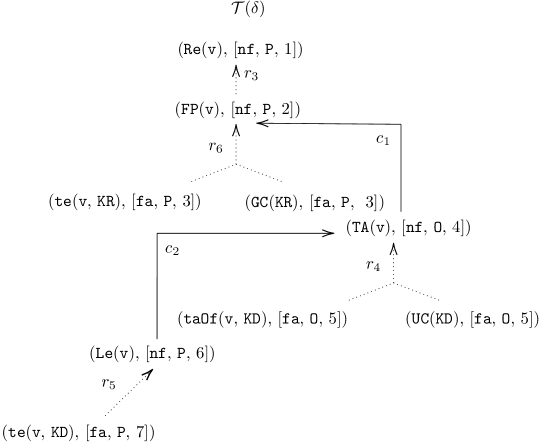
The image is a state transition diagram, visually representing a sequence of states and transitions between them. Each state is labeled with a tuple, and transitions are marked with arrows and labels.
### Components/Axes
* **States:** Represented by text in the format `(Label, [Attribute1, Attribute2, Attribute3, Number])`.
* **Transitions:** Represented by arrows labeled with `c1`, `c2`, `r3`, `r4`, `r5`, and `r6`.
* **Root Node:** `T(δ)` at the top of the diagram.
### Detailed Analysis
* **Top Node:** `T(δ)`
* **Level 1:**
* `(Re(v), [nf, P, 1])` is directly below `T(δ)`.
* Transition `r3` points upwards to this node.
* **Level 2:**
* `(FP(v), [nf, P, 2])` is below `(Re(v), [nf, P, 1])`.
* Transition `r6` points upwards to this node.
* **Level 3:**
* `(te(v, KR), [fa, P, 3])` and `(GC(KR), [fa, P, 3])` are below `(FP(v), [nf, P, 2])`.
* Transition `c1` goes from `(te(v, KR), [fa, P, 3])` to `(FP(v), [nf, P, 2])`.
* **Level 4:**
* `(TA(v), [nf, 0, 4])` is to the right of `(te(v, KR), [fa, P, 3])` and `(GC(KR), [fa, P, 3])`.
* Transition `c2` goes from `(TA(v), [nf, 0, 4])` downwards.
* Transition `r4` points upwards to this node.
* **Level 5:**
* `(ta0f(v, KD), [fa, 0, 5])` and `(UC(KD), [fa, 0, 5])` are below `(TA(v), [nf, 0, 4])`.
* **Level 6:**
* `(Le(v), [nf, P, 6])` is below and to the left of `(ta0f(v, KD), [fa, 0, 5])`.
* Transition `r5` points upwards to this node.
* **Level 7:**
* `(te(v, KD), [fa, P, 7])` is below `(Le(v), [nf, P, 6])`.
### Key Observations
* The diagram represents a hierarchical structure with transitions between different states.
* The states are labeled with tuples containing a label and a list of attributes.
* Transitions are labeled with `c1`, `c2`, `r3`, `r4`, `r5`, and `r6`, possibly indicating different types of transitions.
### Interpretation
The diagram likely represents a state machine or a decision tree used in a formal system or algorithm. The labels within the states and the transition labels probably denote specific conditions or actions that trigger the transitions between the states. The diagram's structure suggests a flow of control or data through a series of processing steps, where each state represents a particular stage in the process. The attributes within the states could represent flags, counters, or other relevant data associated with that state. The diagram provides a visual representation of the system's logic and can be used to understand and analyze its behavior.